Japanese
English
- 有料閲覧
- Abstract 文献概要
- 1ページ目 Look Inside
- 参考文献 Reference
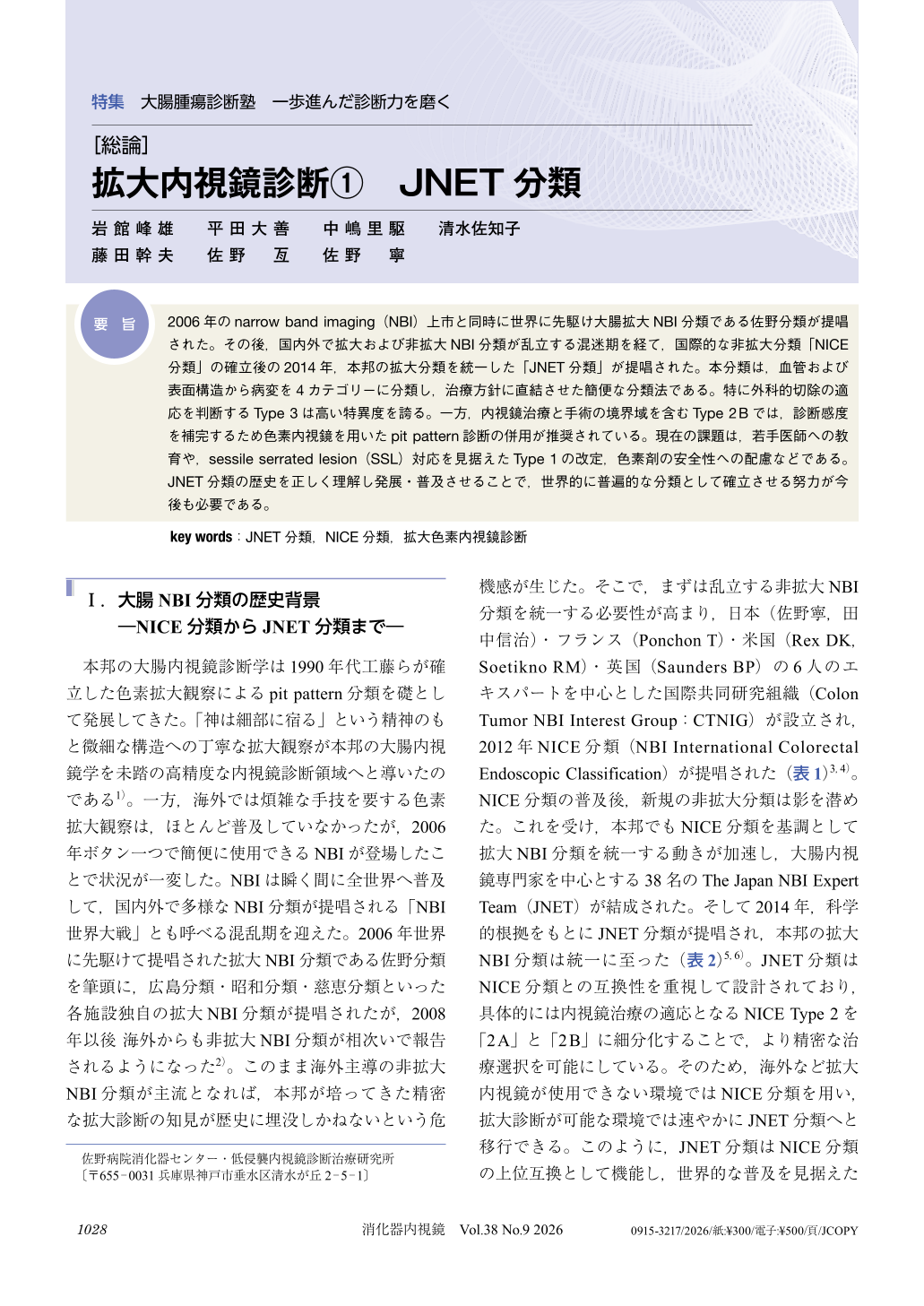
2006年のnarrow band imaging(NBI)上市と同時に世界に先駆け大腸拡大NBI分類である佐野分類が提唱された。その後,国内外で拡大および非拡大NBI分類が乱立する混迷期を経て,国際的な非拡大分類「NICE分類」の確立後の2014年,本邦の拡大分類を統一した「JNET分類」が提唱された。本分類は,血管および表面構造から病変を4カテゴリーに分類し,治療方針に直結させた簡便な分類法である。特に外科的切除の適応を判断するType 3は高い特異度を誇る。一方,内視鏡治療と手術の境界域を含むType 2Bでは,診断感度を補完するため色素内視鏡を用いたpit pattern診断の併用が推奨されている。現在の課題は,若手医師への教育や,sessile serrated lesion(SSL)対応を見据えたType 1の改定,色素剤の安全性への配慮などである。JNET分類の歴史を正しく理解し発展・普及させることで,世界的に普遍的な分類として確立させる努力が今後も必要である。
Concurrent with the market launch of NBI in 2006, the Sano classification was proposed as the world's first magnified NBI classification for colorectal lesions. Following a period of clinical confusion marked by a proliferation of various magnified and non-magnified NBI classifications globally, the JNET classification was established in 2014 to unify the magnified NBI classifications in Japan, following the establishment of the international non-magnified “NICE classification.”
The JNET classification is a streamlined system that categorizes lesions into four groups based on vessel and surface patterns, directly linking them to therapeutic strategies. Notably, Type 3, used to determine indications for surgical resection, demonstrates high specificity. Conversely, for Type 2B, which encompasses the borderline between endoscopic treatment and surgery, the concomitant use of pit pattern diagnosis with crystal violet staining is recommended to supplement diagnostic sensitivity.
Current challenges include the education of early-career physicians, the revision of Type 1 to better address sessile serrated lesions (SSLs), and considerations regarding the safety of crystal violet dyes. Continuous efforts are required to correctly understand the history of the JNET classification and to further develop and disseminate it, ensuring its establishment as a globally universal classification system.
© tokyo-igakusha.co.jp. All right reserved.