Japanese
English
- 有料閲覧
- Abstract 文献概要
- 1ページ目 Look Inside
- 参考文献 Reference
はじめに
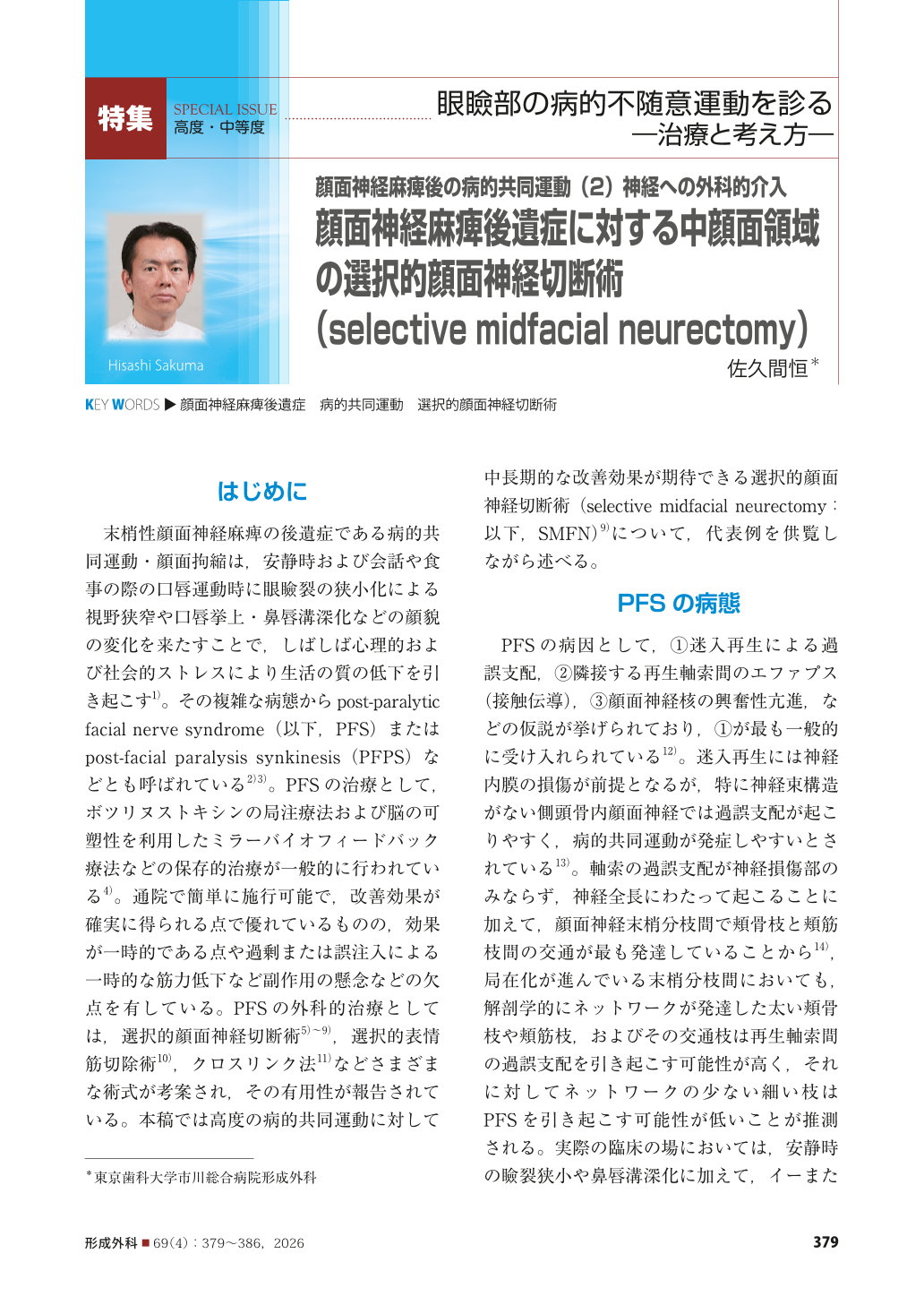
末梢性顔面神経麻痺の後遺症である病的共同運動・顔面拘縮は,安静時および会話や食事の際の口唇運動時に眼瞼裂の狭小化による視野狭窄や口唇挙上・鼻唇溝深化などの顔貌の変化を来たすことで,しばしば心理的および社会的ストレスにより生活の質の低下を引き起こす 1)。その複雑な病態からpost-paralytic facial nerve syndrome(以下,PFS)またはpost-facial paralysis synkinesis(PFPS)などとも呼ばれている 2)3)。PFSの治療として,ボツリヌストキシンの局注療法および脳の可塑性を利用したミラーバイオフィードバック療法などの保存的治療が一般的に行われている 4)。通院で簡単に施行可能で,改善効果が確実に得られる点で優れているものの,効果が一時的である点や過剰または誤注入による一時的な筋力低下など副作用の懸念などの欠点を有している。PFSの外科的治療としては,選択的顔面神経切断術 5)~9),選択的表情筋切除術 10),クロスリンク法 11)などさまざまな術式が考案され,その有用性が報告されている。本稿では高度の病的共同運動に対して中長期的な改善効果が期待できる選択的顔面神経切断術(selective midfacial neurectomy:以下,SMFN) 9)について,代表例を供覧しながら述べる。
Post-paralytic facial nerve syndrome (PFS) is an intractable pathophysiology in which residual mimetic muscle weakness, hypertonicity, synkinesis, myokymia, and mass hemifacial contractions result from incomplete recovery of the facial nerve after peripheral facial paralysis. Chemodenervation with botulinum A toxin and neuromuscular retraining therapy are commonly performed as first-line treatments for PFS. We devised a new selective midfacial neurectomy for moderate or severe PFS with periocular and perioral synkinesis, taking into account the anatomical characteristics. In our approach, the facial flap is elevated subcutaneously, and facial nerve branches are identified at the anterior margin of the parotid gland. Using intraoperative nerve stimulation, the thin cranial zygomatic branches that innervate the lateral portion of the orbicularis oculi muscle and the buccal branches that innervate the orbicularis oris muscle are independently preserved. The thick caudal zygomatic branch and its communicating branch with the cranial buccal branches, which simultaneously and strongly contract both the periocular and perioral mimetic muscles (especially around the upper and lower medial eyelid) are selectively excised.
Selective midfacial neurectomy may be a useful method for treating moderate or severe PFS, providing immediate and mid- to long-term improvement without complications.
Copyright© 2026 KOKUSEIDO CO., LTD. All Rights Reserved.