Japanese
English
- 有料閲覧
- Abstract 文献概要
- 1ページ目 Look Inside
- 参考文献 Reference
はじめに
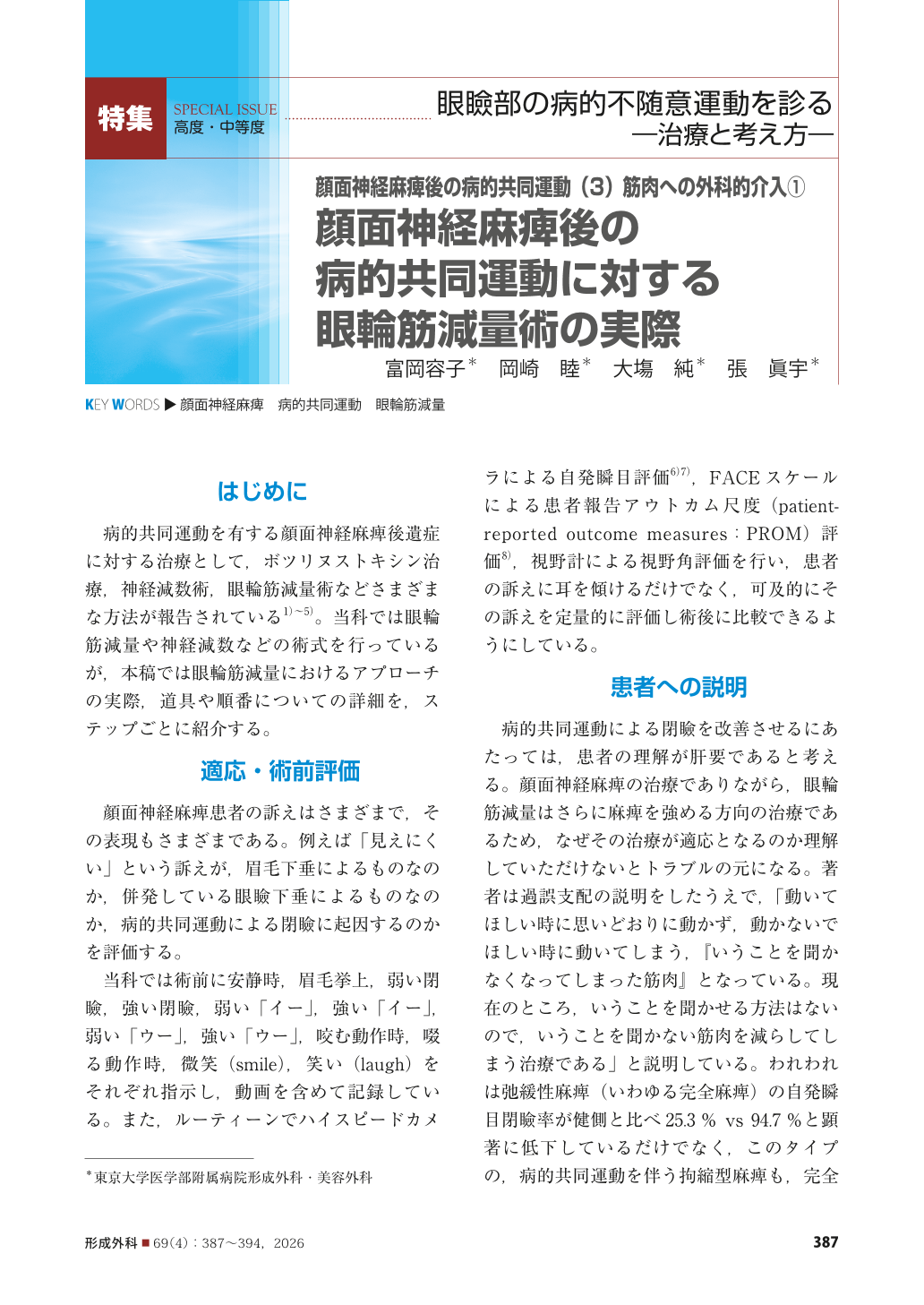
病的共同運動を有する顔面神経麻痺後遺症に対する治療として,ボツリヌストキシン治療,神経減数術,眼輪筋減量術などさまざまな方法が報告されている 1)〜5)。当科では眼輪筋減量や神経減数などの術式を行っているが,本稿では眼輪筋減量におけるアプローチの実際,道具や順番についての詳細を,ステップごとに紹介する。
Post-facial paralysis synkinesis often causes involuntary eyelid closure during facial movements, impairing both the visual field and facial expressiveness and significantly reducing patientsʼ quality of life. Many patients seek improvement of this distressing condition. Various treatments have been reported, including botulinum toxin injection, selective neurectomy, and orbicularis oculi muscle reduction. This article provides a step-by-step description of the indications, preoperative evaluation, surgical design, and detailed technical procedure used for orbicularis oculi muscle reduction in cases of postparalytic synkinesis. Although this procedure effectively reduces unwanted synkinetic eye closure, it also weakens voluntary and spontaneous blinking. Because it paradoxically induces further paresis in the context of treating facial palsy, thorough preoperative counseling is essential to ensure the patientʼs understanding and postoperative compliance with eye care and ophthalmologic follow-up, which is critical for avoiding complications. Intraoperatively, maintaining precise dissection planes and minimizing thermal injury are emphasized. The postoperative care focuses on continuous cooling and compression. Most patients experience improvement in visual comfort and openness after surgery. With appropriate case selection and a comprehensive preoperative explanation, this technique offers a reproducible, stable, and effective surgical option for patients suffering from post-facial palsy synkinesis.
Copyright© 2026 KOKUSEIDO CO., LTD. All Rights Reserved.