Japanese
English
- 有料閲覧
- Abstract 文献概要
- 1ページ目 Look Inside
- 参考文献 Reference
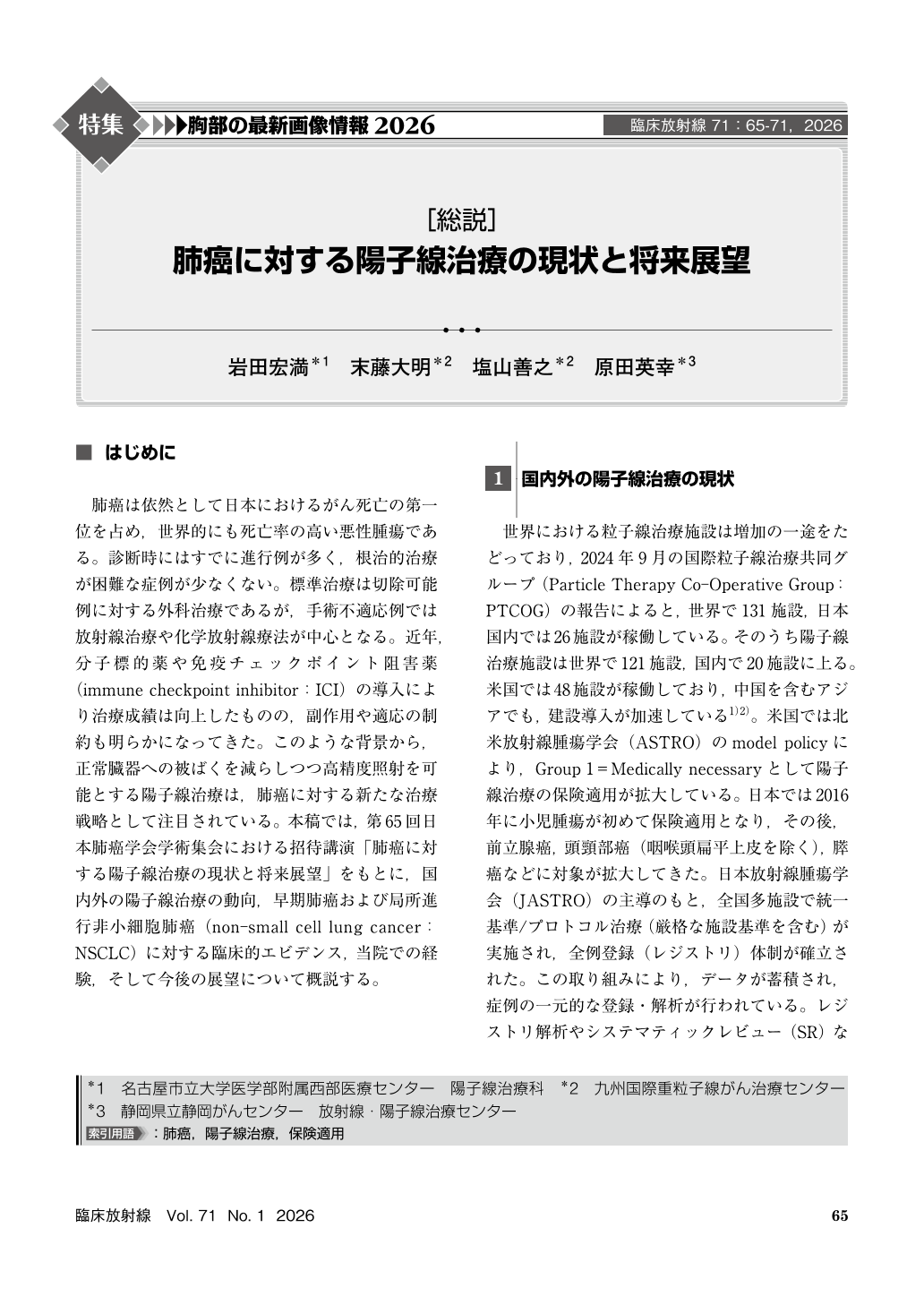
肺癌は依然として日本におけるがん死亡の第一位を占め,世界的にも死亡率の高い悪性腫瘍である。診断時にはすでに進行例が多く,根治的治療が困難な症例が少なくない。標準治療は切除可能例に対する外科治療であるが,手術不適応例では放射線治療や化学放射線療法が中心となる。近年,分子標的薬や免疫チェックポイント阻害薬(immune checkpoint inhibitor:ICI)の導入により治療成績は向上したものの,副作用や適応の制約も明らかになってきた。このような背景から,正常臓器への被ばくを減らしつつ高精度照射を可能とする陽子線治療は,肺癌に対する新たな治療戦略として注目されている。本稿では,第65回日本肺癌学会学術集会における招待講演「肺癌に対する陽子線治療の現状と将来展望」をもとに,国内外の陽子線治療の動向,早期肺癌および局所進行非小細胞肺癌(non-small cell lung cancer:NSCLC)に対する臨床的エビデンス,当院での経験,そして今後の展望について概説する。
Proton therapy has become an important treatment option for lung cancer, providing superior dose distribution and reduced normal tissue toxicity compared with X-ray therapy. In early-stage non-small cell lung cancer(NSCLC), nationwide registry data in Japan demonstrated survival outcomes comparable to surgery, leading to insurance coverage in June 2024. For locally advanced stage Ⅲ NSCLC, concurrent chemo-proton therapy achieved favorable tumor control with lower pneumonitis rates and facilitated the introduction of immune checkpoint inhibitors. Ongoing studies such as RTOG1308 and the development of intensity-modulated proton therapy are expected to further enhance the efficacy and safety of proton therapy for lung cancer.
Copyright © 2026, KANEHARA SHUPPAN Co.LTD. All rights reserved.