Japanese
English
- 有料閲覧
- Abstract 文献概要
- 1ページ目 Look Inside
- 参考文献 Reference
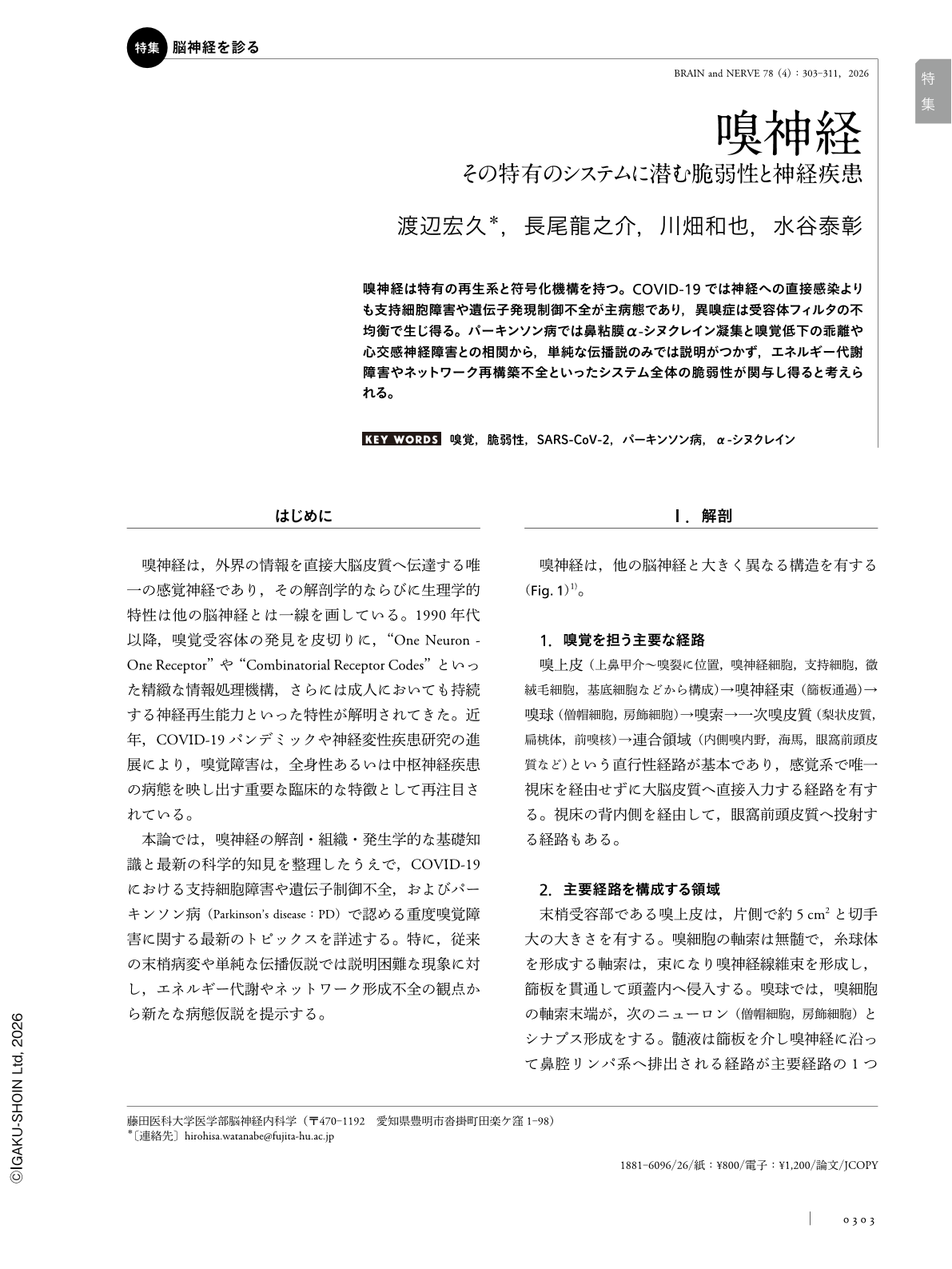
嗅神経は特有の再生系と符号化機構を持つ。COVID-19では神経への直接感染よりも支持細胞障害や遺伝子発現制御不全が主病態であり,異嗅症は受容体フィルタの不均衡で生じ得る。パーキンソン病では鼻粘膜α-シヌクレイン凝集と嗅覚低下の乖離や心交感神経障害との相関から,単純な伝播説のみでは説明がつかず,エネルギー代謝障害やネットワーク再構築不全といったシステム全体の脆弱性が関与し得ると考えられる。
Abstract
The olfactory nerve possesses unique anatomical features, including direct central nervous system (CNS) projection and continuous regeneration. Scientific advances have elucidated mechanisms such as combinatorial receptor coding and signal amplification. This review summarizes these foundations and examines olfactory dysfunction in COVID-19 and Parkinson's disease (PD). In COVID-19, evidence suggests that SARS-CoV-2 targets sustentacular cells rather than olfactory neurons, causing gene downregulation and parosmia attributed to incomplete peripheral filtering, while direct CNS invasion remains rare. In PD, olfactory loss is a prodromal feature. However, seed amplification assays reveal that alpha-synuclein aggregation in the nasal mucosa does not fully correlate with olfactory dysfunction, as reflected by differences between PD and Multiple System Atrophy. This, together with correlations with cardiac sympathetic denervation, challenges simple pathogen propagation hypotheses. We propose that PD-related hyposmia reflects a systemic vulnerability involving deficits in energy metabolism and neural network organization, rather than solely peripheral protein aggregation. Understanding these pathologies requires a multifaceted approach beyond anatomical lesions.
Copyright © 2026, Igaku-Shoin Ltd. All rights reserved.