Japanese
English
- 販売していません
- Abstract 文献概要
- 1ページ目 Look Inside
- 参考文献 Reference
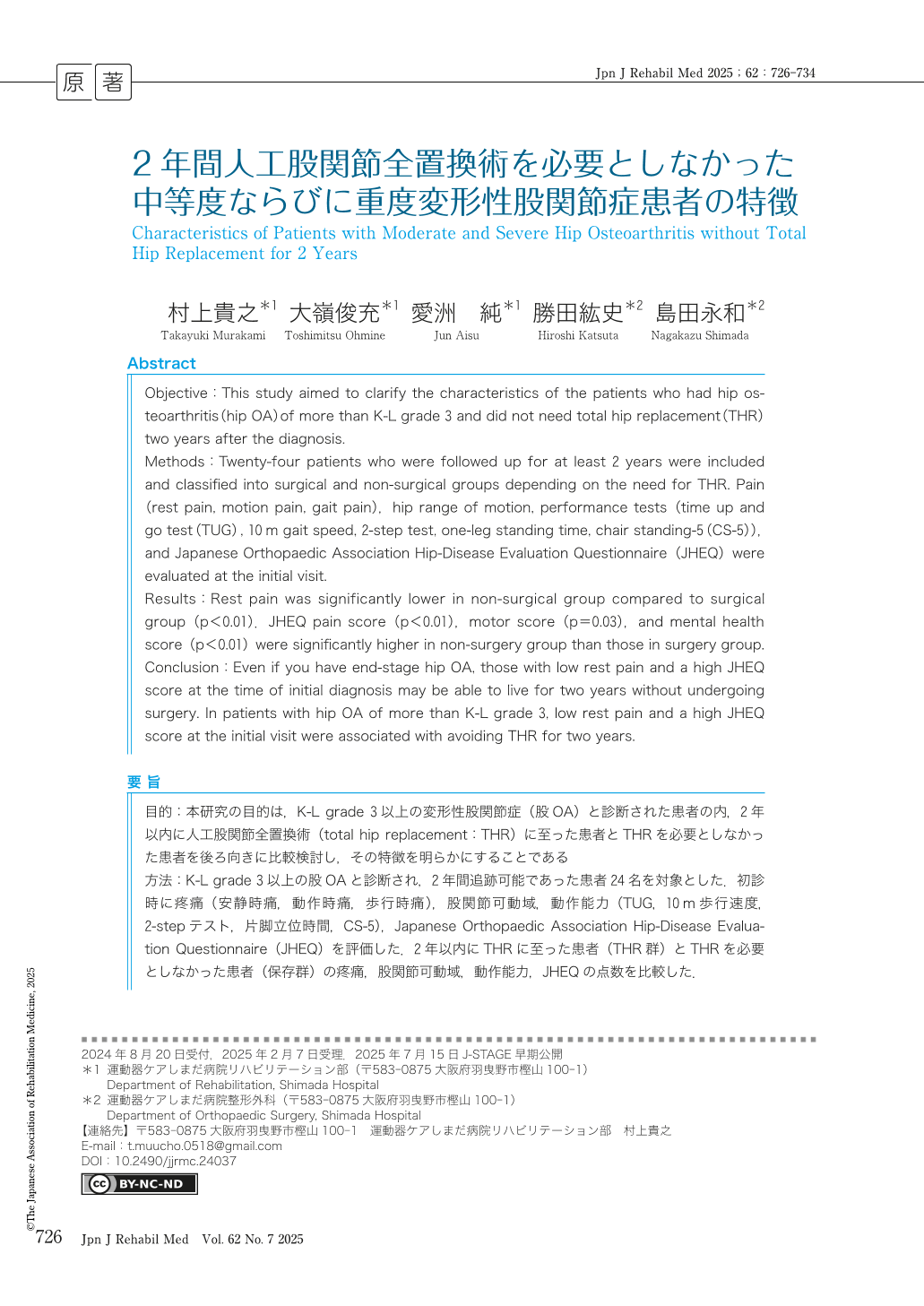
要旨 目的:本研究の目的は,K-L grade 3以上の変形性股関節症(股OA)と診断された患者の内,2年以内に人工股関節全置換術(total hip replacement:THR)に至った患者とTHRを必要としなかった患者を後ろ向きに比較検討し,その特徴を明らかにすることである
方法:K-L grade 3以上の股OAと診断され,2年間追跡可能であった患者24名を対象とした.初診時に疼痛(安静時痛,動作時痛,歩行時痛),股関節可動域,動作能力(TUG,10m歩行速度,2-stepテスト,片脚立位時間,CS-5),Japanese Orthopaedic Association Hip-Disease Evaluation Questionnaire(JHEQ)を評価した.2年以内にTHRに至った患者(THR群)とTHRを必要としなかった患者(保存群)の疼痛,股関節可動域,動作能力,JHEQの点数を比較した.
結果:保存群で安静時痛が有意に低く(p<0.01),JHEQの下位項目である患側痛み(p<0.01),患側動作(p=0.03),患側メンタル(p<0.01)の全ての項目でTHR群と比較して保存群で有意に高値を示した.
結論:K-L grade 3以上の股OAであっても,初診時の安静時痛が少なく,JHEQの数値が高い患者は,THRを必要とせずに中期的に生活できる可能性が示唆された.
Abstract Objective: This study aimed to clarify the characteristics of the patients who had hip osteoarthritis (hip OA) of more than K-L grade 3 and did not need total hip replacement (THR) two years after the diagnosis.
Methods: Twenty-four patients who were followed up for at least 2 years were included and classified into surgical and non-surgical groups depending on the need for THR. Pain (rest pain, motion pain, gait pain), hip range of motion, performance tests (time up and go test (TUG), 10 m gait speed, 2-step test, one-leg standing time, chair standing-5 (CS-5)), and Japanese Orthopaedic Association Hip-Disease Evaluation Questionnaire (JHEQ) were evaluated at the initial visit.
Results: Rest pain was significantly lower in non-surgical group compared to surgical group (p<0.01). JHEQ pain score (p<0.01), motor score (p=0.03), and mental health score (p<0.01) were significantly higher in non-surgery group than those in surgery group.
Conclusion: Even if you have end-stage hip OA, those with low rest pain and a high JHEQ score at the time of initial diagnosis may be able to live for two years without undergoing surgery. In patients with hip OA of more than K-L grade 3, low rest pain and a high JHEQ score at the initial visit were associated with avoiding THR for two years.
Copyright © 2025, The Japanese Association of Rehabilitation Medicine. All rights reserved.