Japanese
English
- 有料閲覧
- Abstract 文献概要
- 1ページ目 Look Inside
- 参考文献 Reference
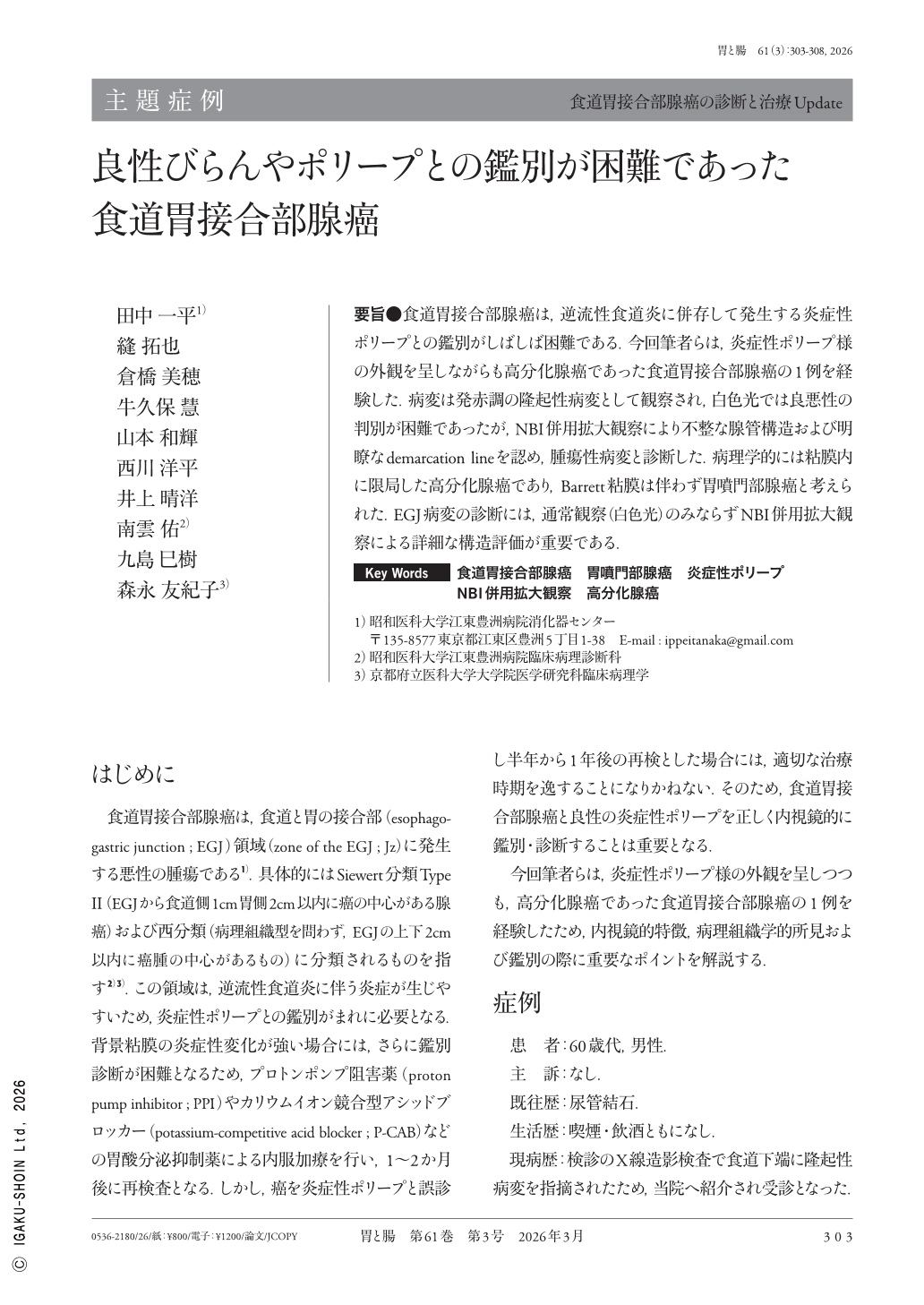
要旨●食道胃接合部腺癌は,逆流性食道炎に併存して発生する炎症性ポリープとの鑑別がしばしば困難である.今回筆者らは,炎症性ポリープ様の外観を呈しながらも高分化腺癌であった食道胃接合部腺癌の1例を経験した.病変は発赤調の隆起性病変として観察され,白色光では良悪性の判別が困難であったが,NBI併用拡大観察により不整な腺管構造および明瞭なdemarcation lineを認め,腫瘍性病変と診断した.病理学的には粘膜内に限局した高分化腺癌であり,Barrett粘膜は伴わず胃噴門部腺癌と考えられた.EGJ病変の診断には,通常観察(白色光)のみならずNBI併用拡大観察による詳細な構造評価が重要である.
Esophagogastric junction(EGJ)adenocarcinoma is often difficult to differentiate from inflammatory polyps that develop secondary to reflux esophagitis. We encountered a case of EGJ adenocarcinoma that appeared endoscopically as an inflammatory polyp but was a well-differentiated adenocarcinoma from a pathological perspective. The lesion presented as a reddish, elevated lesion that was hardly distinguishable from a benign one under white-light imaging(WLI). However, magnified endoscopy with narrow-band imaging(NBI-ME)revealed an irregular surface pattern and a distinct demarcation line, leading to the diagnosis of a neoplastic lesion. Histopathological examination confirmed an intramucosal well-differentiated adenocarcinoma without Barrett's epithelium, consistent with gastric cardia adenocarcinoma. This case highlights the importance of detailed structural evaluation using NBI-ME, in addition to WLI, for the accurate diagnosis of lesions at the EGJ.
Copyright © 2026, Igaku-Shoin Ltd. All rights reserved.