Japanese
English
- 有料閲覧
- Abstract 文献概要
- 1ページ目 Look Inside
- 参考文献 Reference
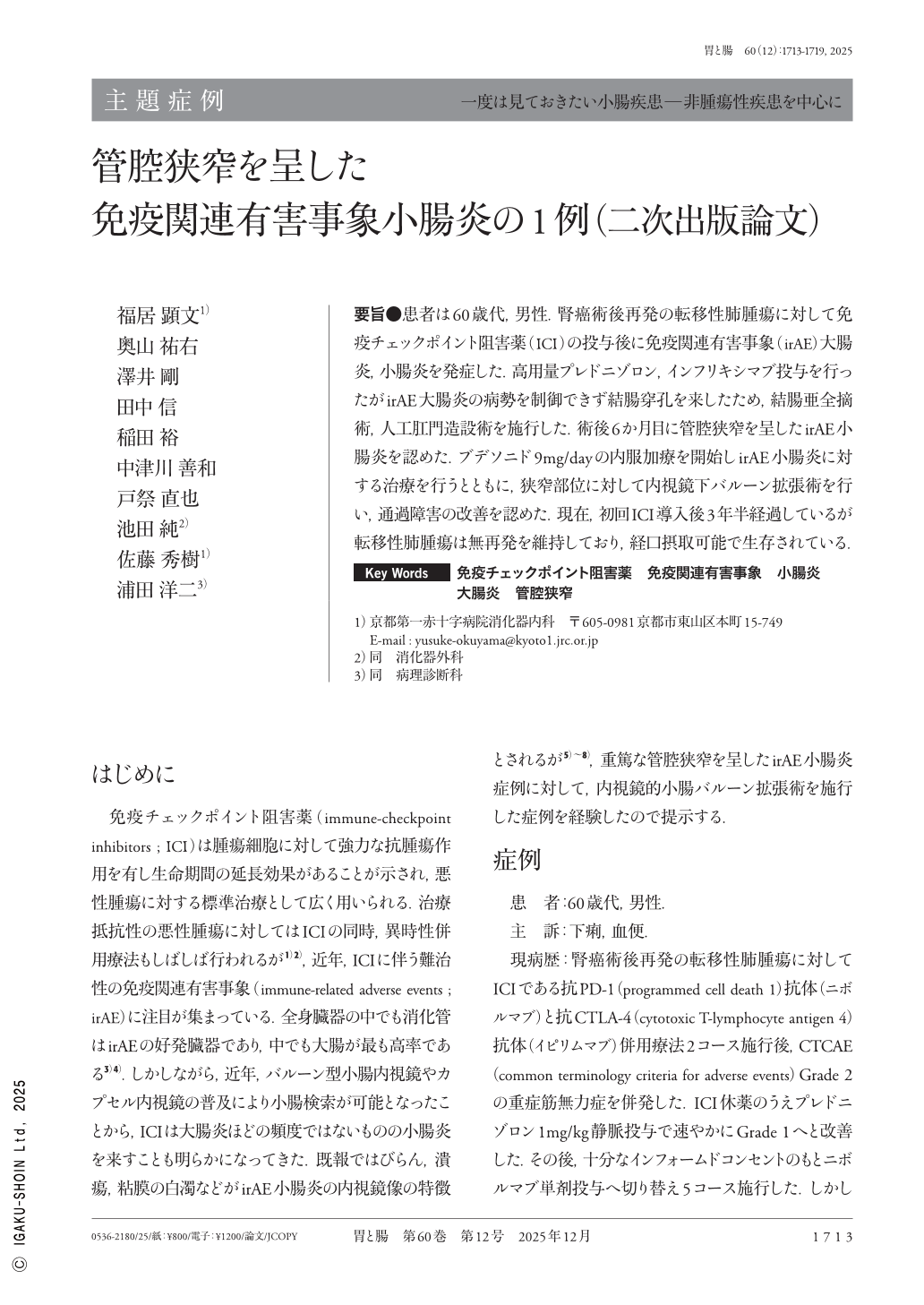
要旨●患者は60歳代,男性.腎癌術後再発の転移性肺腫瘍に対して免疫チェックポイント阻害薬(ICI)の投与後に免疫関連有害事象(irAE)大腸炎,小腸炎を発症した.高用量プレドニゾロン,インフリキシマブ投与を行ったがirAE大腸炎の病勢を制御できず結腸穿孔を来したため,結腸亜全摘術,人工肛門造設術を施行した.術後6か月目に管腔狭窄を呈したirAE小腸炎を認めた.ブデソニド9mg/dayの内服加療を開始しirAE小腸炎に対する治療を行うとともに,狭窄部位に対して内視鏡下バルーン拡張術を行い,通過障害の改善を認めた.現在,初回ICI導入後3年半経過しているが転移性肺腫瘍は無再発を維持しており,経口摂取可能で生存されている.
Immune checkpoint inhibitors, including ipilimumab and nivolumab, target cytotoxic T-lymphocyte-associated antigen 4 and programmed cell death protein 1, respectively, and are increasingly used in cancer treatment. These therapies can induce immune-related adverse events, including colitis and ileitis. However, reports on enteritis caused by these immune-related adverse events are lacking, particularly in Japan, with only a few case reports available. The incidence, typical location, and timing of onset of such inflammation remain undefined. We present the case of a 56-year-old man who developed severe colitis and enteritis after receiving immune checkpoint inhibitor therapy for a recurrent metastatic lung tumor following surgical treatment for renal cell carcinoma. Despite administration of high-dose prednisolone and infliximab, he developed colonic perforation, requiring subtotal proctocolectomy and colostomy. At 6 months postoperatively, he presented with enteritis with luminal narrowing. Oral budesonide was initiated, and endoscopic balloon dilation of the stenotic site improved the obstruction. Consequently, 3.5 years after initiating immune checkpoint inhibitor therapy, no recurrence of the metastatic lung tumor was noted and the patient is alive without any difficulties in oral intake. This report highlights the need for careful consideration of immune checkpoint inhibitor administration, even during transitions to a single-agent therapy.
Copyright © 2025, Igaku-Shoin Ltd. All rights reserved.