Japanese
English
- 有料閲覧
- Abstract 文献概要
- 1ページ目 Look Inside
- 参考文献 Reference
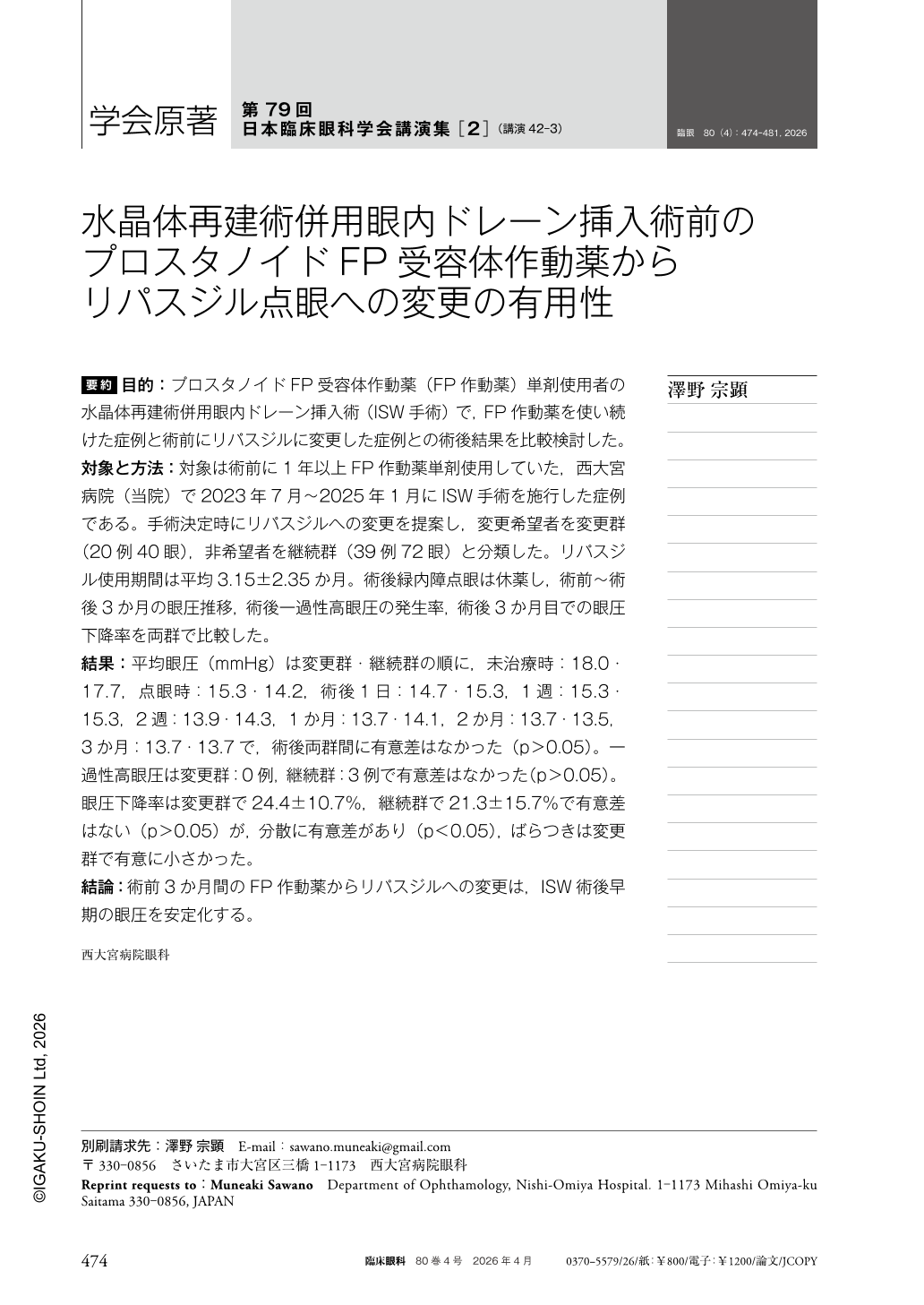
要約 目的:プロスタノイドFP受容体作動薬(FP作動薬)単剤使用者の水晶体再建術併用眼内ドレーン挿入術(ISW手術)で,FP作動薬を使い続けた症例と術前にリパスジルに変更した症例との術後結果を比較検討した。
対象と方法:対象は術前に1年以上FP作動薬単剤使用していた,西大宮病院(当院)で2023年7月〜2025年1月にISW手術を施行した症例である。手術決定時にリパスジルへの変更を提案し,変更希望者を変更群(20例40眼),非希望者を継続群(39例72眼)と分類した。リパスジル使用期間は平均3.15±2.35か月。術後緑内障点眼は休薬し,術前〜術後3か月の眼圧推移,術後一過性高眼圧の発生率,術後3か月目での眼圧下降率を両群で比較した。
結果:平均眼圧(mmHg)は変更群・継続群の順に,未治療時:18.0・17.7,点眼時:15.3・14.2,術後1日:14.7・15.3,1週:15.3・15.3,2週:13.9・14.3,1か月:13.7・14.1,2か月:13.7・13.5,3か月:13.7・13.7で,術後両群間に有意差はなかった(p>0.05)。一過性高眼圧は変更群:0例,継続群:3例で有意差はなかった(p>0.05)。眼圧下降率は変更群で24.4±10.7%,継続群で21.3±15.7%で有意差はない(p>0.05)が,分散に有意差があり(p<0.05),ばらつきは変更群で有意に小さかった。
結論:術前3か月間のFP作動薬からリパスジルへの変更は,ISW術後早期の眼圧を安定化する。
Abstract Purpose:Long-term glaucoma medication use may lead to disuse atrophy in the trabecular meshwork and Schlemm's canal in the aqueous humor outflow pathway. However, the preoperative use of ripasudil eye drops reportedly increases the success rate of microhook ab interno trabeculotomy. This study investigated postoperative outcomes of iStent inject® W implantation(ISW surgery) in patients who had been on long-term monotherapy with FP receptor agonists(FP agonists) and those switched to ripasudil eye drops preoperatively.
Participants and Methods:The participants were patients who underwent ISW surgery between July 2023 and January 2025 at Nishi-Omiya Hospital and had been on monotherapy with FP agonists for ≧1 year preoperatively. Patients who consented to switch eye drops were assigned to the ripasudil switch group(20 cases;40 eyes), whereas those who did not consent were assigned to the FP continuation group(39 cases;72 eyes). The ripasudil switch group received ripasudil for a mean duration of 3.15±2.35 months. Postoperatively, glaucoma eye drops were discontinued, and patients were followed for ≥3 months. The groups were compared for (1)changes in intraocular pressure(IOP) from baseline(before FP monotherapy) to 3 months postoperatively, (2)incidence of postoperative transient ocular hypertension of ≧30 mmHg, and (3)IOP reduction rates from baseline to 3 months postoperatively.
Results:The mean IOP(mmHg) values for the ripasudil switch and FP continuation groups were 18.0 and 17.7(baseline), 15.3 and 14.2(with glaucoma eye drops), 14.7 and 15.3(1 day postoperatively), 15.3 and 15.3(1 week postoperatively), 13.9 and 14.3(2 weeks postoperatively), 13.7 and 14.1(1 month postoperatively), 13.7 and 13.5(2 months postoperatively), and 13.7 and 13.7(3 months postoperatively), respectively;no significant differences were noted between groups(p>0.05). Postoperative transient ocular hypertension occurred in three cases in the FP continuation group but was absent in the ripasudil switch group, with no statistically significant difference(p>0.05, Fisher's exact test). The IOP reduction rate at 3 months postoperatively was 24.4%±10.7% and 21.3%±15.7% in the ripasudil switch and FP continuation groups, respectively with no significant differences between the groups(p>0.05). However, a significant difference in distribution of IOP reduction at 3 months postoperatively was observed between the groups(p<0.05, F-test). Furthermore, the coefficient of variation was 0.44 and 0.74 in the ripasudil switch and FP continuation groups, respectively, indicating a significantly lower variation in the IOP reduction rate in the ripasudil switch group.
Conclusion:Preoperative switching from an FP agonist to ripasudil for 3 months stabilized postoperative IOP, thereby potentially reducing the risk of transient ocular hypertension in the early postoperative period following ISW surgery.
Copyright © 2026, Igaku-Shoin Ltd. All rights reserved.