Japanese
English
- 有料閲覧
PPV購入案内
1,320円 (1,200円+税10%) こちらは、591ページから596ページの文献です。購入には医書.jp本会員登録が必要です。
会員登録完了後に改めて上記「購入サイトへ」を選択してください。
または「購入サイトへ」選択後に「購入ログイン」、「新規会員登録」の順に進んでください。
会員登録について詳しくはをご確認ください。
- Abstract 文献概要
- 1ページ目 Look Inside
- 参考文献 Reference
Ⅰ.有機溶剤の性質
有機溶剤は,常温,常圧で液体であり,油脂,樹脂やゴムなど水に溶けにくい物質を溶かす性質を有する有機化合物の総称である。基本骨格と官能基の種類に基づき,芳香族炭化水素,塩化炭化水素,アルコール類,エステル類,ケトン類,グリコール誘導体,脂環炭化水素,その他に分類され,各有機溶剤に特有な性質を持つ。有機溶剤は,塗料,印刷インキ,接着剤などの製造および使用,合成樹脂の製造や加工,金属材料などの脱脂洗浄,ドライクリーニングなど,産業界で広く使用されている。一般に,有機溶剤の空気に対する比重は1より大きく,揮発性に富み,脂溶性が大きい。そのため,経気道的および経皮的に吸収され,脂質の多い神経組織,肝臓や皮下組織などに分布する1,2)。
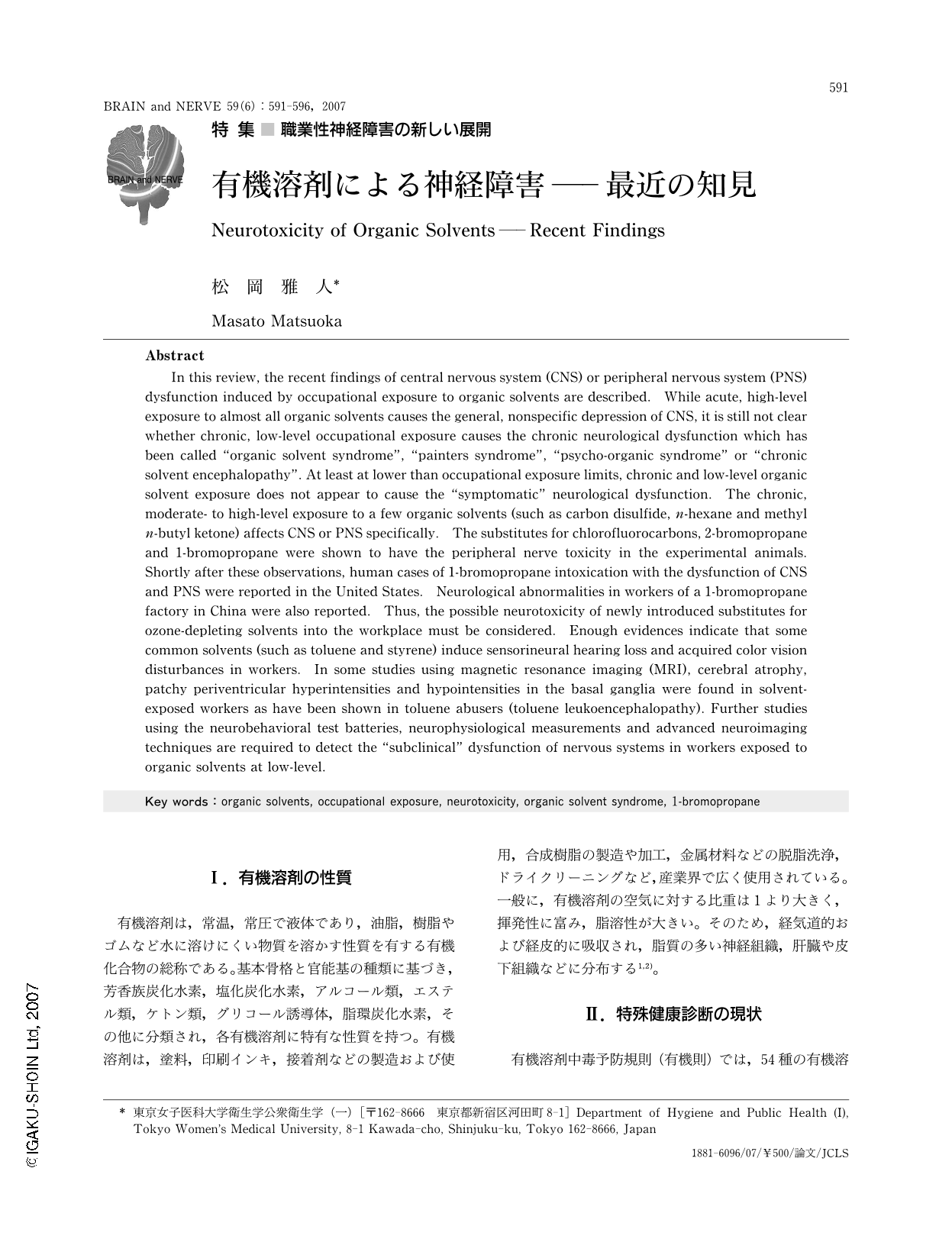
Abstract
In this review,the recent findings of central nervous system (CNS) or peripheral nervous system (PNS) dysfunction induced by occupational exposure to organic solvents are described. While acute,high-level exposure to almost all organic solvents causes the general,nonspecific depression of CNS,it is still not clear whether chronic,low-level occupational exposure causes the chronic neurological dysfunction which has been called "organic solvent syndrome","painters syndrome","psycho-organic syndrome" or "chronic solvent encephalopathy". At least at lower than occupational exposure limits,chronic and low-level organic solvent exposure does not appear to cause the "symptomatic" neurological dysfunction. The chronic,moderate- to high-level exposure to a few organic solvents (such as carbon disulfide,n-hexane and methyl n-butyl ketone) affects CNS or PNS specifically. The substitutes for chlorofluorocarbons,2-bromopropane and 1-bromopropane were shown to have the peripheral nerve toxicity in the experimental animals. Shortly after these observations,human cases of 1-bromopropane intoxication with the dysfunction of CNS and PNS were reported in the United States. Neurological abnormalities in workers of a 1-bromopropane factory in China were also reported. Thus,the possible neurotoxicity of newly introduced substitutes for ozone-depleting solvents into the workplace must be considered. Enough evidences indicate that some common solvents (such as toluene and styrene) induce sensorineural hearing loss and acquired color vision disturbances in workers. In some studies using magnetic resonance imaging (MRI),cerebral atrophy,patchy periventricular hyperintensities and hypointensities in the basal ganglia were found in solvent-exposed workers as have been shown in toluene abusers (toluene leukoencephalopathy). Further studies using the neurobehavioral test batteries,neurophysiological measurements and advanced neuroimaging techniques are required to detect the "subclinical" dysfunction of nervous systems in workers exposed to organic solvents at low-level.
Copyright © 2007, Igaku-Shoin Ltd. All rights reserved.