Japanese
English
- 有料閲覧
PPV購入案内
1,320円 (1,200円+税10%) こちらは、19ページから29ページの文献です。購入には医書.jp本会員登録が必要です。
会員登録完了後に改めて上記「購入サイトへ」を選択してください。
または「購入サイトへ」選択後に「購入ログイン」、「新規会員登録」の順に進んでください。
会員登録について詳しくはをご確認ください。
- Abstract 文献概要
- 1ページ目 Look Inside
- 参考文献 Reference
- サイト内被引用 Cited by
はじめに
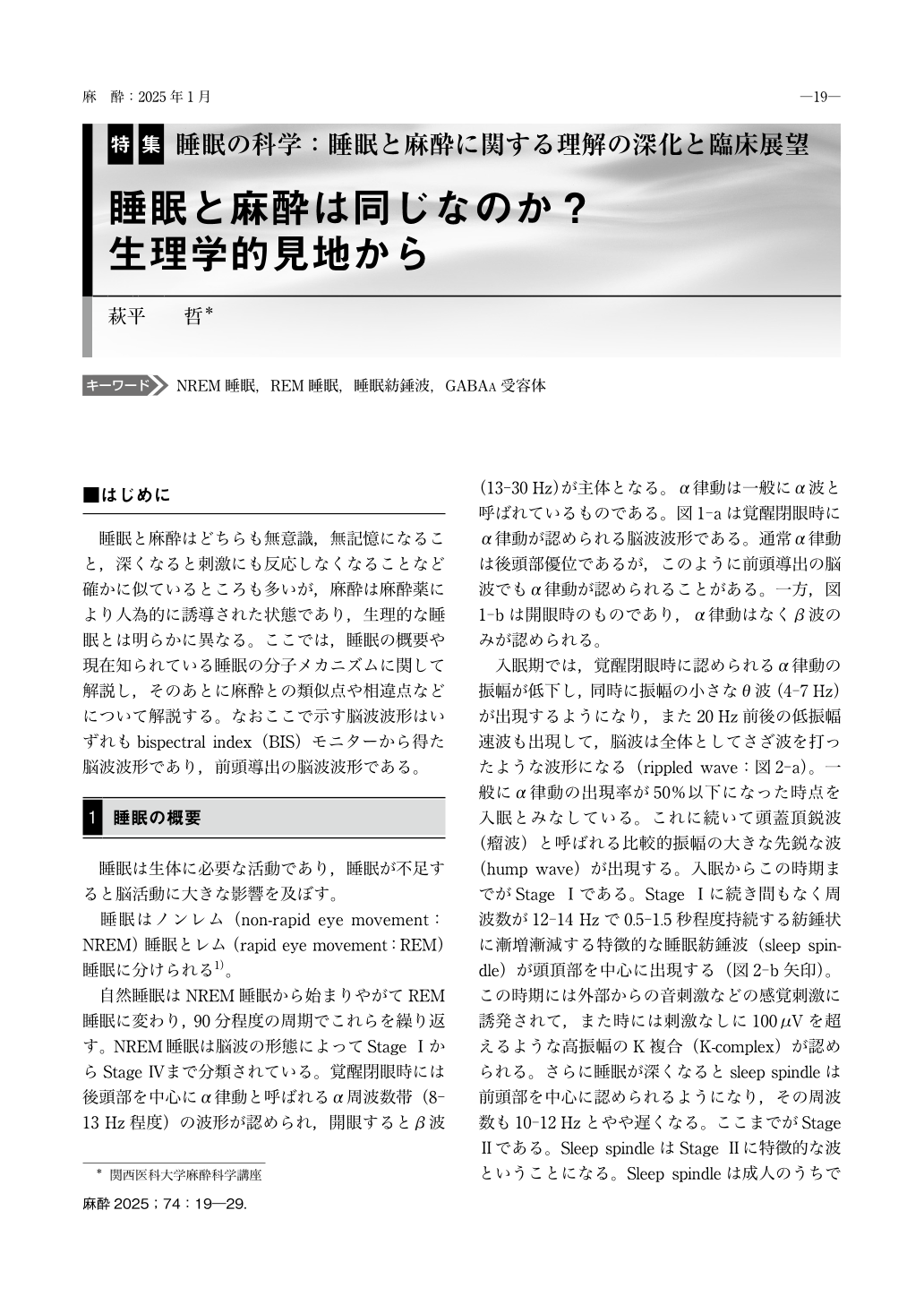
睡眠と麻酔はどちらも無意識,無記憶になること,深くなると刺激にも反応しなくなることなど確かに似ているところも多いが,麻酔は麻酔薬により人為的に誘導された状態であり,生理的な睡眠とは明らかに異なる。ここでは,睡眠の概要や現在知られている睡眠の分子メカニズムに関して解説し,そのあとに麻酔との類似点や相違点などについて解説する。なおここで示す脳波波形はいずれもbispectral index(BIS)モニターから得た脳波波形であり,前頭導出の脳波波形である。
Although sleep and anesthesia are certainly similar in many respects such as unconsciousness, lack of memory, and the inability to respond to stimuli as the state becomes deeper, anesthesia is an artificial state induced by an anesthetic drug and is clearly different from physiological sleep. Sleep can be divided into non-rapid eye movement(NREM)sleep and REM sleep. Natural sleep begins as NREM and eventually changes to REM, which repeats in approx. 90-min cycles. Volatile anesthetics such as sevoflurane, desflurane, and propofol are all known to exert-their anesthetic effects by potentiating the action of GABAa receptors. Anesthetic concentration-related EEG change patterns are common to all patients, and these patterns are quite similar to those observed during NREM sleep. However, the EEG pattern observed during REM sleep never emerges during anesthesia. EEG changes in natural sleep and those induced by anesthetic drugs that potentiate the action of GABAa receptors have many aspects in common, and their rhythm generation is thought to depend on the same mechanism. However, natural sleep and anesthesia are essentially different.
Copyright © 2025 KOKUSEIDO CO., LTD. All Rights Reserved.