Japanese
English
- 有料閲覧
PPV購入案内
1,650円 (1,500円+税10%) こちらは、804ページから808ページの文献です。購入には医書.jp本会員登録が必要です。
会員登録完了後に改めて上記「購入サイトへ」を選択してください。
または「購入サイトへ」選択後に「購入ログイン」、「新規会員登録」の順に進んでください。
会員登録について詳しくはをご確認ください。
- Abstract 文献概要
- 1ページ目 Look Inside
- 参考文献 Reference
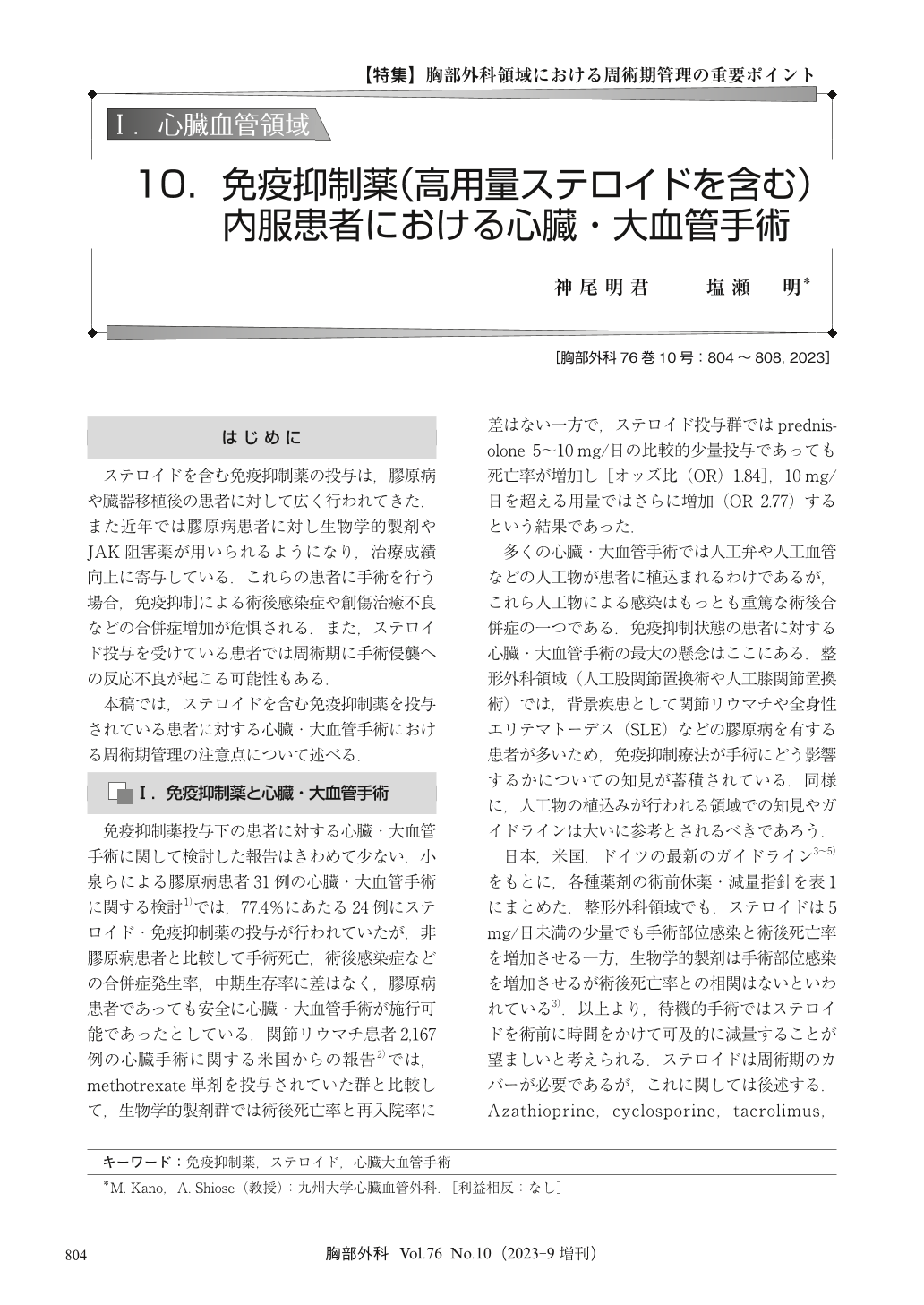
ステロイドを含む免疫抑制薬の投与は,膠原病や臓器移植後の患者に対して広く行われてきた.また近年では膠原病患者に対し生物学的製剤やJAK阻害薬が用いられるようになり,治療成績向上に寄与している.これらの患者に手術を行う場合,免疫抑制による術後感染症や創傷治癒不良などの合併症増加が危惧される.また,ステロイド投与を受けている患者では周術期に手術侵襲への反応不良が起こる可能性もある.
Immunosuppressive agents including steroids are generally given to patients with collagen disease or organ transplant recipients. Cardiovascular surgery for these patients can potentially associate with increased rate of postoperative infection or wound healing complications. Here, some key points for perioperative management in patients under immunosuppressive therapy are reviewed. Before an elective surgery, steroids need to be tapered down as much as possible, because even small amount of steroid can lead to adverse postoperative outcomes. Withholding Biologic disease-modifying antirheumatic drugs (bDMARDs) and Janus kinase (JAK) inhibitors is recommended for stable collagen disease patients. Current guidelines for perioperative management of antirheumatic medication are summarized in Table 1. Perioperative Glucocorticoid management is also required for patients exposed to steroid therapy. Intra-and postoperative steroid cover regimen is shown in Table 2. On the other hand, immunosuppressive therapy should not be discontinued for those after organ transplant and patients with severely active collagen disease. Our experience of kidney transplant recipients who underwent cardiovascular surgery is shown in Table 3. Close monitoring of blood Tacrolimus level is highly important, because it tends to fluctuate after operation and high Tacrolimus level possibly leads to deterioration in renal function. In conclusion, careful perioperative management in cooperation with transplant surgeons and rheumatologists is vital in this clinical setting.
© Nankodo Co., Ltd., 2023