Japanese
English
- 有料閲覧
PPV購入案内
1,650円 (1,500円+税10%) こちらは、203ページから207ページの文献です。購入には医書.jp本会員登録が必要です。
会員登録完了後に改めて上記「購入サイトへ」を選択してください。
または「購入サイトへ」選択後に「購入ログイン」、「新規会員登録」の順に進んでください。
会員登録について詳しくはをご確認ください。
- Abstract 文献概要
- 1ページ目 Look Inside
- 参考文献 Reference
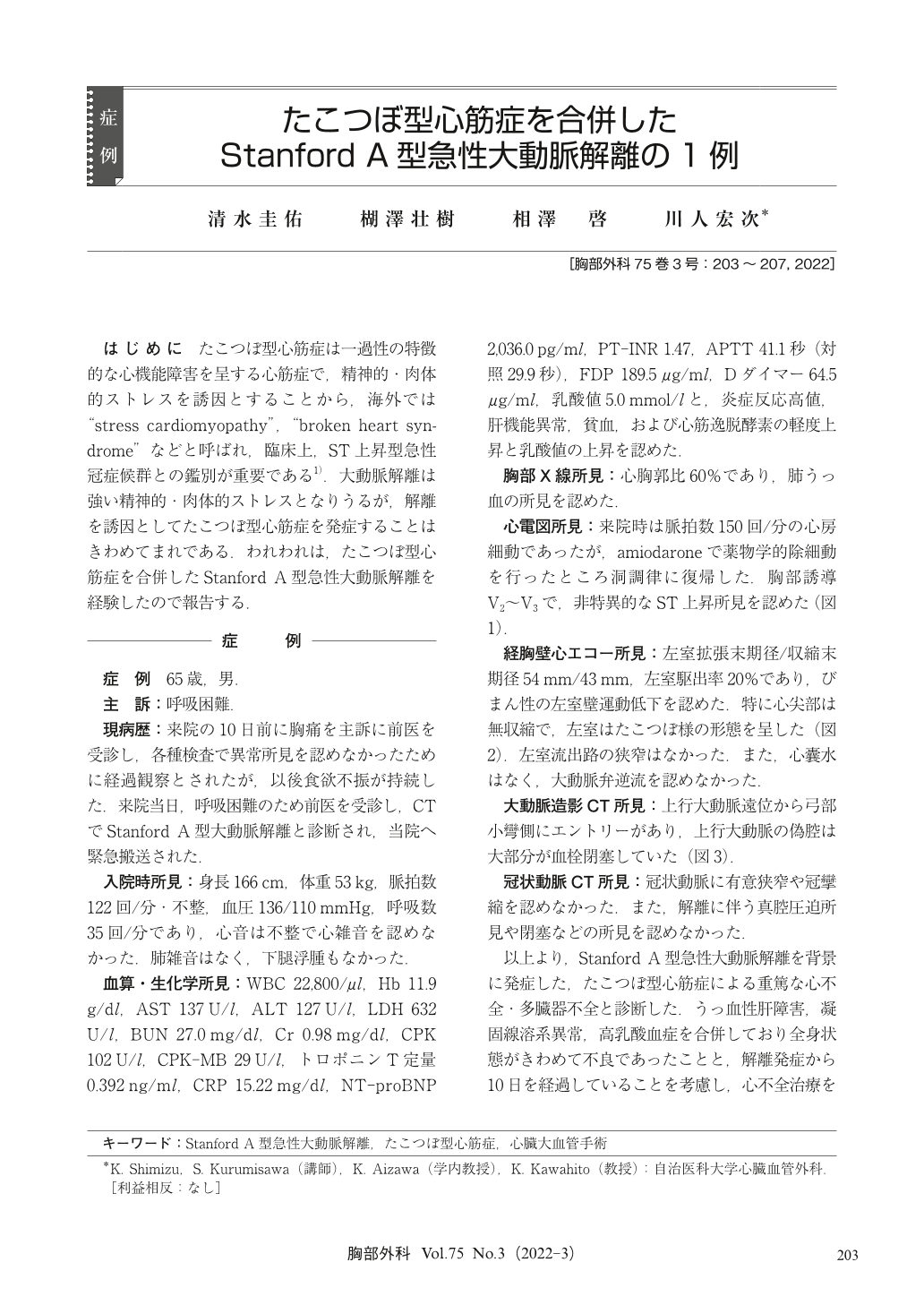
はじめに たこつぼ型心筋症は一過性の特徴的な心機能障害を呈する心筋症で,精神的・肉体的ストレスを誘因とすることから,海外では“stress cardiomyopathy”,“broken heart syndrome”などと呼ばれ,臨床上,ST上昇型急性冠症候群との鑑別が重要である1).大動脈解離は強い精神的・肉体的ストレスとなりうるが,解離を誘因としてたこつぼ型心筋症を発症することはきわめてまれである.われわれは,たこつぼ型心筋症を合併したStanford A型急性大動脈解離を経験したので報告する.
No case report about takotsubo cardiomyopathy with Stanford type A acute dissection is present in the literature. Here we report a case of takotsubo cardiomyopathy that was diagnosed following Stanford type A acute aortic dissection. A 65-year-old man was admitted with dyspnea. He had experienced acute chest pain 10 days prior. Computed tomography (CT) confirmed Stanford type A aortic dissection and primary entry tear in the proximal aortic arch with a thrombosed false lumen in the ascending aorta. Echocardiography revealed takotsubo-like wall motion, with an ejection fraction (EF) of 20%. Electrocardiography (ECG) showed ST-segment elevation in V2-V3. Subsequently, coronary artery disease was excluded by coronary CT. After 1 month, ECG findings and EF appeared normal. Thirty-five days after admission, aortic arch replacement was performed with the frozen elephant trunk technique. The patient’s postoperative course was uneventful. Takotsubo cardiomyopathy should be considered as a possible complication of acute aortic dissection with ST-segment elevation.
© Nankodo Co., Ltd., 2022