Japanese
English
- 有料閲覧
PPV購入案内
1,650円 (1,500円+税10%) こちらは、1070ページから1074ページの文献です。購入には医書.jp本会員登録が必要です。
会員登録完了後に改めて上記「購入サイトへ」を選択してください。
または「購入サイトへ」選択後に「購入ログイン」、「新規会員登録」の順に進んでください。
会員登録について詳しくはをご確認ください。
- Abstract 文献概要
- 1ページ目 Look Inside
- 参考文献 Reference
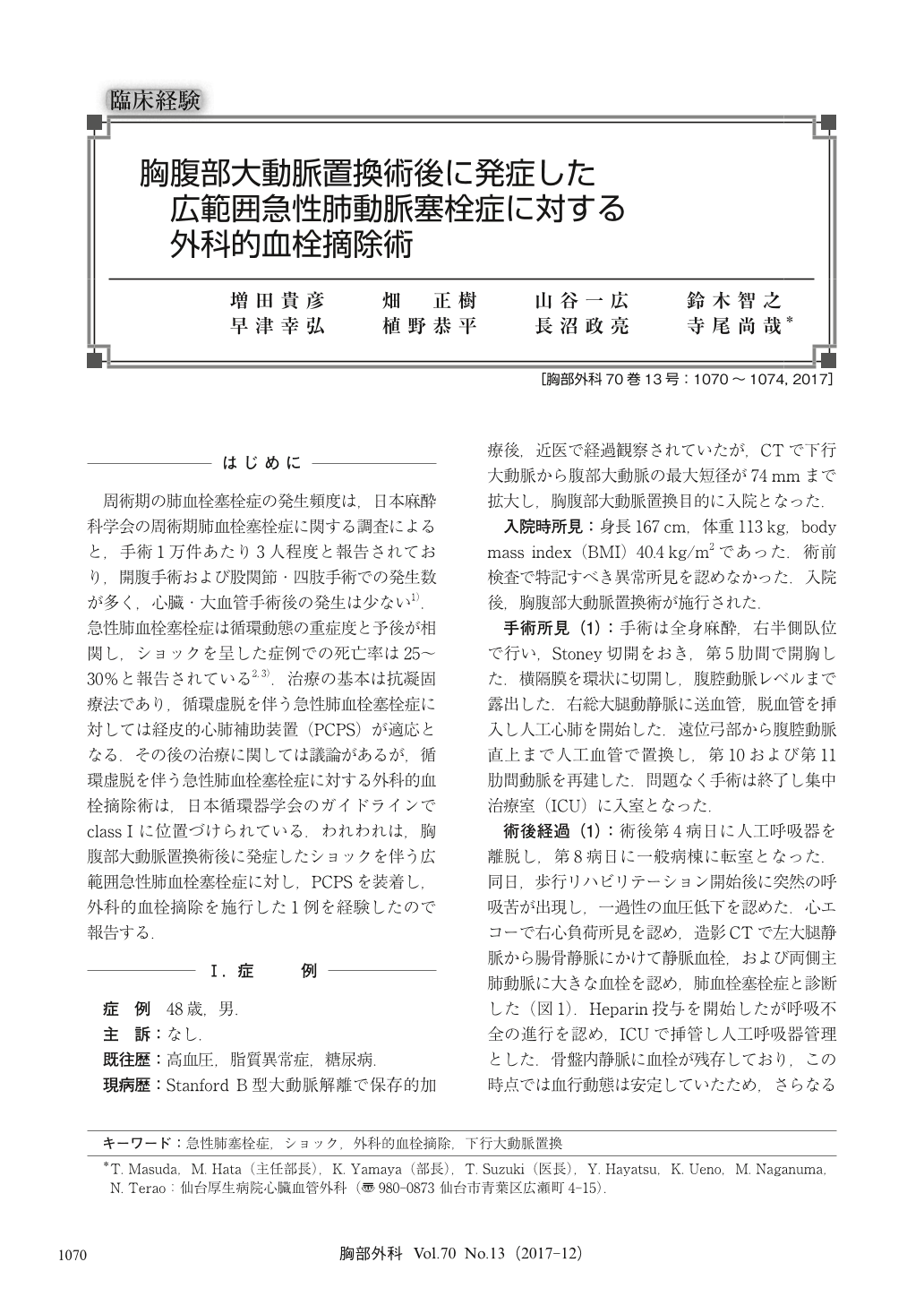
周術期の肺血栓塞栓症の発生頻度は,日本麻酔科学会の周術期肺血栓塞栓症に関する調査によると,手術1万件あたり3人程度と報告されており,開腹手術および股関節・四肢手術での発生数が多く,心臓・大血管手術後の発生は少ない1).急性肺血栓塞栓症は循環動態の重症度と予後が相関し,ショックを呈した症例での死亡率は25~30%と報告されている2,3).治療の基本は抗凝固療法であり,循環虚脱を伴う急性肺血栓塞栓症に
A 48-year-old man was admitted to our hospital and underwent thoracoabdominal aorta replacement. Eight days postoperatively, he developed severe dyspnea and transient drop in blood pressure suddenly following walk rehabilitation. Contrast-enhanced computed tomography showed thrombi in the bilateral main pulmonary artery. Respiratory failure and unstable hemodynamics developed, which required percutaneous cardiopulmonary support (PCPS). Because catheter embolectomy and thrombolytic therapy via pulmonary artery catheter were not effective, surgical thrombectomy was performed. PCPS was successfully removed on the following day. The patient was extubated on postoperative day 10 and discharged without complications on day 46 following rehabilitation. It is important to save a critically ill patient with acute pulmonary embolism requiring PCPS, and surgical treatment should be performed without delay in such patients.
© Nankodo Co., Ltd., 2017