Japanese
English
- 有料閲覧
PPV購入案内
1,320円 (1,200円+税10%) こちらは、283ページから291ページの文献です。購入には医書.jp本会員登録が必要です。
会員登録完了後に改めて上記「購入サイトへ」を選択してください。
または「購入サイトへ」選択後に「購入ログイン」、「新規会員登録」の順に進んでください。
会員登録について詳しくはをご確認ください。
- Abstract 文献概要
- 1ページ目 Look Inside
- 参考文献 Reference
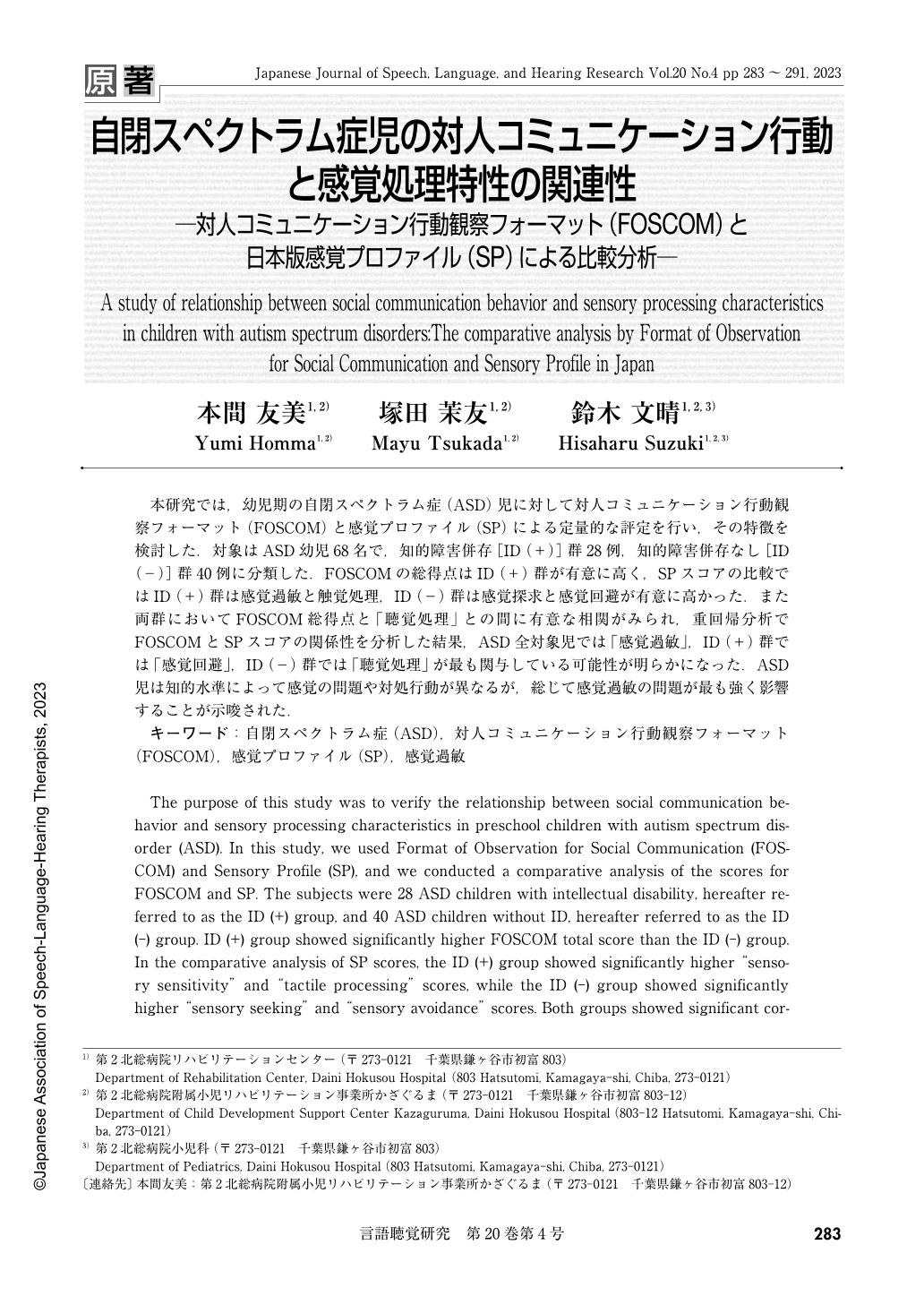
本研究では,幼児期の自閉スペクトラム症(ASD)児に対して対人コミュニケーション行動観察フォーマット(FOSCOM)と感覚プロファイル(SP)による定量的な評定を行い,その特徴を検討した.対象はASD幼児68名で,知的障害併存[ID(+)]群28例,知的障害併存なし[ID(-)]群40例に分類した.FOSCOMの総得点はID(+)群が有意に高く,SPスコアの比較ではID(+)群は感覚過敏と触覚処理,ID(-)群は感覚探求と感覚回避が有意に高かった.また両群においてFOSCOM総得点と「聴覚処理」との間に有意な相関がみられ,重回帰分析でFOSCOMとSPスコアの関係性を分析した結果,ASD全対象児では「感覚過敏」,ID(+)群では「感覚回避」,ID(-)群では「聴覚処理」が最も関与している可能性が明らかになった.ASD児は知的水準によって感覚の問題や対処行動が異なるが,総じて感覚過敏の問題が最も強く影響することが示唆された.
The purpose of this study was to verify the relationship between social communication behavior and sensory processing characteristics in preschool children with autism spectrum disorder (ASD). In this study, we used Format of Observation for Social Communication (FOSCOM) and Sensory Profile (SP), and we conducted a comparative analysis of the scores for FOSCOM and SP. The subjects were 28 ASD children with intellectual disability, hereafter referred to as the ID (+) group, and 40 ASD children without ID, hereafter referred to as the ID (-) group. ID (+) group showed significantly higher FOSCOM total score than the ID (-) group. In the comparative analysis of SP scores, the ID (+) group showed significantly higher “sensory sensitivity” and “tactile processing” scores, while the ID (-) group showed significantly higher “sensory seeking” and “sensory avoidance” scores. Both groups showed significant correlation between the FOSCOM total score and “auditory processing” score. A multiple regression analysis was performed on the relationship between FOSCOM and SP scores in order to determine the explanatory variable for the higher FOSCOM total score. The results showed that for all ASD subjects, the explanatory variable was “sensory sensitivity,” for the ID (+) group, it was “sensory avoidance,” and for the ID (-) group, it was “auditory processing.” These results suggest that although sensory problems and coping behaviors differ depending on the intellectual level of children with ASD, hypersensitivity is the factor that most strongly influenced social communication ability.
Copyright © 2023, Japanese Association of Speech-Language-Hearing Therapists. All rights reserved.