Japanese
English
- 有料閲覧
PPV購入案内
1,320円 (1,200円+税10%) こちらは、241ページから244ページの文献です。購入には医書.jp本会員登録が必要です。
会員登録完了後に改めて上記「購入サイトへ」を選択してください。
または「購入サイトへ」選択後に「購入ログイン」、「新規会員登録」の順に進んでください。
会員登録について詳しくはをご確認ください。
- Abstract 文献概要
- 1ページ目 Look Inside
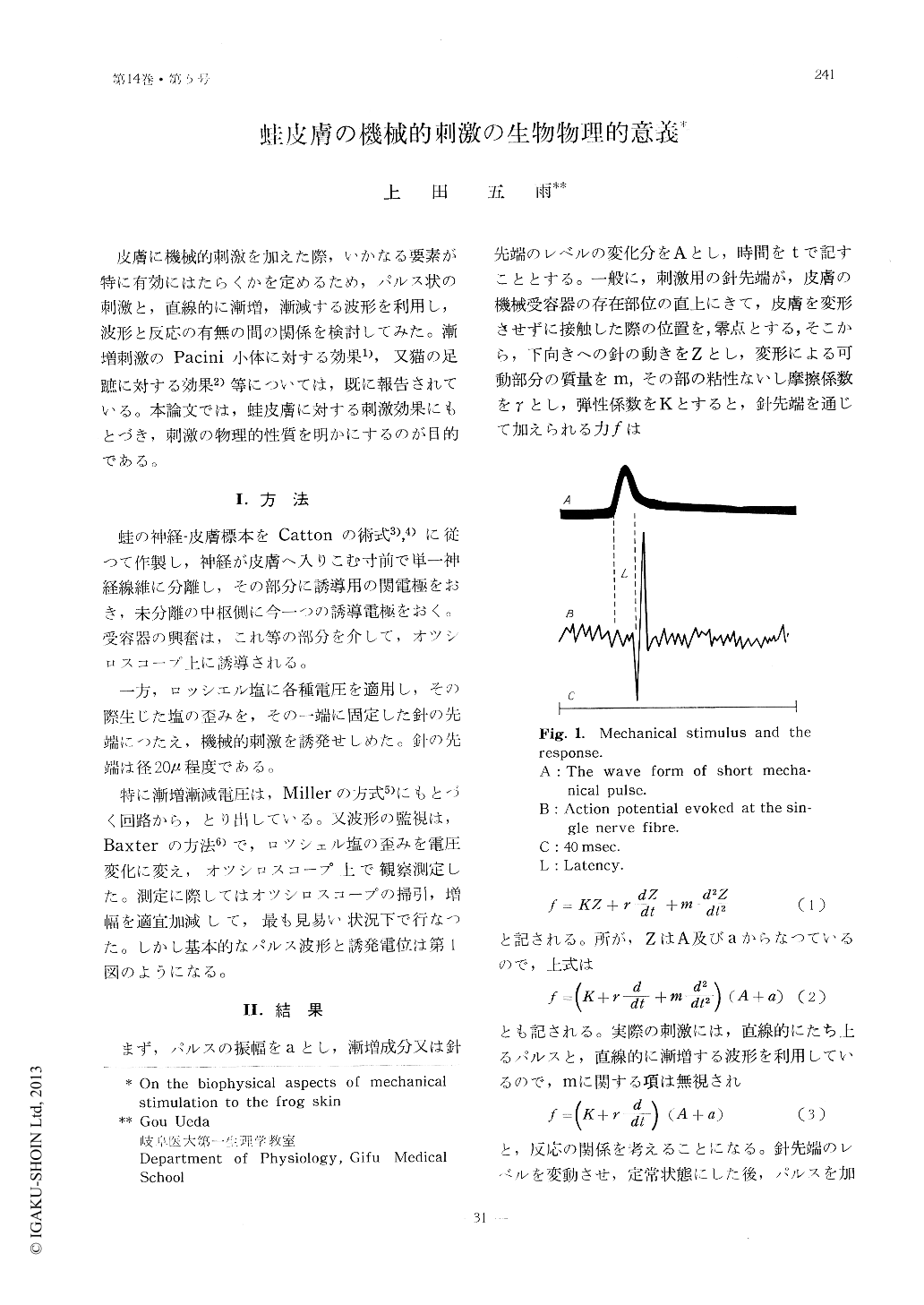
皮膚に機械的刺激を加えた際,いかなる要素が特に有効にはたらくかを定めるため,パルス状の刺激と,直線的に漸増,漸減する波形を利用し,波形と反応の有無の間の関係を検討してみた。漸増刺激のPacini小体に対する効果1),又猫の足蹠に対する効果2)等については,既に報告されている。本論文では,蛙皮膚に対する刺激効果にもとづき,刺激の物理的性質を明かにするのが目的である。
The excitability change of frog skin mecha-noreceptors were investigated by applying mechanical short pulses and or triangular pu-lses.
1.When the absolute value of displacement is A and dA/dt=0, it causes changes of exci-tability, which was named mechanotonus. A rapid component of the pulse was effective in causing response of the receptor.
2. The prefiring stages of supraliminal tri-angular pulses showed various time courses of excitability changes, but most of them in-dicated accommodation. In other words, the fall of threshold, expressed by the height of superposed pulses, was seen.
3. In rising phase of the subliminal triangu-lar displacement, threshold expressed in amp-litude seemed to be lower than the one in falling phase.
4. Velocity of displacements in mechanical stimuli was interpreted to be equivalent with electric current in electric stimulation of the excitable tissues.
5. Strictly speaking, the threshold must be determined by the combination of velocity and duration of the mechanical displacement. At least, two factors are necessary to describe the threshold value.
Copyright © 1963, THE ICHIRO KANEHARA FOUNDATION. All rights reserved.