Japanese
English
- 有料閲覧
PPV購入案内
1,320円 (1,200円+税10%) こちらは、683ページから689ページの文献です。購入には医書.jp本会員登録が必要です。
会員登録完了後に改めて上記「購入サイトへ」を選択してください。
または「購入サイトへ」選択後に「購入ログイン」、「新規会員登録」の順に進んでください。
会員登録について詳しくはをご確認ください。
- Abstract 文献概要
- 1ページ目 Look Inside
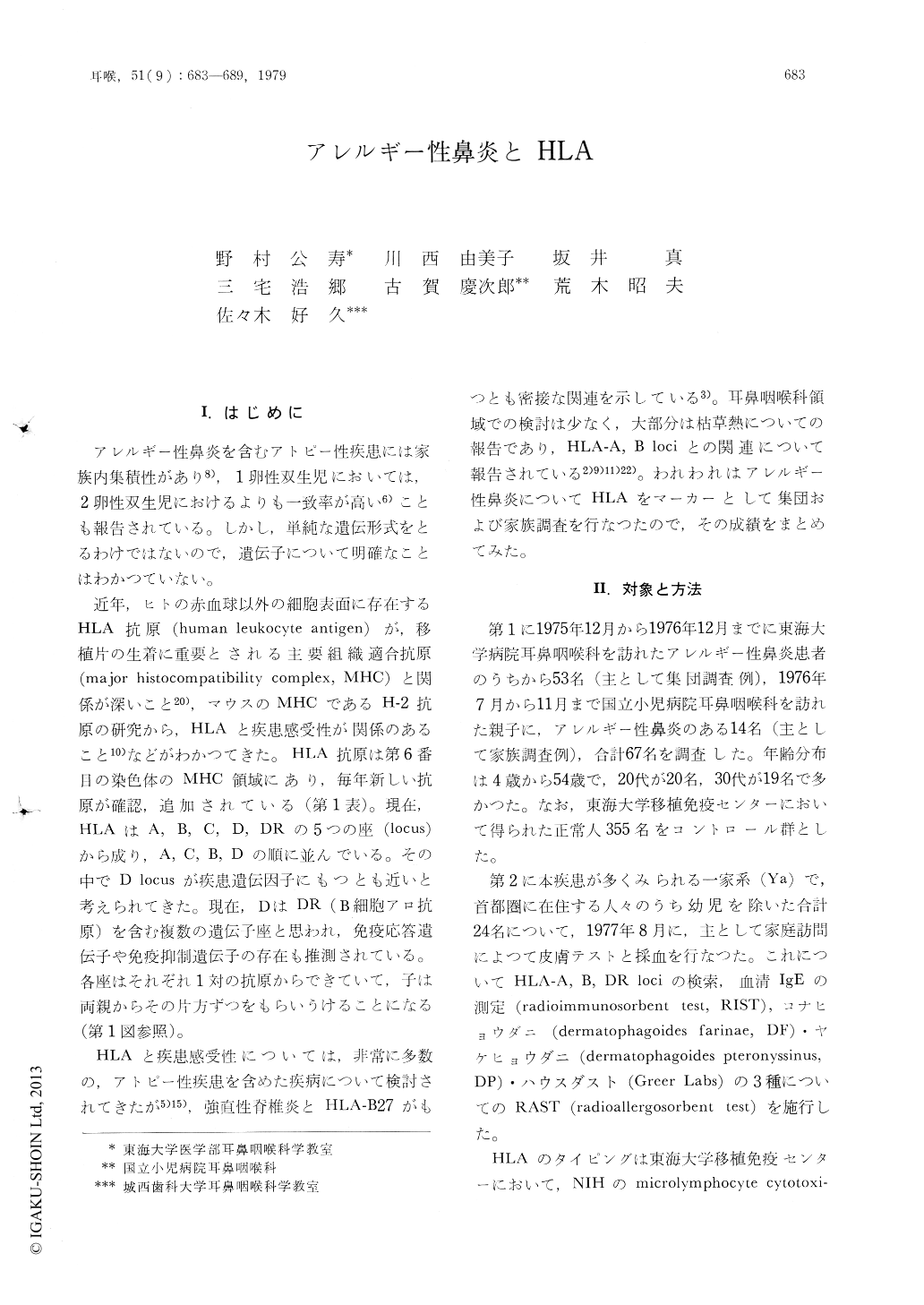
I.はじめに
アレルギー性鼻炎を含むアトピー性疾患には家族内集積性があり8),1卵性双生児においては,2卵性双生児におけるよりも一致率が高い6)ことも報告されている。しかし,単純な遺伝形式をとるわけではないので,遺伝子について明確なことはわかつていない。
近年,ヒトの赤血球以外の細胞表面に存在するHLA抗原(human leukocyte antigen)が,移植片の生着に重要とされる主要組織適合抗原(major histocompatibility complex,MHC)と関係が深いこと20),マウスのMHCであるH-2抗原の研究から,HLAと疾患感受性が関係のあること10)などがわかつてきた。HLA抗原は第6番目の染色体のMHC領域にあり,毎年新しい抗原が確認,追加されている(第1表)。現在,HLAはA,B,C,D,DRの5つの座(locus)から成り,A,C,B,Dの順に並んでいる。その中でDlocusが疾患遺伝因子にもつとも近いと考えられてきた。現在,DはDR(B細胞アロ抗原)を含む複数の遺伝子座と思われ,免疫応答遺伝子や免疫抑制遺伝子の存在も推測されている。各座はそれぞれ1対の抗原からできていて,子は両親からその片方ずつをもらいうけることになる(第1図参照)。
Population study of HLA was performed in 58 cases of allergic rhinitis to dust or pollen. There was a significant increase in the incidence of BW22 including BW54 in allergic rhinitis group (N=58, 20.7%) compared with the healthy adults (N=355, 11.0%) (p <0.05). A further subdivision of these patients into age of onset, causative antigen, ill season, personal history of bronchial asthma and family history of the allergic rhinitis was made. In the children who had been suflering from the disease since less than ten years old, the incidence of BW22 was significant (N=18, p<0.005) to the healthy adults. But even this group showed no significance in corrected p value.
A large family comprising 24 individuals, nine allergic to dust and/or Japanese cedar pollen, was examined. Among five persons whose skin tests were positive to house dust and had perennial symptoms, AW24-BW54 haplotype was found in four. Except for them, none of other family members had the same haplotype. Radioallergosorbent test (RAST) to Dermatophagoides farinae and D. pteronyssinus was made to all individuals. Five were positive to the RAST and three of them had AW24-BW54. From these results a close correlation between house dust allergy and this haplotype was suspected. Detection of DR locus in this family were not successful.
Copyright © 1979, Igaku-Shoin Ltd. All rights reserved.