Japanese
English
- 有料閲覧
PPV購入案内
1,320円 (1,200円+税10%) こちらは、883ページから888ページの文献です。購入には医書.jp本会員登録が必要です。
会員登録完了後に改めて上記「購入サイトへ」を選択してください。
または「購入サイトへ」選択後に「購入ログイン」、「新規会員登録」の順に進んでください。
会員登録について詳しくはをご確認ください。
- Abstract 文献概要
- 1ページ目 Look Inside
I.はじめに
すべての外科手術の合併症に創部感染がある.脳神経外科手術において創感染は頭蓋内感染へと進展し,髄膜炎・脳炎を併発する可能性があり,今までの報告では脳外科手術の術後頭蓋内感染症発生率は0.5-5%である2,5,7,8,14,17-19).
創感染の発生を予防する目的で手術直前に全頭部剃毛を行う施設は少なくないが,全頭部剃毛によってどの程度創感染が抑制されるかについては明らかな根拠はない.手術器具や術後管理技術の進歩により神経学的合併症の発生率は減少し,脳神経外科手術を受けた患者の在院日数は短くなる傾向がある.退院した患者が毛髪を失ったために社会復帰をためらう場合も多く,特に女性では一旦失った毛髪が伸びそろうには少なくとも1年間はかかるので社会生活を送る上での障害となることが多い.今回われわれは,開頭・穿頭術前における毛髪の全頭部剃毛が術後創感染予防にどの程度有効なのかを,部分剃毛で手術を行った症例と術後頭蓋内感染症の発生率を比較し検討した.
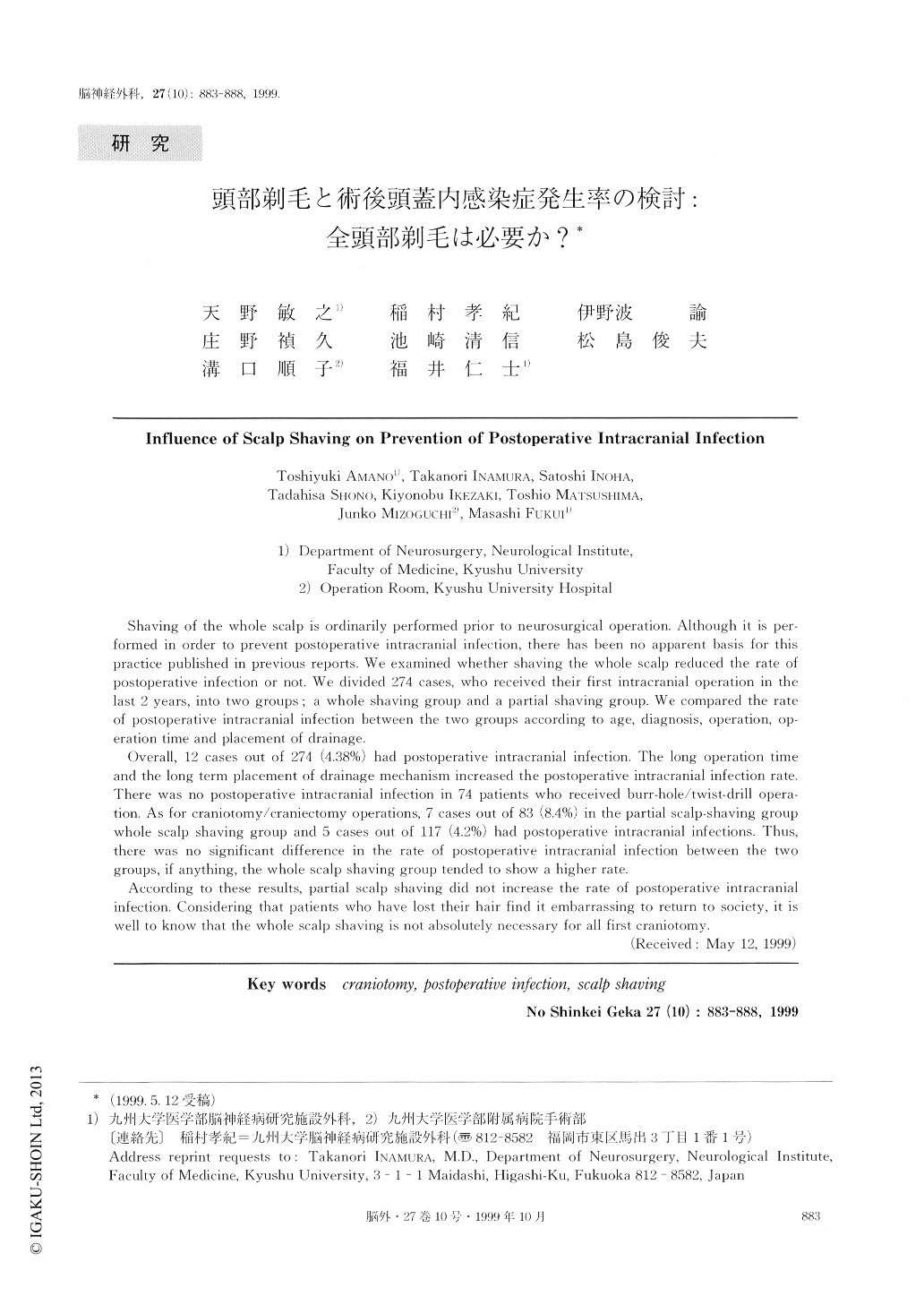
Shaving of the whole scalp is ordinarily performed prior to neurosurgical operation. Although it is per-formed in order to prevent postoperative intracranial infection, there has been no apparent basis for thispractice published in previous reports. We examined whether shaving the whole scalp reduced the rate ofpostoperative infection or not. We divided 274 cases, who received their first intracranial operation in thelast 2 years, into two groups; a whole shaving group and a partial shaving group. We compared the rateof postoperative intracranial infection between the two groups according to age, diagnosis, operation, op-eration time and placement of drainage.
Overall, 12 cases out of 274 (4.38%) had postoperative intracranial infection. The long operation timeand the long term placement of drainage mechanism increased the postoperative intracranial infection rate.There was no postoperative intracranial infection in 74 patients who received burr-hole/twist-drill Opera-tion. As for craniotomy/craniectomy operations, 7 cases out of 83 (8.4%) in the partial scalp-shaving groupwhole scalp shriving group and 5 cases out of 117 (4.2%) had postoperative intracranial infections. Thus,there was no significant difference in the rate of postoperative intracranial infection between the twogroups, if anything, the whole scalp shaving group tended to show a higher rate.
According to these results, partial scalp shaving did not increase the rate of postoperative intracranialinfection. Considering that patients who have lost their hair find it embarrassing to return to society, it iswell to know that the whole scalp shaving is not absolutely necessary for all first craniotomy.
Copyright © 1999, Igaku-Shoin Ltd. All rights reserved.