Japanese
English
- 有料閲覧
PPV購入案内
1,320円 (1,200円+税10%) こちらは、1043ページから1047ページの文献です。購入には医書.jp本会員登録が必要です。
会員登録完了後に改めて上記「購入サイトへ」を選択してください。
または「購入サイトへ」選択後に「購入ログイン」、「新規会員登録」の順に進んでください。
会員登録について詳しくはをご確認ください。
- Abstract 文献概要
- 1ページ目 Look Inside
I.はじめに
頭蓋内に多量のairが貯留し,圧迫症状を来たす緊張性気脳症は座位手術後7,10),髄液漏に対するシャント術後,前頭洞閉鎖不良の状態で行ったシャント術後や慢性硬膜下血腫に対する穿頭術後2,3)に生じ,しかも術後24時間以内に起こってくるとされている.
今回われわれは9年前に施行した穿頭部に瘻孔を生じ,緊張性気脳症を来たした稀な1症例を経験したので報告する.
We report a case of tension pneumocephalus due to scalp-ventricle fistula following trepanation surgery af-ter a 9-year interval. A 68-year-old man had a past his-tory of subarachnoid hemorrhage (unknown etiology) in 1987. At that time, he underwent an operation for ventriculoperitoneal (V-P) shunt and subduroperitoneal (S-P) shunt following ventricular drainage for hydroce-phalus. He was admitted to our hospital with general-ized convulsions on Feb. 26, 1996.
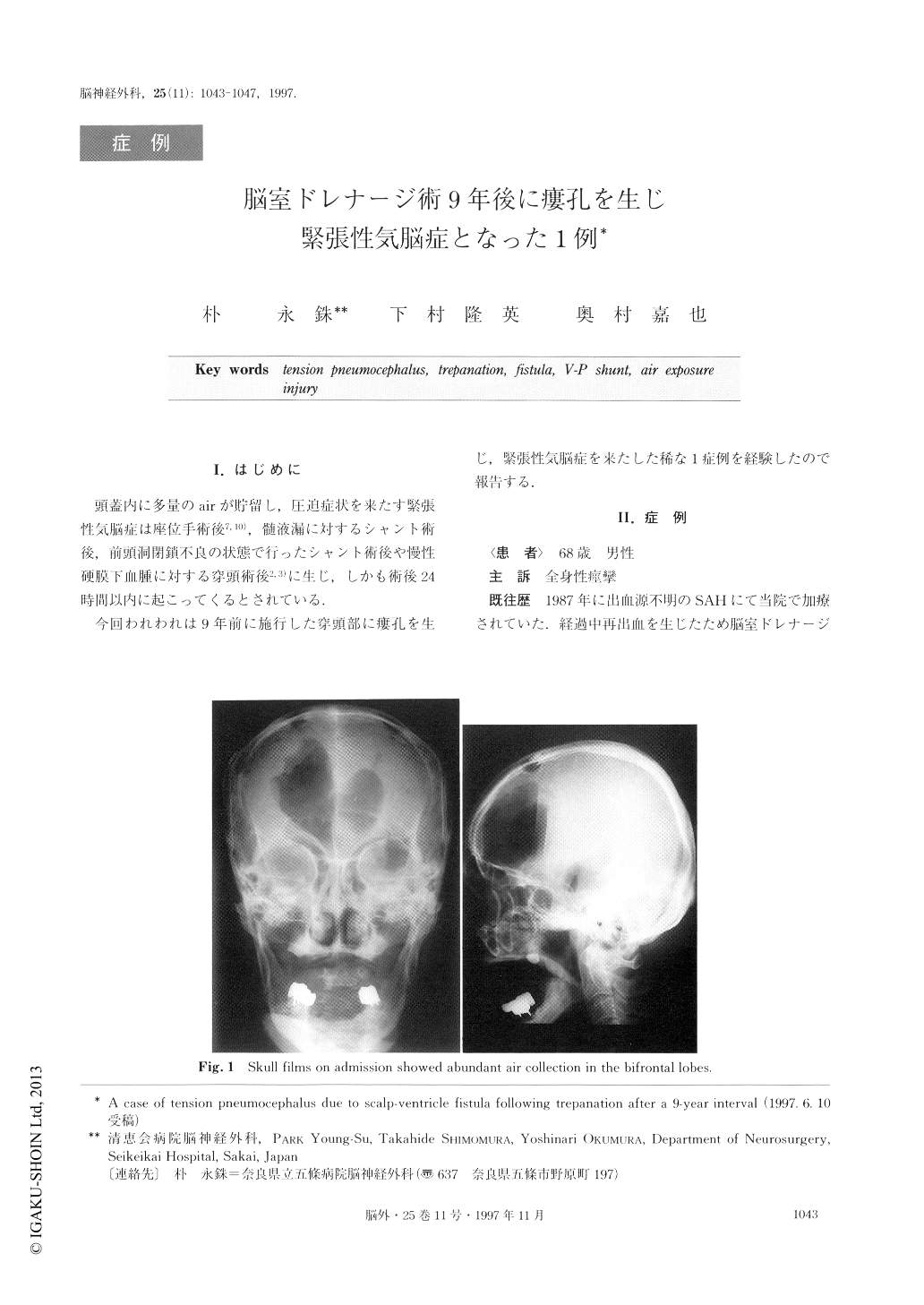
On admission, he presented with disorientated con-sciousness and mild left hemiparesis. The skull films and CT showed abundant air collection in the bifrontal lobe mainly in the bilateral anterior horns of the lateral ventricle.
We initially suspected air entry from frontal skull base fracture. However, a dimple was found on the right frontal scalp and a connection between the dimple and the intracranial space was detected by fistu-lography.
Scalp-ventricle fistula following trepanation was proved to be the air entry and it brought about tension pneumocephalus. On Mar. 6, closure of the fistula with a rotation skin flap was achieved. The collected air was completely absorbed, but a low-density area in the right frontal lobe remained on CT examination. We surmised that irreversible brain damage had been caused by longtime air exposure injury.
Copyright © 1997, Igaku-Shoin Ltd. All rights reserved.