Japanese
English
- 有料閲覧
PPV購入案内
1,320円 (1,200円+税10%) こちらは、1121ページから1127ページの文献です。購入には医書.jp本会員登録が必要です。
会員登録完了後に改めて上記「購入サイトへ」を選択してください。
または「購入サイトへ」選択後に「購入ログイン」、「新規会員登録」の順に進んでください。
会員登録について詳しくはをご確認ください。
- Abstract 文献概要
- 1ページ目 Look Inside
I.はじめに
高血圧性小脳出血は手術適応のある症例が多く,外科的治療に関してはこれまでにも多くの報告がみられる.近年,高血圧性脳出血に対して,侵襲の少ない定位的血腫吸引術が多く試みられ,良好な成績が得られているが3,5,6,10),高血圧性小脳出血に対する吸引術のまとまった報告は未だ少ないようである4,12,13,18,20).また本法の手術成績を後頭下開頭血腫除去術の成績と比較検討した報告はわれわれの調べ得た限りではみられなかった.今回われわれは自験例について,定位的血腫吸引術の成績を後頭下開頭血腫除去術の成績と比較検討したので報告する.
Patients with severe types of hypertensive cerebellar hemorrhage have been treated usually by suboccipital craniectomy and hematoma evacuation. However, since 1981, we have treated such patients with stereotactic aspiration surgery.
The purpose of this study was to evaluate the pro-gnosis of patients treated by stereotactic aspiration surgery for cerebellar hemorrhage in comparison with those who underwent suboccipital craniectomy.
Between May 1976 and December 1989, 246 patients with hypertensive cerebellar hemorrhage were admitted to our university hospital and affiliated hospitals.
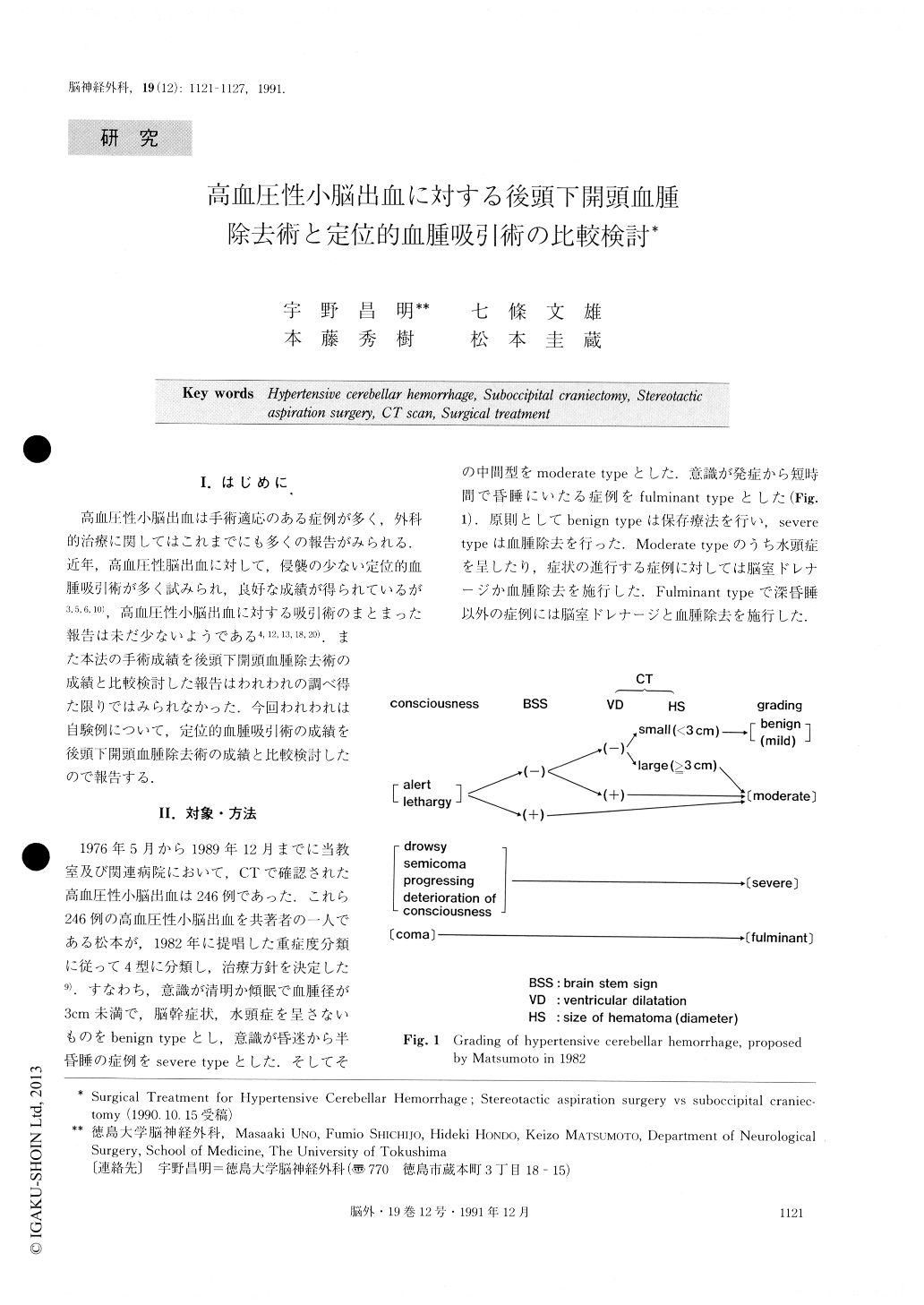
The patients were classified into four categories according to the grading of hypertensive cerebellar hemorrhage proposed by Matsumoto in 1982 ; benign, moderate, severe, and fulminant. Then we decided the most appropriate therapy according to this grading. Fif-ty-nine patients (24.0%) underwent suboccipital craniec-tomy and 38 (15.4%) underwent stereotactic aspiration surgery.
There was no significant difference in the postopera-tive outcome between suboccipital craniectomy and stereotactic aspiration surgery in the overall study. However prognosis of the fulminant type was signifi-cantly better with stereotactic aspiration surgery than with suboccipital craniectomy. Possible reasons for this include: 1) All patients of this type who underwent aspiration surgery had this procedure within 12 hours after the onset of cerebellar hemorrhage. 2) The hema-toma volume of most patients of this type who had aspiration surgery was under 30ml. 3) The age of all patients of this type with aspiration surgery was under 70 years old.
In conclusion, we suggest that aspiration surgery for hypertensive cerebellar hemorrhage is indicated for all patients with moderate, severe and fulminant types of hemorrhage.
Copyright © 1991, Igaku-Shoin Ltd. All rights reserved.