Japanese
English
- 有料閲覧
PPV購入案内
1,320円 (1,200円+税10%) こちらは、263ページから269ページの文献です。購入には医書.jp本会員登録が必要です。
会員登録完了後に改めて上記「購入サイトへ」を選択してください。
または「購入サイトへ」選択後に「購入ログイン」、「新規会員登録」の順に進んでください。
会員登録について詳しくはをご確認ください。
- Abstract 文献概要
- 1ページ目 Look Inside
- 参考文献 Reference
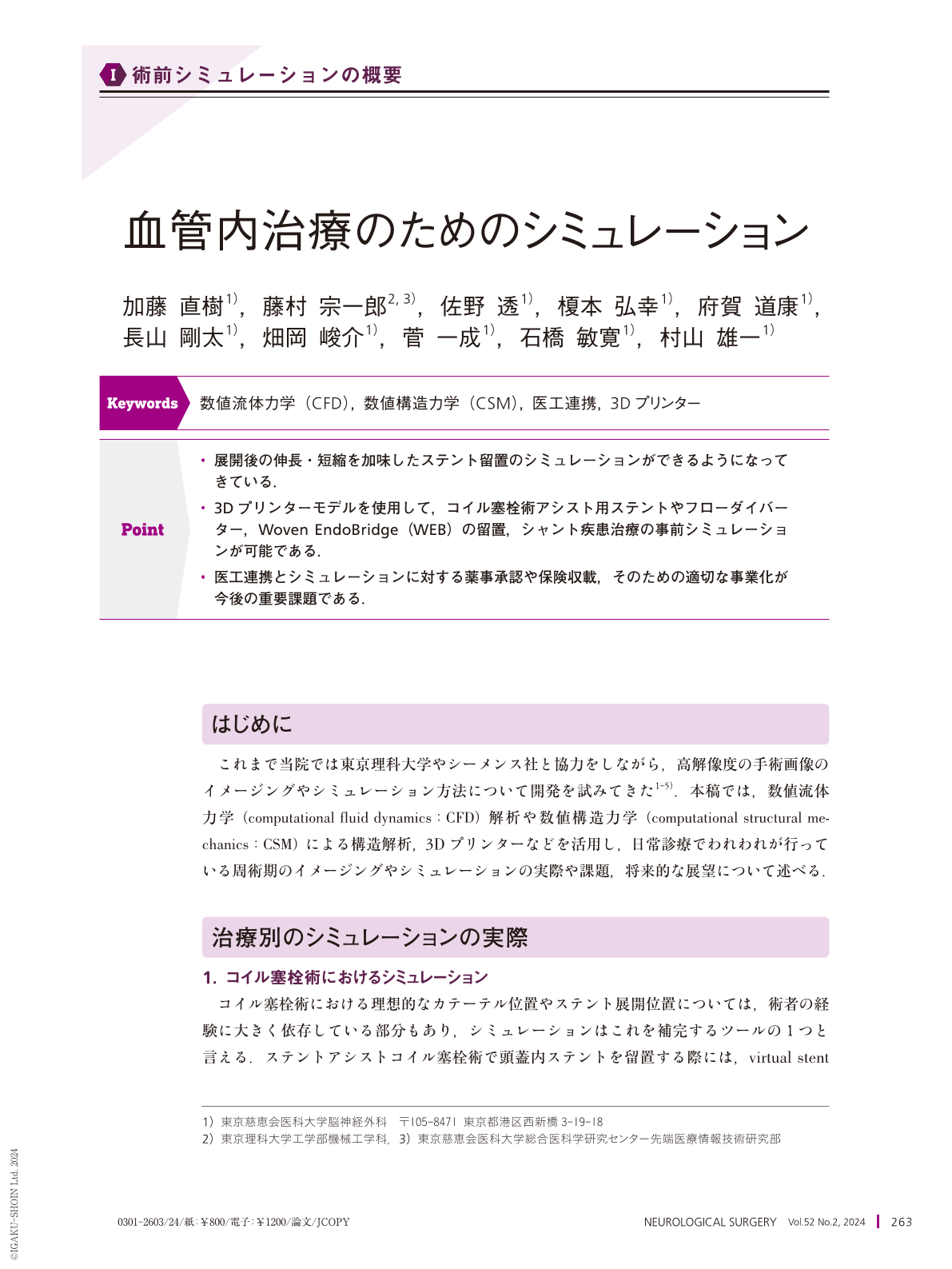
Point
・展開後の伸長・短縮を加味したステント留置のシミュレーションができるようになってきている.
・3Dプリンターモデルを使用して,コイル塞栓術アシスト用ステントやフローダイバーター,Woven EndoBridge(WEB)の留置,シャント疾患治療の事前シミュレーションが可能である.
・医工連携とシミュレーションに対する薬事承認や保険収載,そのための適切な事業化が今後の重要課題である.
With the advent of high-resolution imaging and advancements in computational fluid dynamics(CFD)and computational structural mechanics(CSM)analyses, clinical simulation of endovascular intervention has gradually become feasible. Virtual stents have become indispensable for coil embolization. For braided stents, such as those with low-profile visualized intraluminal support and flow diverters, predicting postplacement elongation and contraction is challenging; however, software development has enabled more precise treatment planning. Additionally, simulations utilizing three-dimensional(3D)printer models can enable realistic simulations of procedures such as intracranial stents and Woven EndoBridge placement. This approach is beneficial for shunt disorders such as arteriovenous malformations and dural arteriovenous fistulas, offering 3D visualization of shunt access routes and intuitive treatment strategy planning, even for beginners. Furthermore, it can be applied to procedures such as open surgical clipping and nidus resection, aiding in the selection of suitable clips and considerations for ideal resection based on nidus curvature. Simulations using CFD, CSM, and 3D printers are crucial for training surgeons and handling new devices. Harnessing medicine-engineering synergy is essential, and regulatory approval(insurance coverage)and appropriate commercialization of simulations are paramount for the future.
Copyright © 2024, Igaku-Shoin Ltd. All rights reserved.