Japanese
English
- 有料閲覧
- Abstract 文献概要
- 1ページ目 Look Inside
- 参考文献 Reference
Point
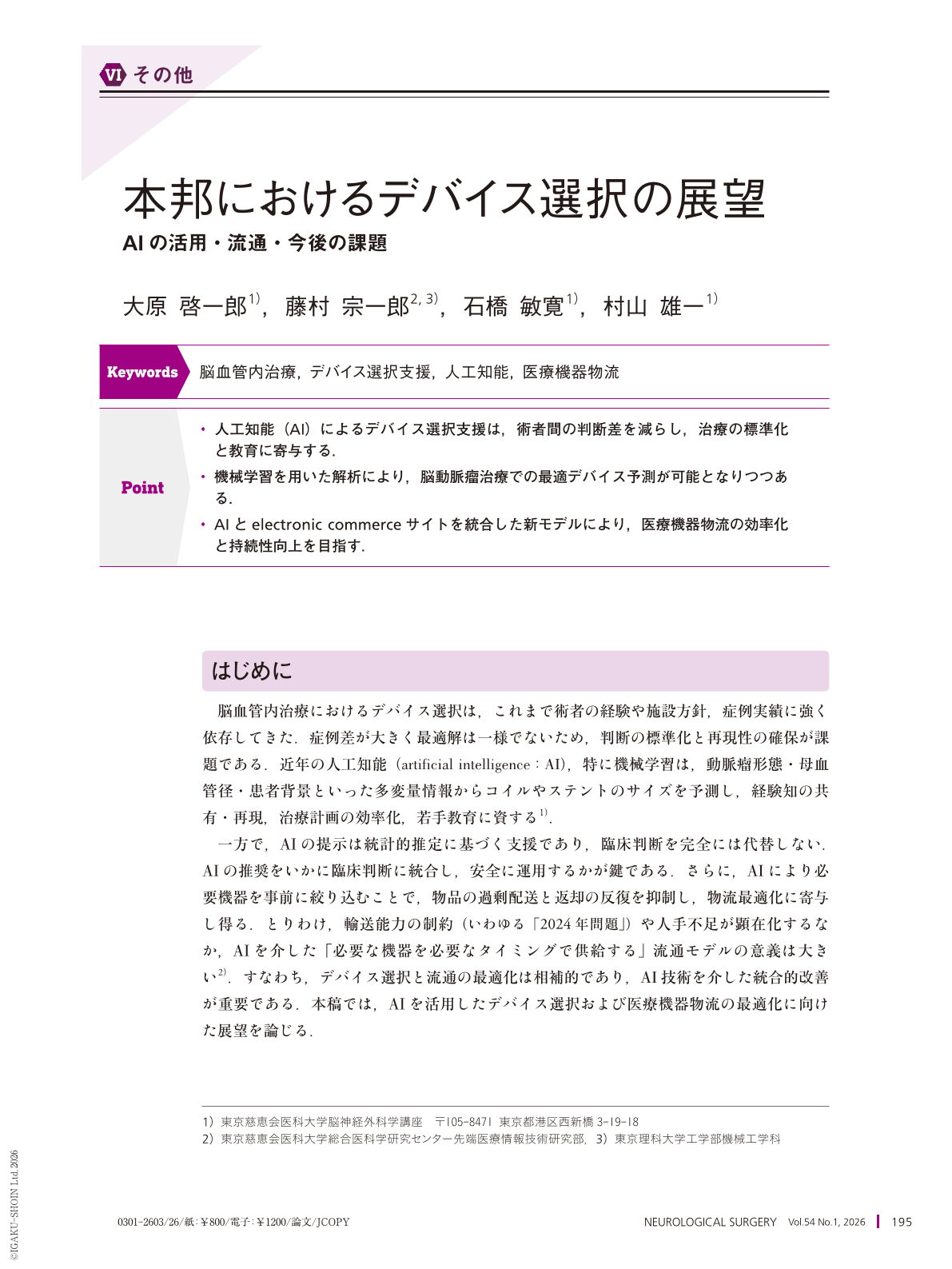
・人工知能(AI)によるデバイス選択支援は,術者間の判断差を減らし,治療の標準化と教育に寄与する.
・機械学習を用いた解析により,脳動脈瘤治療での最適デバイス予測が可能となりつつある.
・AIとelectronic commerceサイトを統合した新モデルにより,医療機器物流の効率化と持続性向上を目指す.
Device selection in neuroendovascular therapy has traditionally relied on operator experience and institutional routines, leading to variability and limited reproducibility. Advances in artificial intelligence (AI), particularly machine learning, now allow analysis of complex clinical and morphological data to support optimal device selection. AI can visualize and share tacit expert knowledge, enhance decision-making, and promote procedural standardization and education. However, its recommendations remain probabilistic, and final clinical responsibility must rest with the physician. Reliable application requires adequate multi-institutional data and improved interpretability.
In addition to supporting clinical judgment, AI-based prediction can optimize medical device logistics by forecasting necessary items and reducing excessive deliveries and returns. Such efficiency is increasingly important in the context of workforce shortages and transportation constraints, including Japan's “2024 logistics problem.” We developed an integrated system combining AI-driven device selection with an electronic ordering platform, enabling real-time information sharing among physicians, distributors, and logistics providers. In preliminary validation involving unruptured aneurysm cases, this approach reduced delivered items by 20-55% without compromising safety. AI-assisted device selection therefore represents both a clinical advancement and a pathway toward more sustainable medical supply chains, linking healthcare, industry, and logistics through data-driven optimization.
Copyright © 2026, Igaku-Shoin Ltd. All rights reserved.