Japanese
English
- 有料閲覧
PPV購入案内
1,320円 (1,200円+税10%) こちらは、876ページから883ページの文献です。購入には医書.jp本会員登録が必要です。
会員登録完了後に改めて上記「購入サイトへ」を選択してください。
または「購入サイトへ」選択後に「購入ログイン」、「新規会員登録」の順に進んでください。
会員登録について詳しくはをご確認ください。
- Abstract 文献概要
- 1ページ目 Look Inside
- 参考文献 Reference
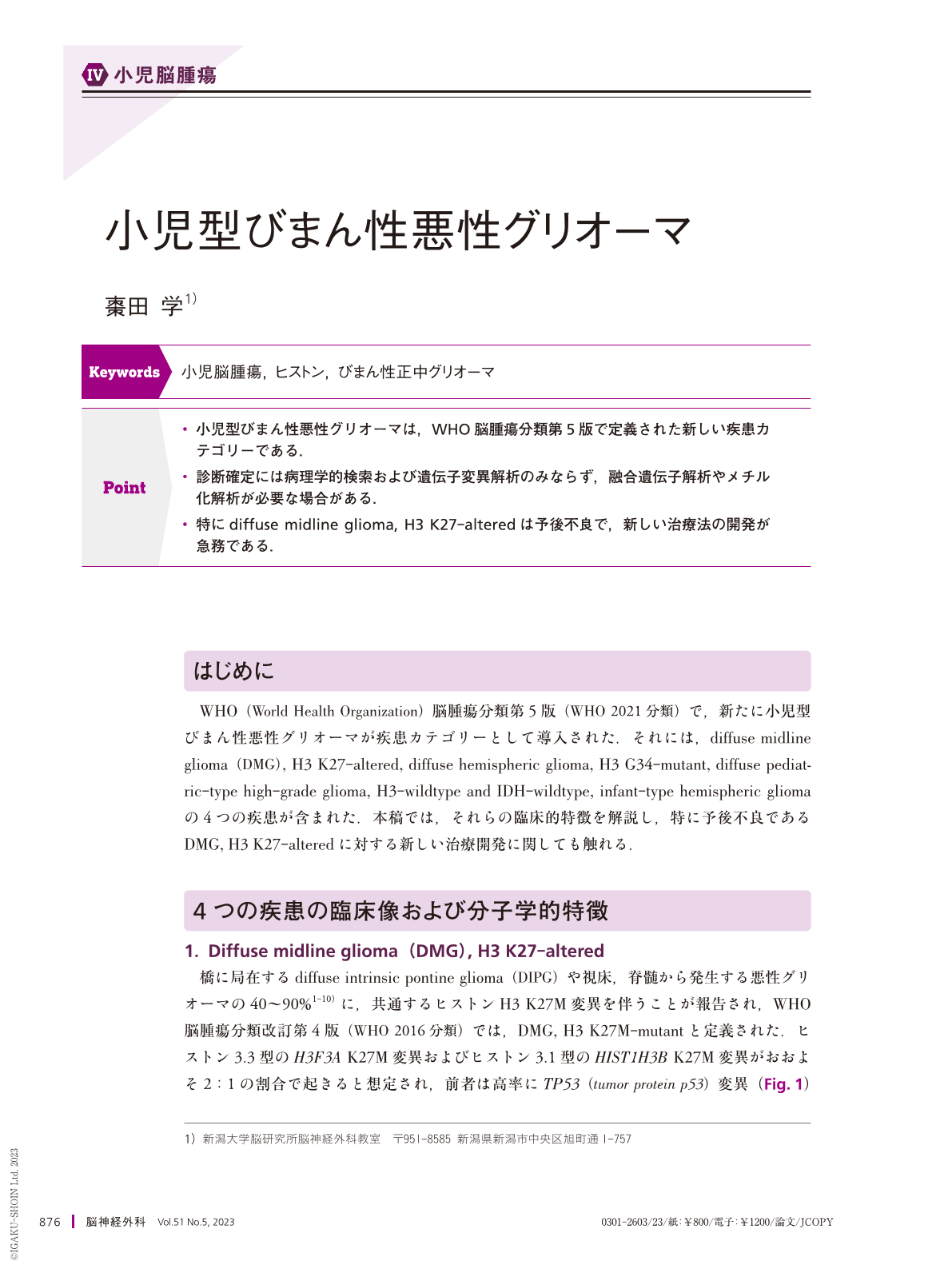
Point
・小児型びまん性悪性グリオーマは,WHO脳腫瘍分類第5版で定義された新しい疾患カテゴリーである.
・診断確定には病理学的検索および遺伝子変異解析のみならず,融合遺伝子解析やメチル化解析が必要な場合がある.
・特にdiffuse midline glioma, H3 K27-alteredは予後不良で,新しい治療法の開発が急務である.
Pediatric-type diffuse high-grade glioma is a new tumor class defined in the 5th edition of the WHO Classification of Tumors of the Central Nervous System(WHO2021). The class includes the following four tumor types: diffuse midline glioma, H3 K27-altered; diffuse hemispheric glioma, H3 G34-mutant; diffuse pediatric-type high-grade glioma, H3-wildtype and IDH-wildtype; and infant-type hemispheric glioma. Genetic detection of histone H3 mutations as well as detection of fusion genes and even methylation classifiers may be necessary to diagnose these tumors. Therefore, understanding their clinical and radiographical features is vital. Urgent establishment of new treatments is necessary for diffuse midline glioma, H3 K27-altered, as it is associated with very poor prognosis and is generally resistant to temozolomide. In this chapter, we focus on the clinical, radiographical, pathological, and molecular features of pediatric-type diffuse high-grade gliomas and introduce promising new treatments for diffuse midline glioma, H3 K27-altered.
Copyright © 2023, Igaku-Shoin Ltd. All rights reserved.