Japanese
English
- 有料閲覧
PPV購入案内
1,320円 (1,200円+税10%) こちらは、8ページから18ページの文献です。購入には医書.jp本会員登録が必要です。
会員登録完了後に改めて上記「購入サイトへ」を選択してください。
または「購入サイトへ」選択後に「購入ログイン」、「新規会員登録」の順に進んでください。
会員登録について詳しくはをご確認ください。
- Abstract 文献概要
- 1ページ目 Look Inside
- 参考文献 Reference
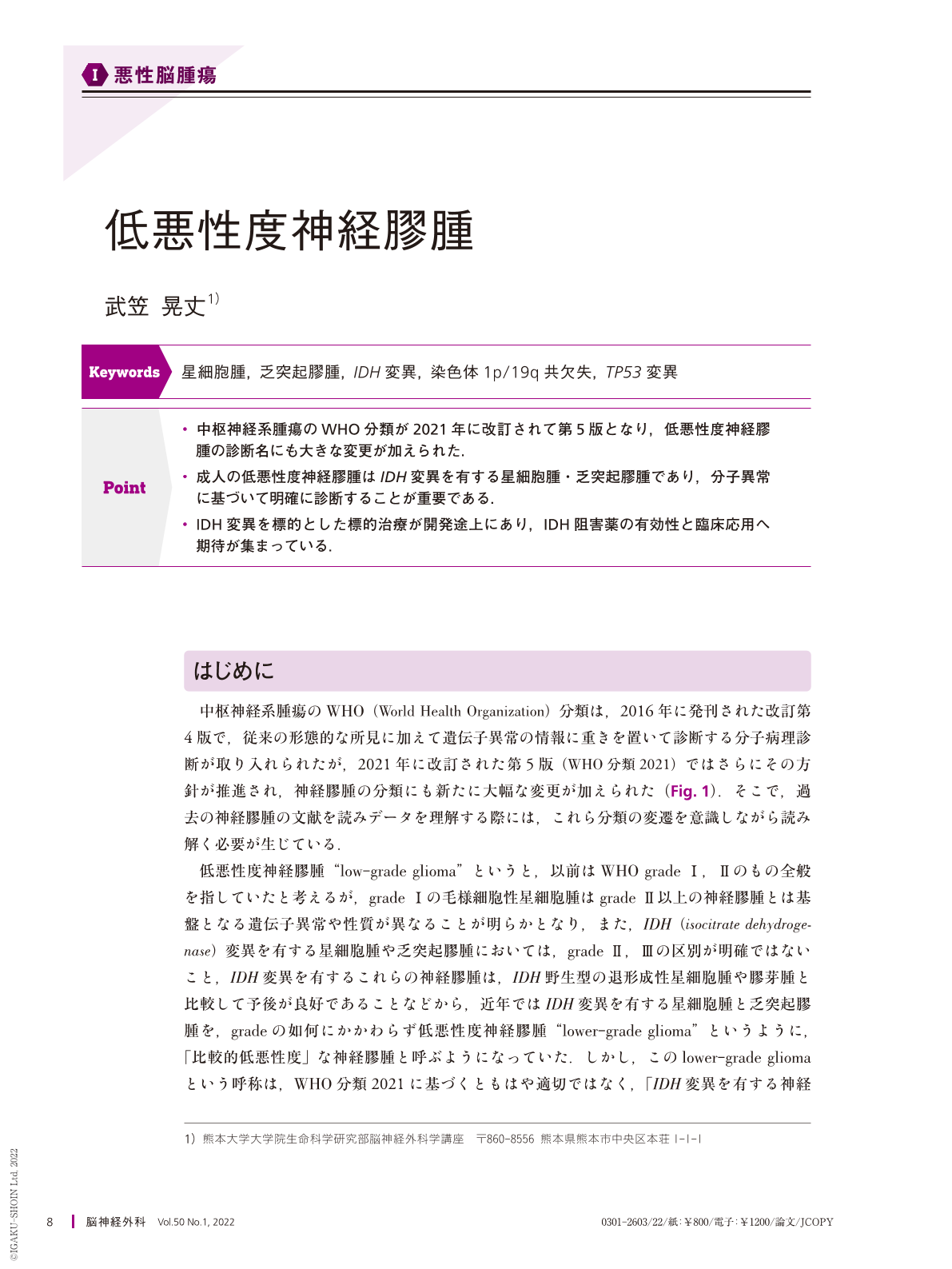
Point
・中枢神経系腫瘍のWHO分類が2021年に改訂されて第5版となり,低悪性度神経膠腫の診断名にも大きな変更が加えられた.
・成人の低悪性度神経膠腫はIDH変異を有する星細胞腫・乏突起膠腫であり,分子異常に基づいて明確に診断することが重要である.
・IDH変異を標的とした標的治療が開発途上にあり,IDH阻害薬の有効性と臨床応用へ期待が集まっている.
Several important revisions were made regarding the classification of brain tumors in the newest version(5th edition)of the WHO classification of tumours of the central nervous system published in 2021. Now, most so-called “lower-grade glioma(s)” fall into the category of IDH-mutant diffuse glioma, represented by astrocytoma and oligodendroglioma. For the diagnosis of these IDH-mutant gliomas, the determination of genetic alterations in IDH1/2, TP53, chromosome 1p/19q, ATRX, TERT promoter, and CDNK2A/B is important. Generally, in addition to the IDH mutation, astrocytomas have TP53 mutation and ATRX mutation, whereas oligodendrogliomas have 1p/19q codeletion and TERT promoter mutation. For tumor grading in the new WHO classification, astrocytomas harboring CDNK2A/B homozygous deletion can be categorized as WHO grade 4 astrocytomas, even though they do not have microvascular proliferation or necrosis. For these IDH-mutant tumors, molecular targeted therapy for IDH mutation has been under development. Several enzymatic inhibitors of IDH1/2 have been tested in clinical trials and were suggested to have some clinical effectiveness. Currently, large-scale trials are ongoing. Besides these inhibitors, other strategies for targeting IDH mutations, such as immunotherapy and therapy targeting aberrant metabolic pathways resulting from IDH mutation are also examined. These novel therapies will be beneficial to patients.
Copyright © 2022, Igaku-Shoin Ltd. All rights reserved.