Japanese
English
- 有料閲覧
PPV購入案内
1,320円 (1,200円+税10%) こちらは、597ページから607ページの文献です。購入には医書.jp本会員登録が必要です。
会員登録完了後に改めて上記「購入サイトへ」を選択してください。
または「購入サイトへ」選択後に「購入ログイン」、「新規会員登録」の順に進んでください。
会員登録について詳しくはをご確認ください。
- Abstract 文献概要
- 1ページ目 Look Inside
- 参考文献 Reference
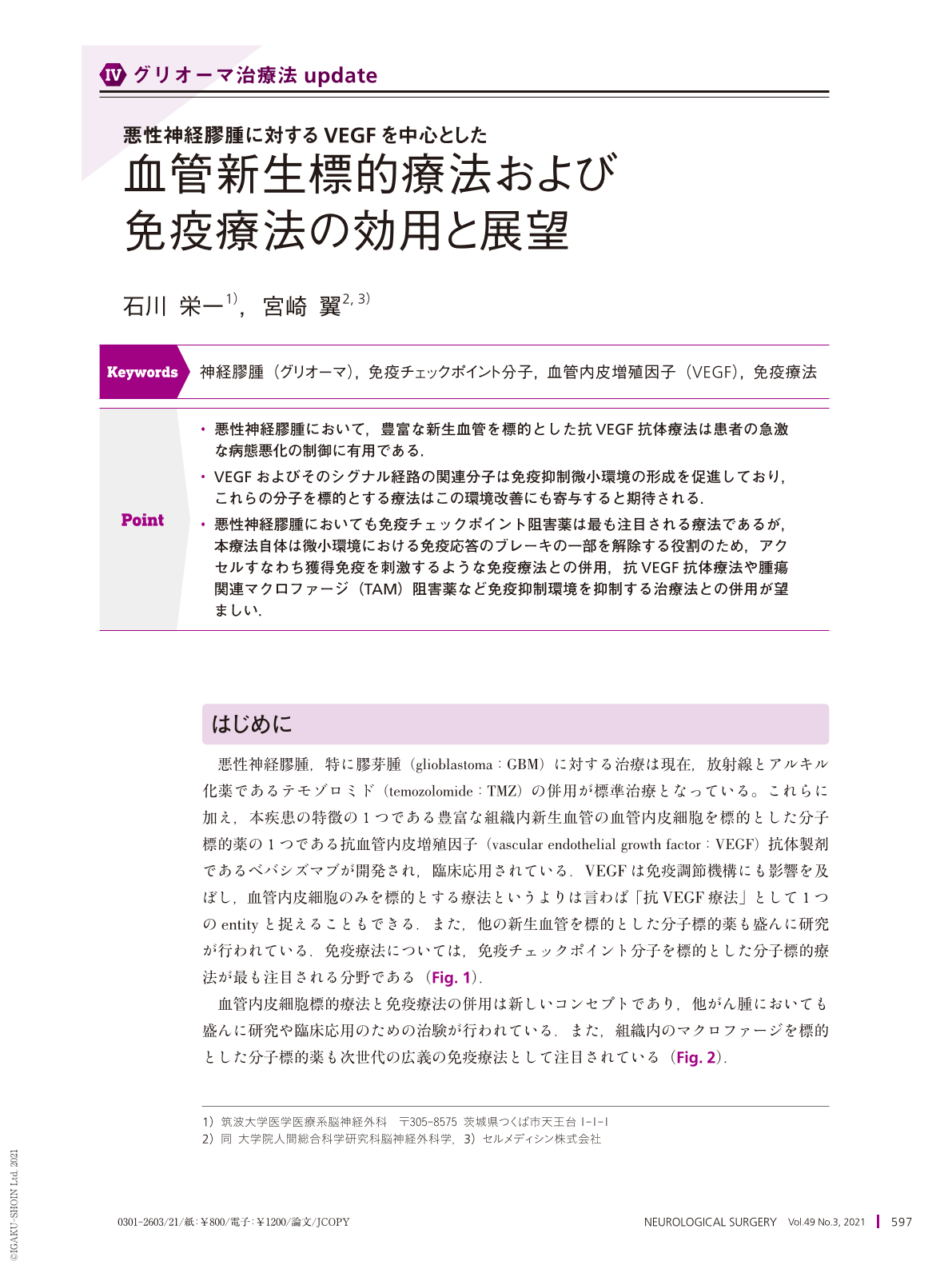
Point
・悪性神経膠腫において,豊富な新生血管を標的とした抗VEGF抗体療法は患者の急激な病態悪化の制御に有用である.
・VEGFおよびそのシグナル経路の関連分子は免疫抑制微小環境の形成を促進しており,これらの分子を標的とする療法はこの環境改善にも寄与すると期待される.
・悪性神経膠腫においても免疫チェックポイント阻害薬は最も注目される療法であるが,本療法自体は微小環境における免疫応答のブレーキの一部を解除する役割のため,アクセルすなわち獲得免疫を刺激するような免疫療法との併用,抗VEGF抗体療法や腫瘍関連マクロファージ(TAM)阻害薬など免疫抑制環境を抑制する治療法との併用が望ましい.
Elucidation of the ecological characteristics of malignant tumors has shown that angiogenesis and an immunosuppressive status in the tumor microenvironment are important for resolving treatment resistance and poor prognosis. Vascular endothelial growth factor(VEGF) and components of related signaling pathway can be targeted by anti-angiogenic therapy. Suppression of abundant angiogenesis using anti-angiogenic agents in high-grade gliomas inhibits rapid neurological deterioration in patients. Additionally, as VEGF promotes the formation of an immunosuppressive tumor microenvironment, anti-angiogenic therapy is expected to contribute to improving the immune status in the tumor microenvironment. In this review, we discuss the role of VEGF-targeted therapy and immunotherapy targeting immune checkpoint inhibitors and macrophages in high-grade gliomas. The authors also discuss the possibility of using these as combination therapies.
Copyright © 2021, Igaku-Shoin Ltd. All rights reserved.