Japanese
English
- 有料閲覧
PPV購入案内
1,320円 (1,200円+税10%) こちらは、117ページから125ページの文献です。購入には医書.jp本会員登録が必要です。
会員登録完了後に改めて上記「購入サイトへ」を選択してください。
または「購入サイトへ」選択後に「購入ログイン」、「新規会員登録」の順に進んでください。
会員登録について詳しくはをご確認ください。
- Abstract 文献概要
- 1ページ目 Look Inside
- 参考文献 Reference
Ⅰ.背 景
髄芽腫は小児悪性脳腫瘍のなかで最も多く,また小児の腫瘍死の原因として最多であり14,16),その予後は5年生存率約60%程度である.現在,手術摘出に加え化学療法および放射線療法を組み合わせることにより一部の患者の予後は改善してきてはいるが1,2,15),それでもなお標準治療として放射線治療を要するために精神発達障害,内分泌障害などの放射線晩期障害が高頻度にみられる6,7,17).そのためたとえ5年生存率が数字上改善しているようにみえても,決して患者および家族にとって満足できる治療効果を得ていないことは明らかであり,より特異的で効果的な治療法が求められている.また言うまでもなく,治療反応性の低い予後不良群に対する新規治療の開発は急務である.
古典的には髄芽腫は小脳顆粒細胞の癌化による単一疾患と信じられてきたが,近年,大規模な遺伝子解析プロジェクト11)などから,髄芽腫は単一の疾患ととらえるべきではなく,予後や治療反応性だけではなく,起源細胞や活性化されている分子シグナルも異なる,少なくとも4種類以上のサブグループ10)に分類することができることが明らかになった(Table1).これらは,2010年秋にボストンで開かれたコンセンサス会議にて協議され,現段階ではWntグループ,Shhグループ,グループ3,グループ4の4つに分類するのが妥当であると結論された.これらは,主に発現遺伝子の解析により分類されており,分子サブグループと呼ばれる18).
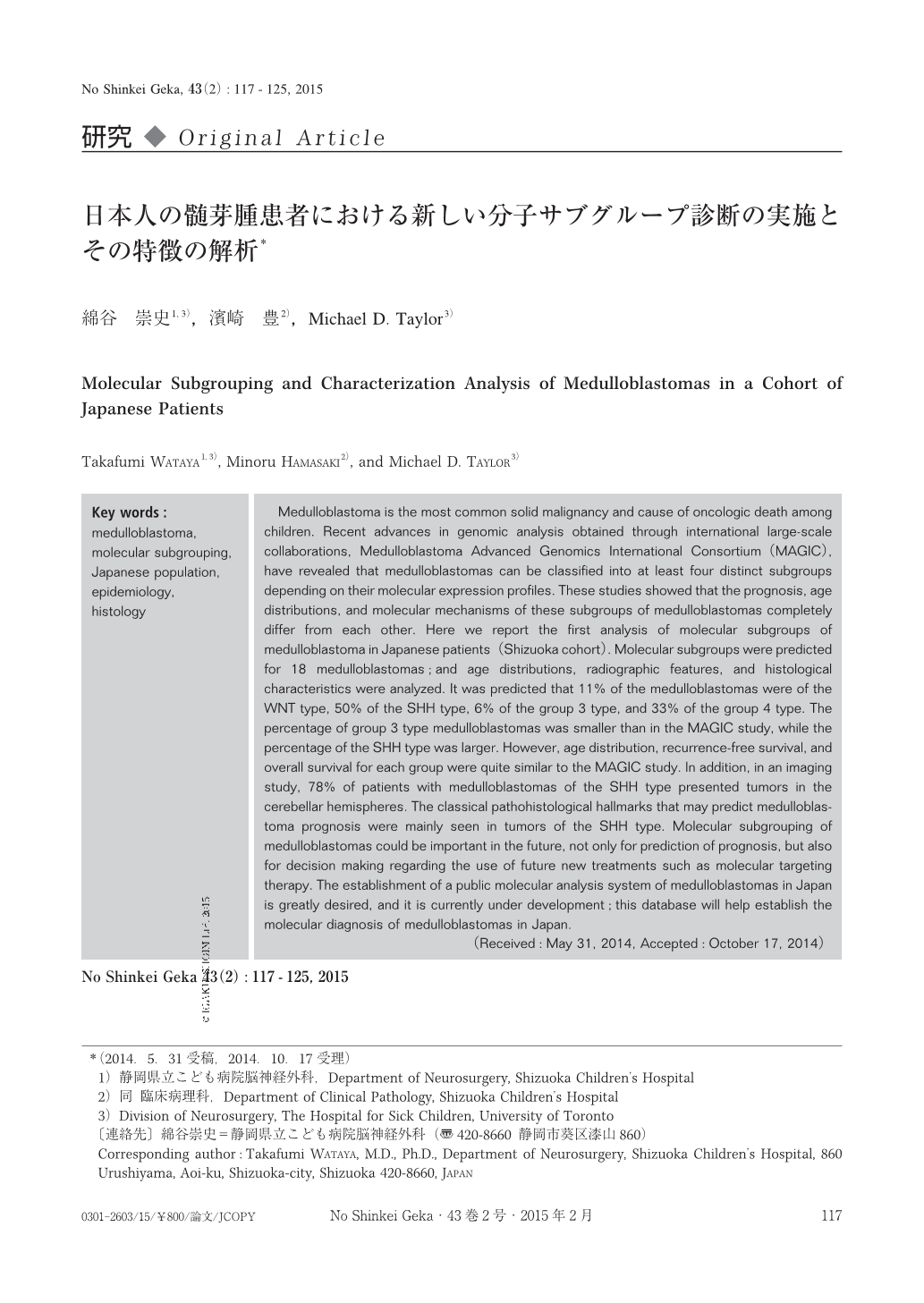
Medulloblastoma is the most common solid malignancy and cause of oncologic death among children. Recent advances in genomic analysis obtained through international large-scale collaborations, Medulloblastoma Advanced Genomics International Consortium(MAGIC), have revealed that medulloblastomas can be classified into at least four distinct subgroups depending on their molecular expression profiles. These studies showed that the prognosis, age distributions, and molecular mechanisms of these subgroups of medulloblastomas completely differ from each other. Here we report the first analysis of molecular subgroups of medulloblastoma in Japanese patients(Shizuoka cohort). Molecular subgroups were predicted for 18 medulloblastomas;and age distributions, radiographic features, and histological characteristics were analyzed. It was predicted that 11% of the medulloblastomas were of the WNT type, 50% of the SHH type, 6% of the group 3 type, and 33% of the group 4 type. The percentage of group 3 type medulloblastomas was smaller than in the MAGIC study, while the percentage of the SHH type was larger. However, age distribution, recurrence-free survival, and overall survival for each group were quite similar to the MAGIC study. In addition, in an imaging study, 78% of patients with medulloblastomas of the SHH type presented tumors in the cerebellar hemispheres. The classical pathohistological hallmarks that may predict medulloblastoma prognosis were mainly seen in tumors of the SHH type. Molecular subgrouping of medulloblastomas could be important in the future, not only for prediction of prognosis, but also for decision making regarding the use of future new treatments such as molecular targeting therapy. The establishment of a public molecular analysis system of medulloblastomas in Japan is greatly desired, and it is currently under development;this database will help establish the molecular diagnosis of medulloblastomas in Japan.
Copyright © 2015, Igaku-Shoin Ltd. All rights reserved.