Japanese
English
- 有料閲覧
PPV購入案内
1,320円 (1,200円+税10%) こちらは、731ページから737ページの文献です。購入には医書.jp本会員登録が必要です。
会員登録完了後に改めて上記「購入サイトへ」を選択してください。
または「購入サイトへ」選択後に「購入ログイン」、「新規会員登録」の順に進んでください。
会員登録について詳しくはをご確認ください。
- Abstract 文献概要
- 1ページ目 Look Inside
I.はじめに
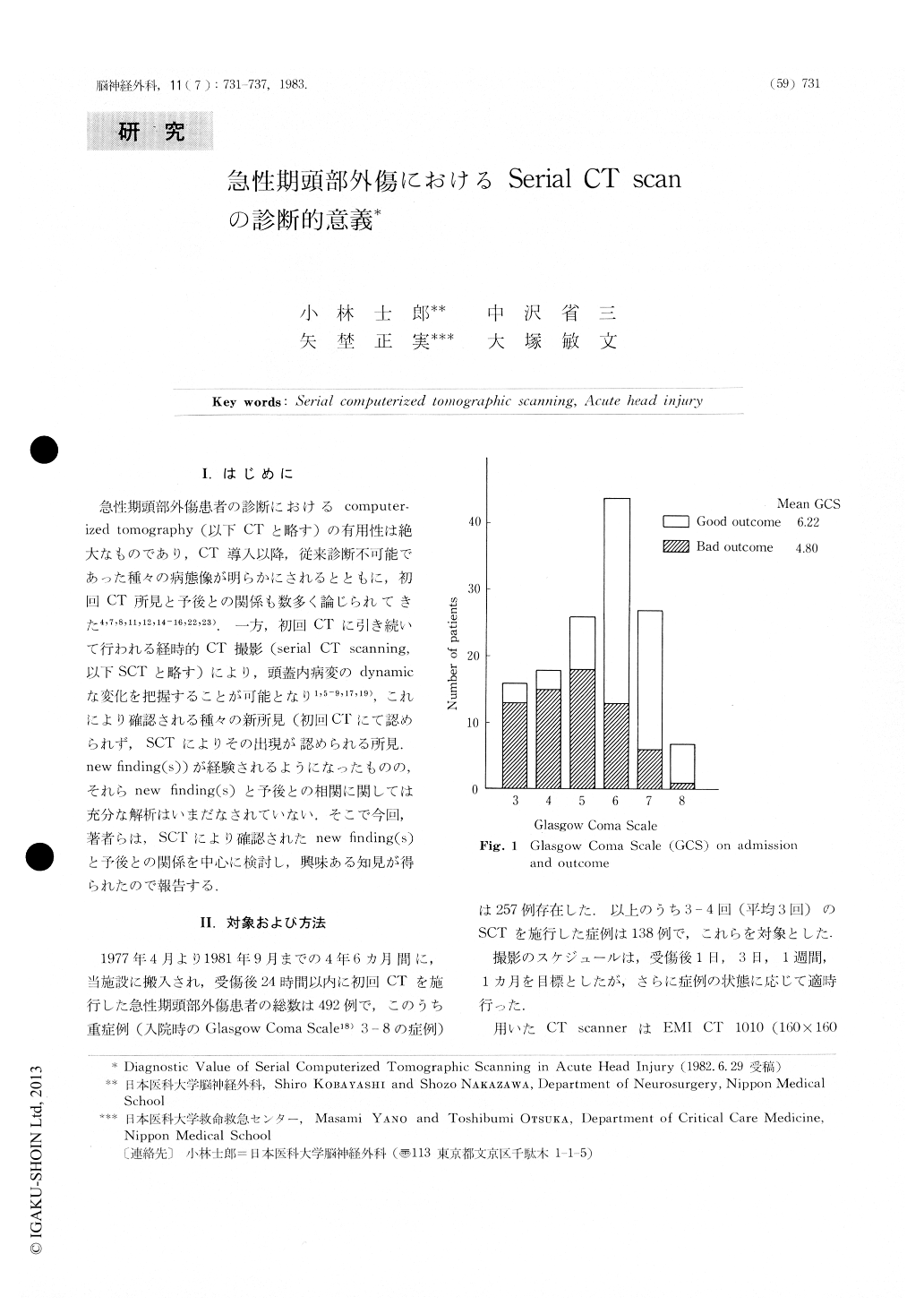
急性期頭部外傷患者の診断におけるcomputer-ized tomography(以下CTと略す)の有用性は絶大なものであり,CT導入以降,従来診断不可能であった種々の病態像が明らかにされるとともに,初回CT所見と予後との関係も数多く論じられてきた4,7,8,11,12,14-16,22,23).一方,初回CTに引き続いて行われる経時的CT撮影(serial CT scanning,以下SCTと略す)により,頭蓋内病変のdynamicな変化を把握することが可能となり1,5-9,17,19),これにより確認される種々の新所見(初回CTにて認められず,SCTによりその出現が認められる所見.new finding(s))が経験されるようになったものの,それらnew finding(s)と予後との相関に関しては充分な解析はいまだなされていない,そこで今回,著者らは,SCTにより確認されたnew finding(s)と予後との関係を中心に検討し,興味ある知見が得られたので報告する.
Nowadays computerized tomography (CT) is widelyused in the diagnosis and care of patients with severehead injuries because of its safety, speed, and abilityto allow visualization of the entire intracranial area.In particular, serial CT scanning (SCT), performedseveral times after the initial CT, has confirmed thedynamics of morphological changes in severe headinjuries, hitherto only revealed by surgery or autopsy.
Several new findings, not visualized on the initialCT but appearing on subsequent ones have beenreported, mainly of the so-called "delayed traumaticintracerebral hematomas."
Copyright © 1983, Igaku-Shoin Ltd. All rights reserved.