Japanese
English
- 有料閲覧
PPV購入案内
1,320円 (1,200円+税10%) こちらは、751ページから768ページの文献です。購入には医書.jp本会員登録が必要です。
会員登録完了後に改めて上記「購入サイトへ」を選択してください。
または「購入サイトへ」選択後に「購入ログイン」、「新規会員登録」の順に進んでください。
会員登録について詳しくはをご確認ください。
- Abstract 文献概要
- 1ページ目 Look Inside
- 参考文献 Reference
Ⅰ.はじめに
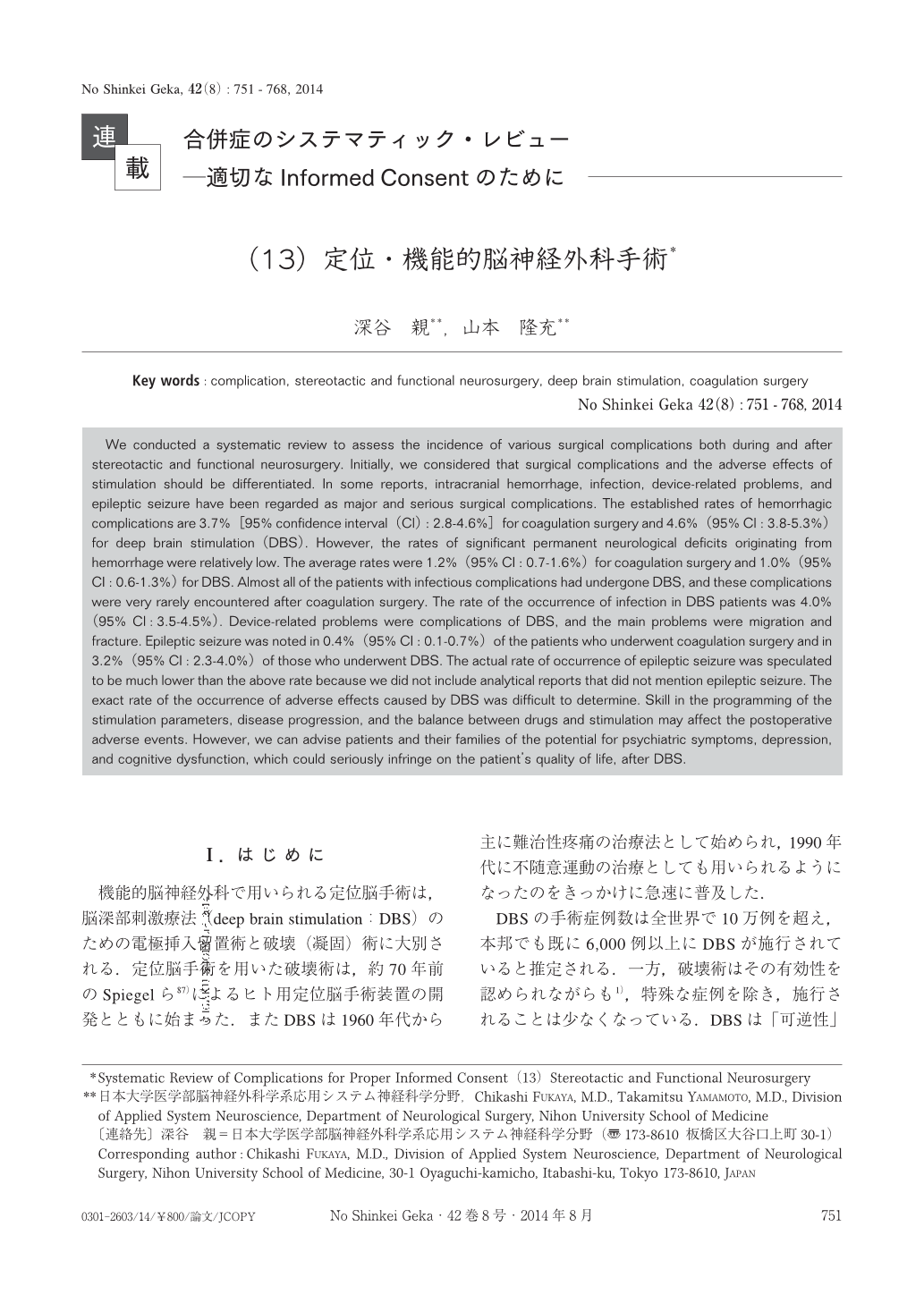
機能的脳神経外科で用いられる定位脳手術は,脳深部刺激療法(deep brain stimulation:DBS)のための電極挿入留置術と破壊(凝固)術に大別される.定位脳手術を用いた破壊術は,約70年前のSpiegelら87)によるヒト用定位脳手術装置の開発とともに始まった.またDBSは1960年代から主に難治性疼痛の治療法として始められ,1990年代に不随意運動の治療としても用いられるようになったのをきっかけに急速に普及した.
DBSの手術症例数は全世界で10万例を超え,本邦でも既に6,000例以上にDBSが施行されていると推定される.一方,破壊術はその有効性を認められながらも1),特殊な症例を除き,施行されることは少なくなっている.DBSは「可逆性」と「調節性」という外科的治療には稀有な特長をもつため,破壊術よりも優先的に選択されることが多くなった.ガンマナイフや超音波を用いた定位破壊術61)の普及により,観血的な定位脳手術による破壊術は今後さらに症例数を減じていくことが予想される.
本稿では,DBSと破壊術の両方の合併症を取り上げるが,上述の理由からDBSにより重きを置く.DBSは脳神経外科手術の中では特殊性の高いものであるが,手術手技そのものは比較的均一で術者間のばらつきが少ないため,合併症に関するデータの臨床的価値は高いと考えられる.ただし,これはいわゆる「手術手技に伴う合併症」に関してである.
しばしば混同されるのが「手術手技に伴う合併症」と「刺激の副作用として生じる合併症」である.前者には,電極刺入時の頭蓋内出血や手術創の感染などが含まれる.後者には,刺激強度を上げていくことによって生じる眼球運動障害,異常感覚,痙縮や精神症状などが含まれるが,これらは刺激条件の調整により対応可能なことが多い.
つまり刺激副作用の発生には,調整が適切か否かにかなりの部分が依存する.したがって手術手技に直接関係する合併症(手術合併症)と刺激の副作用として発生する合併症(刺激副作用)は,明確に区別して考えるべきである.本稿では,主に手術合併症について述べ,明確な発生率を示すことが難しい刺激副作用に関しては考察で述べるにとどめる.
We conducted a systematic review to assess the incidence of various surgical complications both during and after stereotactic and functional neurosurgery. Initially, we considered that surgical complications and the adverse effects of stimulation should be differentiated. In some reports, intracranial hemorrhage, infection, device-related problems, and epileptic seizure have been regarded as major and serious surgical complications. The established rates of hemorrhagic complications are 3.7%[95% confidence interval(CI):2.8-4.6%]for coagulation surgery and 4.6%(95% CI:3.8-5.3%)for deep brain stimulation(DBS). However, the rates of significant permanent neurological deficits originating from hemorrhage were relatively low. The average rates were 1.2%(95% CI:0.7-1.6%)for coagulation surgery and 1.0%(95% CI:0.6-1.3%)for DBS. Almost all of the patients with infectious complications had undergone DBS, and these complications were very rarely encountered after coagulation surgery. The rate of the occurrence of infection in DBS patients was 4.0%(95% CI:3.5-4.5%). Device-related problems were complications of DBS, and the main problems were migration and fracture. Epileptic seizure was noted in 0.4%(95% CI:0.1-0.7%)of the patients who underwent coagulation surgery and in 3.2%(95% CI:2.3-4.0%)of those who underwent DBS. The actual rate of occurrence of epileptic seizure was speculated to be much lower than the above rate because we did not include analytical reports that did not mention epileptic seizure. The exact rate of the occurrence of adverse effects caused by DBS was difficult to determine. Skill in the programming of the stimulation parameters, disease progression, and the balance between drugs and stimulation may affect the postoperative adverse events. However, we can advise patients and their families of the potential for psychiatric symptoms, depression, and cognitive dysfunction, which could seriously infringe on the patient's quality of life, after DBS.
Copyright © 2014, Igaku-Shoin Ltd. All rights reserved.