Japanese
English
- 有料閲覧
PPV購入案内
1,320円 (1,200円+税10%) こちらは、627ページから634ページの文献です。購入には医書.jp本会員登録が必要です。
会員登録完了後に改めて上記「購入サイトへ」を選択してください。
または「購入サイトへ」選択後に「購入ログイン」、「新規会員登録」の順に進んでください。
会員登録について詳しくはをご確認ください。
- Abstract 文献概要
- 1ページ目 Look Inside
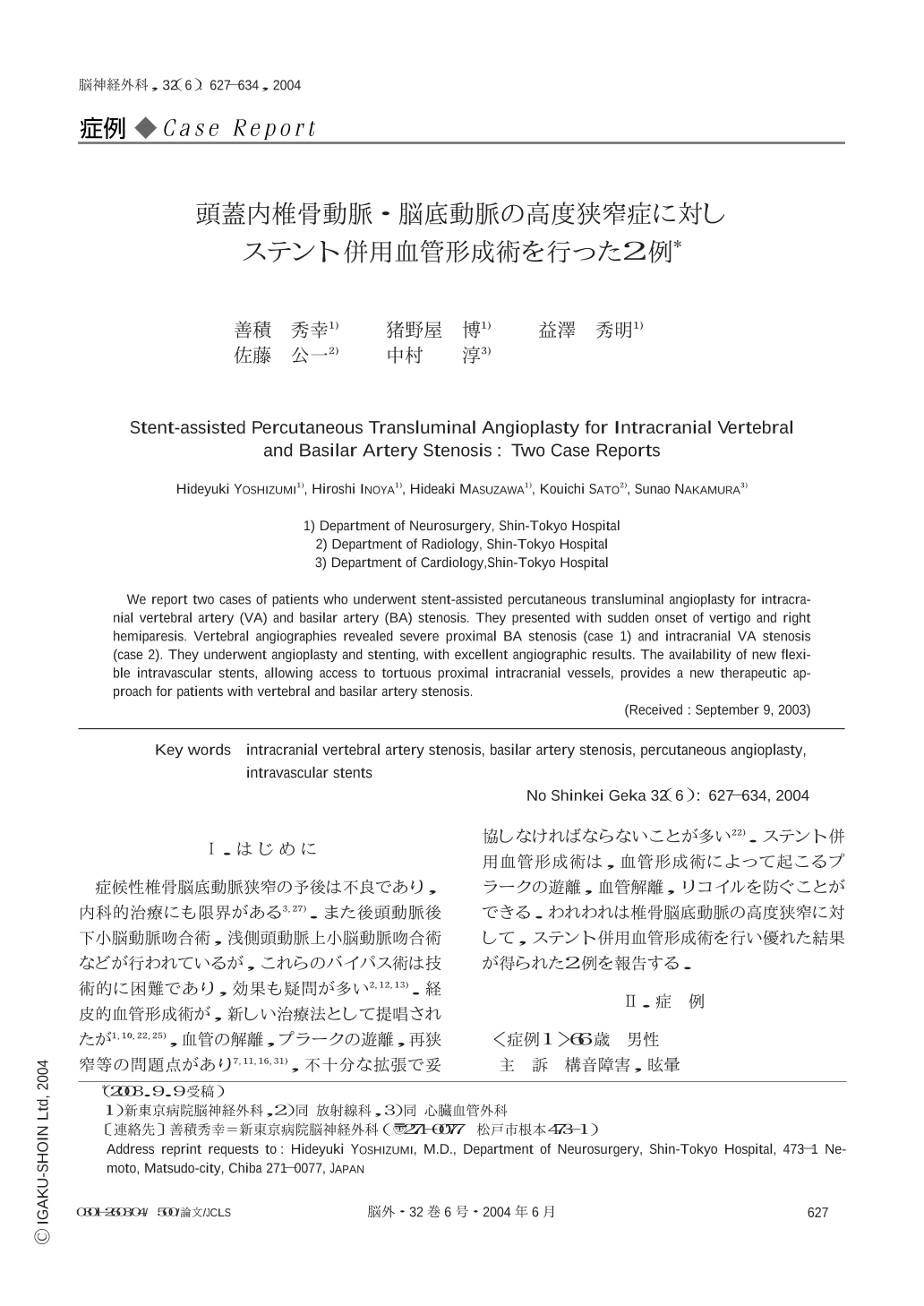
Ⅰ.はじめに
症候性椎骨脳底動脈狭窄の予後は不良であり,内科的治療にも限界がある3,27).また後頭動脈後下小脳動脈吻合術,浅側頭動脈上小脳動脈吻合術などが行われているが,これらのバイパス術は技術的に困難であり,効果も疑問が多い2,12,13).経皮的血管形成術が,新しい治療法として提唱されたが1,10,22,25),血管の解離,プラークの遊離,再狭窄等の問題点があり7,11,16,31),不十分な拡張で妥協しなければならないことが多い22).ステント併用血管形成術は,血管形成術によって起こるプラークの遊離,血管解離,リコイルを防ぐことができる.われわれは椎骨脳底動脈の高度狭窄に対して,ステント併用血管形成術を行い優れた結果が得られた2例を報告する.
We report two cases of patients who underwent stent-assisted percutaneous transluminal angioplasty for intracranial vertebral artery (VA) and basilar artery (BA) stenosis. They presented with sudden onset of vertigo and right hemiparesis. Vertebral angiographies revealed severe proximal BA stenosis (case 1) and intracranial VA stenosis (case 2). They underwent angioplasty and stenting,with excellent angiographic results. The availability of new flexible intravascular stents,allowing access to tortuous proximal intracranial vessels,provides a new therapeutic approach for patients with vertebral and basilar artery stenosis.
Copyright © 2004, Igaku-Shoin Ltd. All rights reserved.