Japanese
English
- 有料閲覧
PPV購入案内
1,320円 (1,200円+税10%) こちらは、1073ページから1080ページの文献です。購入には医書.jp本会員登録が必要です。
会員登録完了後に改めて上記「購入サイトへ」を選択してください。
または「購入サイトへ」選択後に「購入ログイン」、「新規会員登録」の順に進んでください。
会員登録について詳しくはをご確認ください。
- Abstract 文献概要
- 1ページ目 Look Inside
- 参考文献 Reference
Ⅰ.はじめに
現在,神経外傷の病態は画像所見により形態的に分類されているが,脳損傷がどの程度なのかを定量的に評価するのは困難である.近年,神経損傷のマーカーとして,血清S-100B蛋白およびneuron specific enolase(NSE)の有用性が注目されている1,3-5,8-13,17).S-100B蛋白はグリア細胞,NSEは神経細胞に存在するため,神経特異性が比較的高いとされる1,3-5,8-13,17).本研究は,頭部外傷後,急性期の血清S-100B蛋白,NSEが神経学的重症度の指標,および転帰の予測因子となり得るか,また,画像上の診断との関連を検討し,病態を解析することを目的とした.
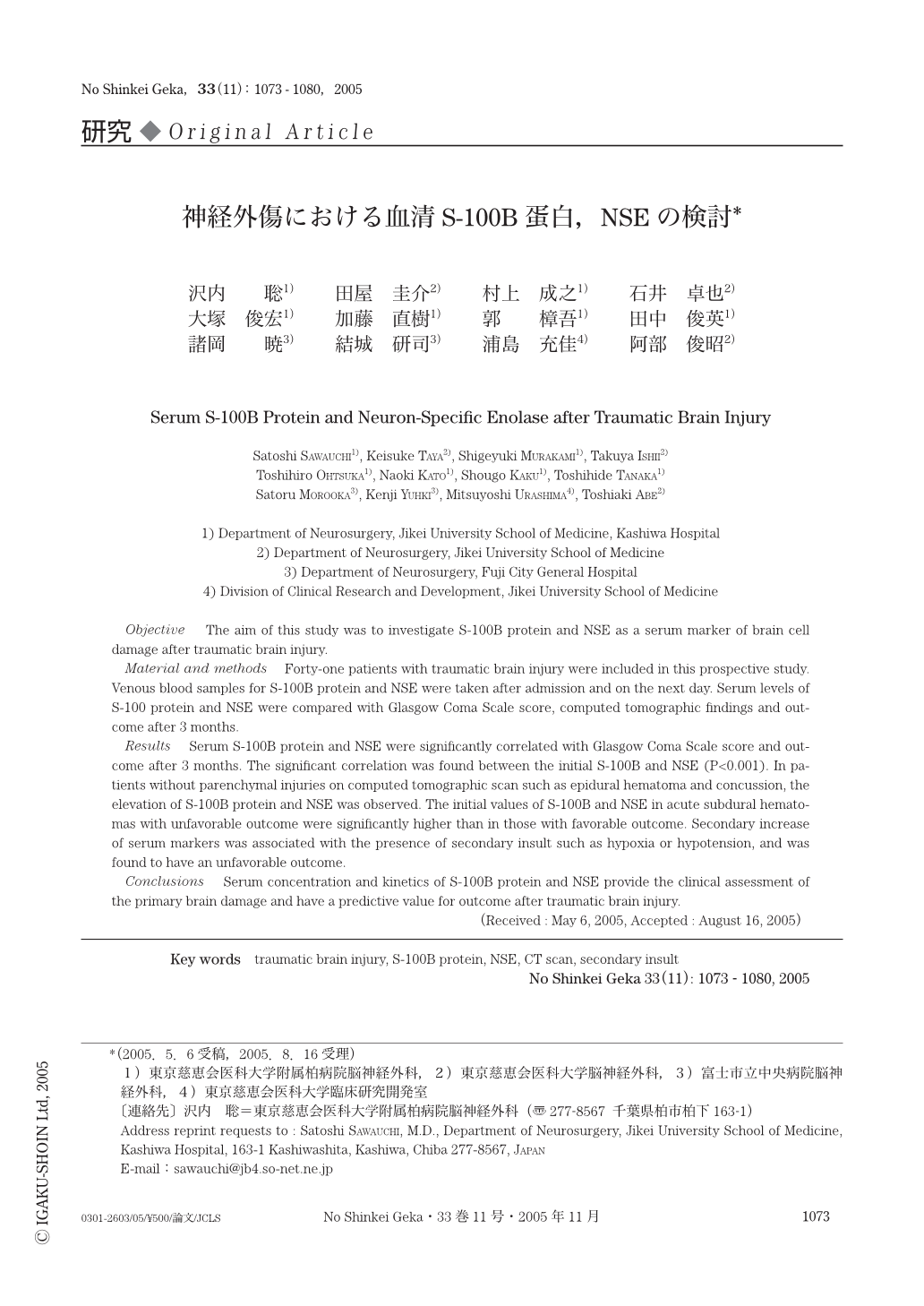
Objective The aim of this study was to investigate S-100B protein and NSE as a serum marker of brain cell damage after traumatic brain injury.
Material and methods Forty-one patients with traumatic brain injury were included in this prospective study. Venous blood samples for S-100B protein and NSE were taken after admission and on the next day. Serum levels of S-100 protein and NSE were compared with Glasgow Coma Scale score,computed tomographic findings and outcome after 3 months.
Results Serum S-100B protein and NSE were significantly correlated with Glasgow Coma Scale score and outcome after 3 months. The significant correlation was found between the initial S-100B and NSE (P<0.001). In patients without parenchymal injuries on computed tomographic scan such as epidural hematoma and concussion,the elevation of S-100B protein and NSE was observed. The initial values of S-100B and NSE in acute subdural hematomas with unfavorable outcome were significantly higher than in those with favorable outcome. Secondary increase of serum markers was associated with the presence of secondary insult such as hypoxia or hypotension,and was found to have an unfavorable outcome.
Conclusions Serum concentration and kinetics of S-100B protein and NSE provide the clinical assessment of the primary brain damage and have a predictive value for outcome after traumatic brain injury.
Copyright © 2005, Igaku-Shoin Ltd. All rights reserved.