Japanese
English
- 有料閲覧
PPV購入案内
1,320円 (1,200円+税10%) こちらは、412ページから422ページの文献です。購入には医書.jp本会員登録が必要です。
会員登録完了後に改めて上記「購入サイトへ」を選択してください。
または「購入サイトへ」選択後に「購入ログイン」、「新規会員登録」の順に進んでください。
会員登録について詳しくはをご確認ください。
- Abstract 文献概要
- 1ページ目 Look Inside
I.はじめに
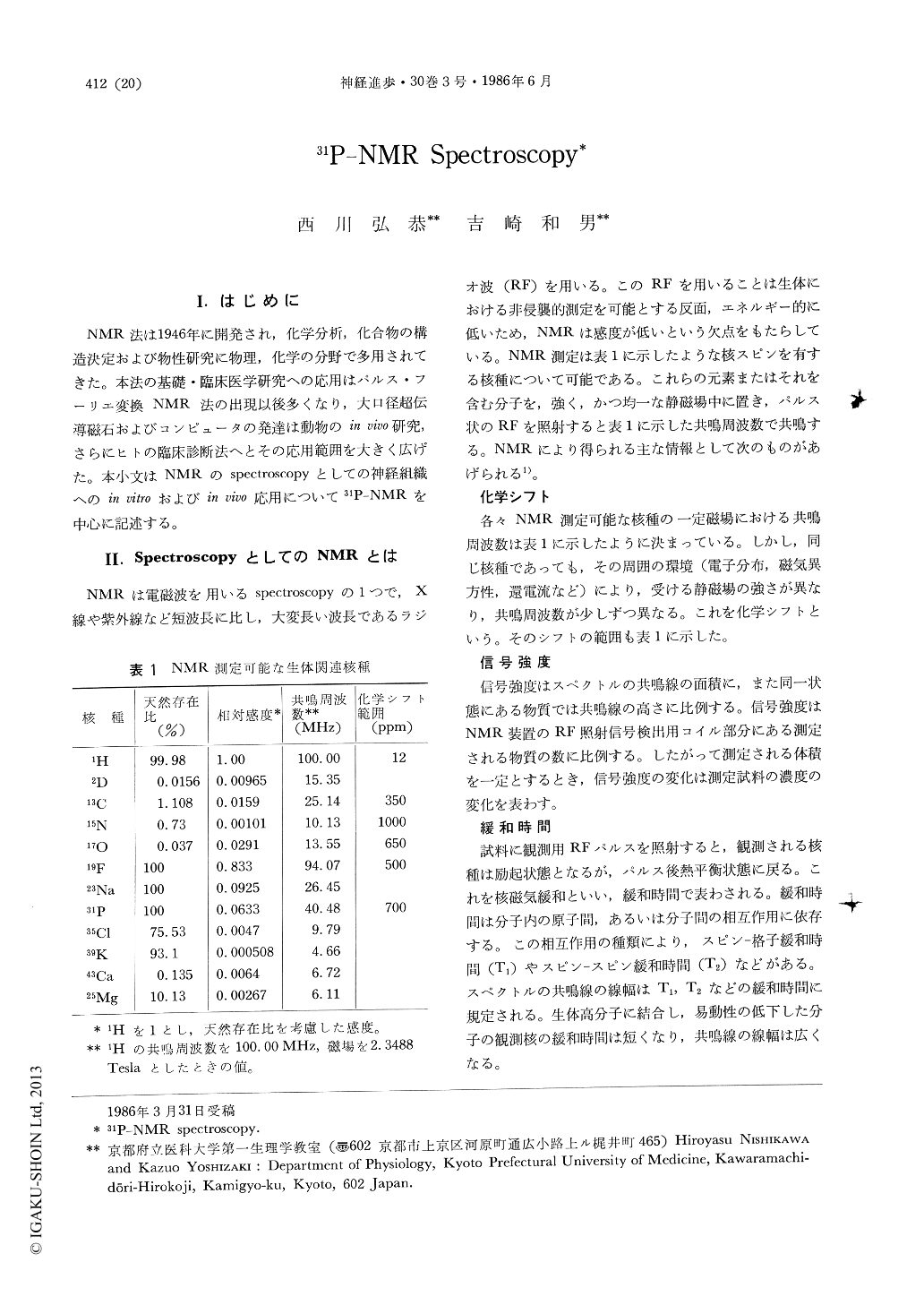
NMR法は1946年に開発され,化学分析,化合物の構造決定および物性研究に物理,化学の分野で多用されてきた。本法の基礎・臨床医学研究への応用はパルス・フーリエ変換NMR法の出現以後多くなり,大口径超伝導磁石およびコンピュータの発達は動物のin vivo研究,さらにヒトの臨床診断法へとその応用範囲を大きく広げた。本小文はNMRのspectroscopyとしての神経組織へのin vitroおよびin vivo応用について31P-NMRを中心に記述する。
Since its discovery 1946, NMR has been used for studies on molecular structure and motion in chemistry and physics. Biological and clinical applications of NMR have increased remarkably with the developments of palse FT technique and wide bore superconducting magnet. In this review we introduce the general principles of NMR, in vitro and in vivo applications of 31P-NMR spectroscopy to nervous system and briefly those of other nuclei (23Na, 19F and 1H).
NMR is a spectroscopy using electromagnetic wave at a radio frequency (RF), and a strong, homogenous and stable magnetic field. NMR using RF wave has the advantage of being a non-invasive method for biological system and the disadvantage of having a low sensitivity. Information obtained by NMR is on chemical shift, signal intensity and relaxation time. Nuclei with nuclear spin quantum numbers can be observed by NMR. The biologically important nuclei with high relative sensitivities are 1H, and 23Na and 31p.
Copyright © 1986, Igaku-Shoin Ltd. All rights reserved.