Japanese
English
- 有料閲覧
PPV購入案内
1,320円 (1,200円+税10%) こちらは、269ページから281ページの文献です。購入には医書.jp本会員登録が必要です。
会員登録完了後に改めて上記「購入サイトへ」を選択してください。
または「購入サイトへ」選択後に「購入ログイン」、「新規会員登録」の順に進んでください。
会員登録について詳しくはをご確認ください。
- Abstract 文献概要
- 1ページ目 Look Inside
I.はじめに
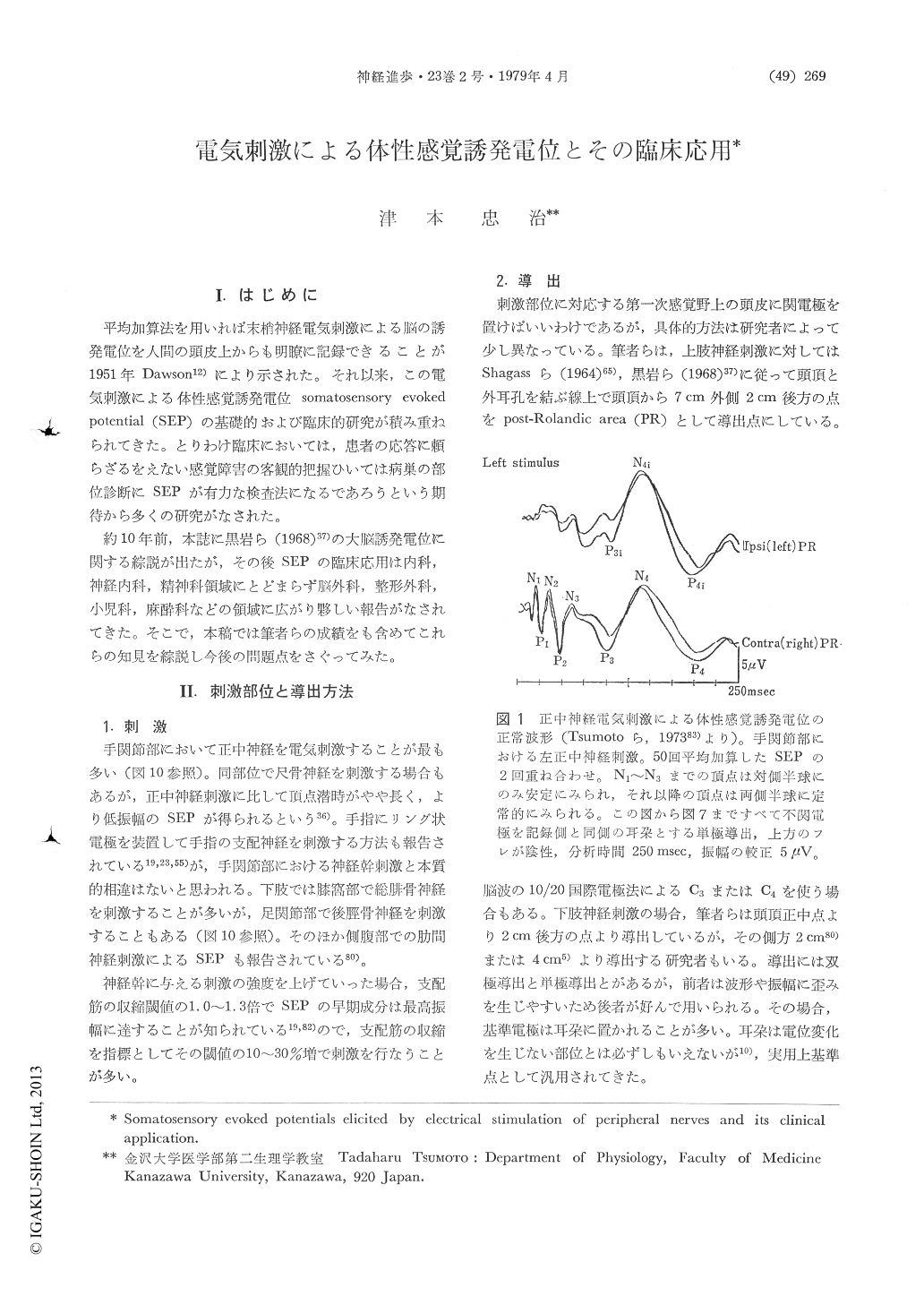
平均加算法を用いれば末梢神経電気刺激による脳の誘発電位を人間の頭皮上からも明瞭に記録できることが1951年Dawson12)により示された。それ以来,この電気刺激による体性感覚誘発電位somatosensory evokedpotential(SEP)の基礎的および臨床的研究が積み重ねられてきた。とりわけ臨床においては,患者の応答に頼らざるをえない感覚障害の客観的把握ひいては病巣の部位診断にSEPが有力な検査法になるであろうという期待から多くの研究がなされた。
約10年前,本誌に黒岩ら(1968)37)の大脳誘発電位に関する綜説が出たが,その後SEPの臨床応用は内科,神経内科,精神科領域にとどまらず脳外科,整形外科,小児科,麻酔科などの領域に広がり夥しい報告がなされてきた。そこで,本稿では筆者らの成績をも含めてこれらの知見を綜説し今後の問題点をさぐってみた。
Abstract
Clinical studies on somatosensory evoked poten-tials (SEP) elicited by electrical stimulation of the peripheral nerves were reviewed. The results of these studies and clinical usefulness of SEP recordings were briefly summarized as follows; 1. Changes in SEP are related to disturbances in the somatosensory afferent pathways and cerebral cortex, particularly in the dorsal column-medial lemniscal system and primary somatosensory cortex. Thus, SEP may give us an important information on whether or not the lesions in a patient are located in the afferent pathways, and further on where they are located.
Copyright © 1979, Igaku-Shoin Ltd. All rights reserved.