Japanese
English
- 有料閲覧
PPV購入案内
1,320円 (1,200円+税10%) こちらは、965ページから973ページの文献です。購入には医書.jp本会員登録が必要です。
会員登録完了後に改めて上記「購入サイトへ」を選択してください。
または「購入サイトへ」選択後に「購入ログイン」、「新規会員登録」の順に進んでください。
会員登録について詳しくはをご確認ください。
- Abstract 文献概要
- 1ページ目 Look Inside
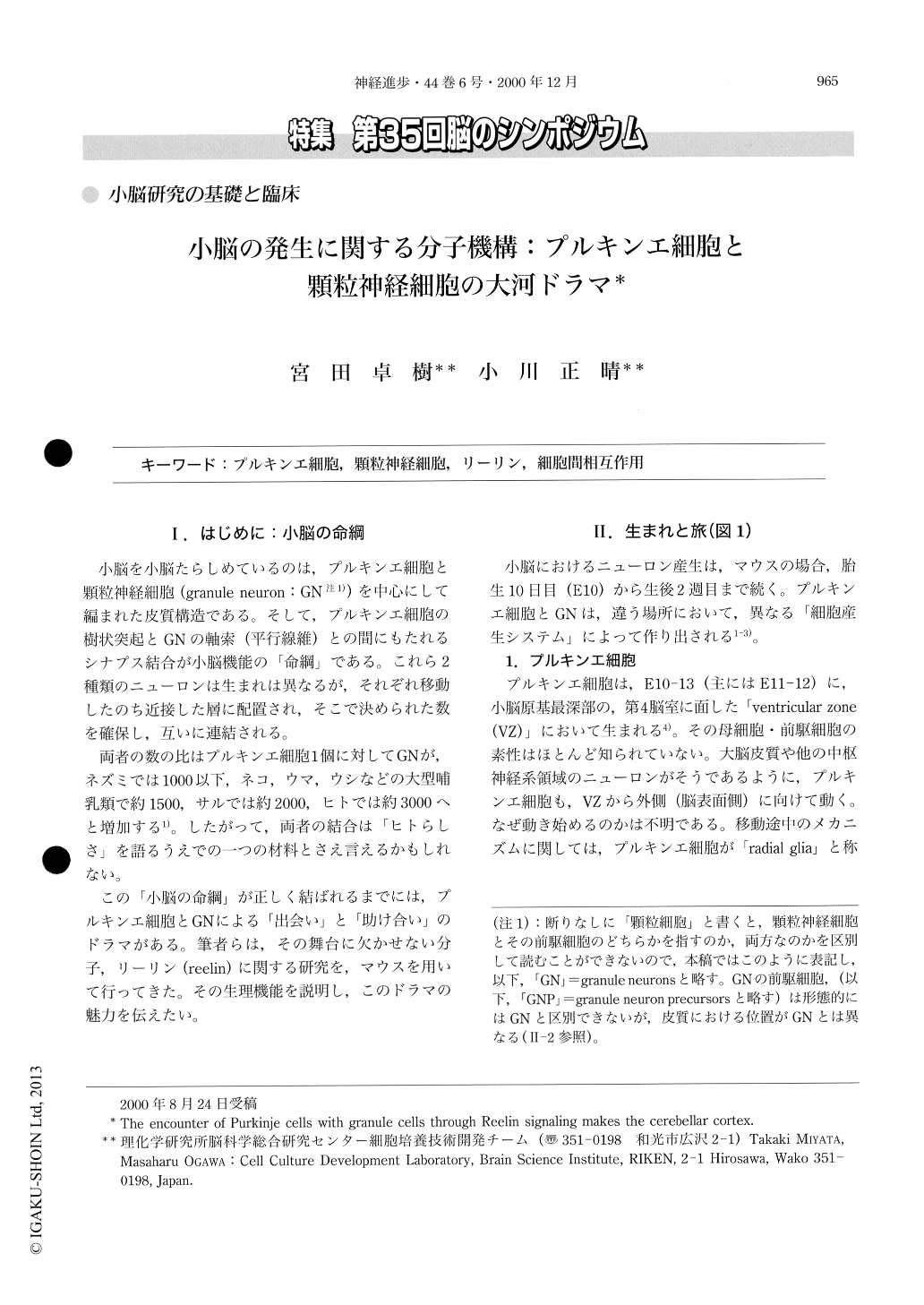
I.はじめに:小脳の命綱
小脳を小脳たらしめているのは,プルキンエ細胞と顆粒神経細胞(granule neuron:GN注1))を中心にして編まれた皮質構造である。そして,プルキンエ細胞の樹状突起とGNの軸索(平行線維)との間にもたれるシナプス結合が小脳機能の「命綱」である。これら2種類のニューロンは生まれは異なるが,それぞれ移動したのち近接した層に配置され,そこで決められた数を確保し,互いに連結される。
両者の数の比はプルキンエ細胞1個に対してGNが,ネズミでは1000以下,ネコ,ウマ,ウシなどの大型哺乳類で約1500,サルでは約2000,ヒトでは約3000へと増加する1)。したがって,両者の結合は「ヒトらしさ」を語るうえでの一つの材料とさえ言えるかもしれない。
The cerebellar cortex has the stereotypical laminar organization with its limited number of input and output lines, and only several major classes of neurons. Synaptic connections between Purkinje cells and granule neurons, based upon close positioning of these neurons, are a “life line” of the cerebellar electrical function.
Purkinje cells are generated early in the embryonic period at the ventricular zone ; while granule neurons are continuously produced until the second postnatal week by their precursors which originate from the germinal trigon and spread over the cerebellar surface.
Copyright © 2000, Igaku-Shoin Ltd. All rights reserved.