Japanese
English
- 有料閲覧
PPV購入案内
1,320円 (1,200円+税10%) こちらは、532ページから542ページの文献です。購入には医書.jp本会員登録が必要です。
会員登録完了後に改めて上記「購入サイトへ」を選択してください。
または「購入サイトへ」選択後に「購入ログイン」、「新規会員登録」の順に進んでください。
会員登録について詳しくはをご確認ください。
- Abstract 文献概要
- 1ページ目 Look Inside
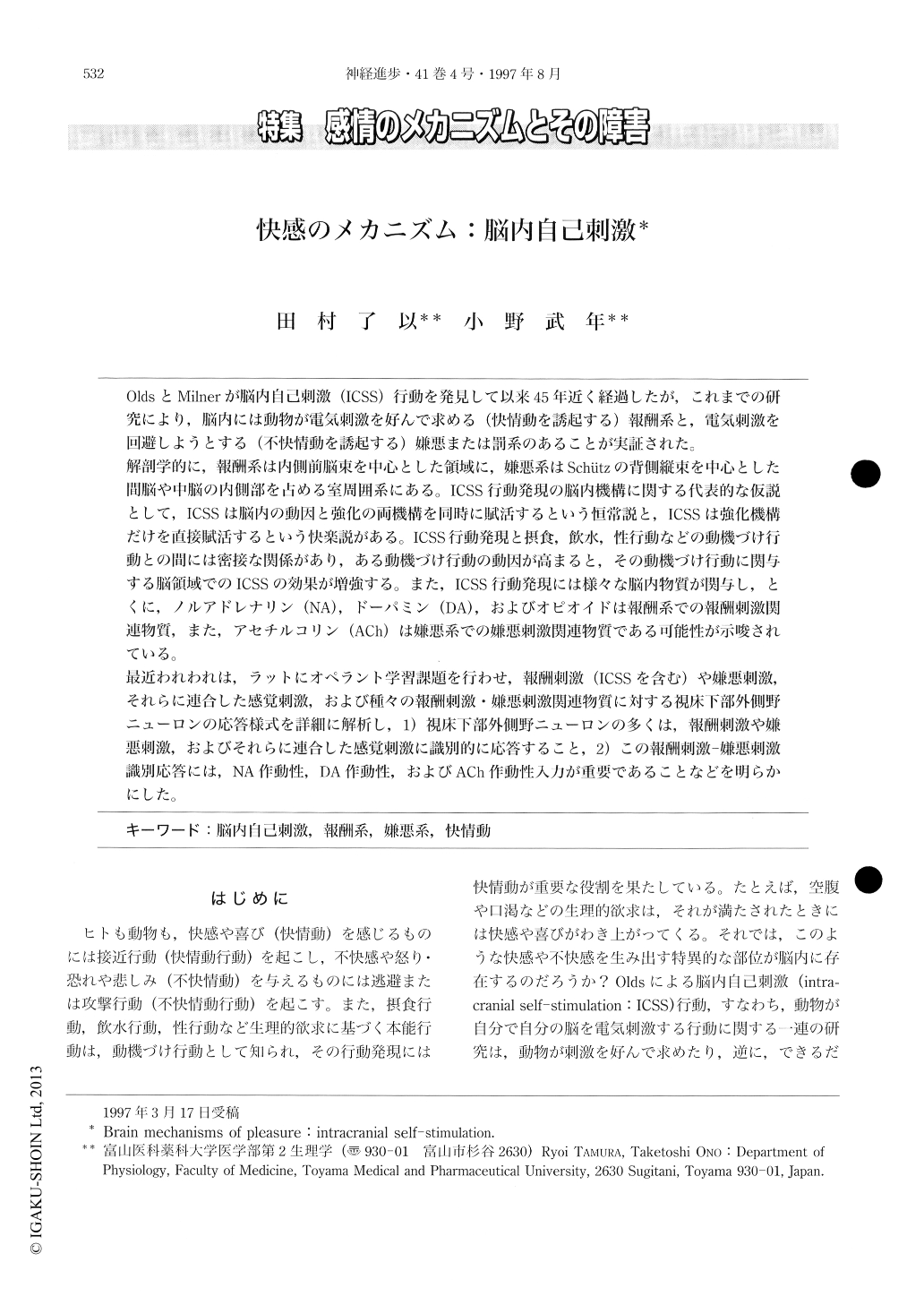
OldsとMilnerが脳内自己刺激(ICSS)行動を発見して以来45年近く経過したが,これまでの研究により,脳内には動物が電気刺激を好んで求める(快情動を誘起する)報酬系と,電気刺激を回避しようとする(不快情動を誘起する)嫌悪または罰系のあることが実証された。
解剖学的に,報酬系は内側前脳束を中心とした領域に,嫌悪系はSchützの背側縦束を中心とした間脳や中脳の内側部を占める室周囲系にある。ICSS行動発現の脳内機構に関する代表的な仮説として,ICSSは脳内の動因と強化の両機構を同時に賦活するという恒常説と,ICSSは強化機構だけを直接賦活するという快楽説がある。ICSS行動発現と摂食,飲水,性行動などの動機づけ行動との間には密接な関係があり,ある動機づけ行動の動因が高まると,その動機づけ行動に関与する脳領域でのICSSの効果が増強する。また,ICSS行動発現には様々な脳内物質が関与し,とくに,ノルアドレナリン(NA),ドーパミン(DA),およびオピオイドは報酬系での報酬刺激関連物質,また,アセチルコリン(ACh)は嫌悪系での嫌悪刺激関連物質である可能性が示唆されている。
Nearly 45 years have passed since Olds and Milner found intracranial self-stimulation (ICSS) behavior. A series of studies on ICSS behavior have demonstrated that, in the brain, there are reward and aversion systems to which animals and/or humans prefer and avoid, respectively, to get electrical stimulation. The reward system consists of the areas connected by the medial forebrain bundle ; the aversion system consists of the periventricular areas in the diencephalon and mesencephalon. There are 2 important theories that explain the brain mechanisms of ICSS behavior : the homeostatic theory assumes that ICSS activates neural substrates of drives and reinforcements, and the hedonic theory assumes that ICSS activates only the neural substrates of drives. ICSS behaviors and motivational (feeding, drinking, sexual, etc.) behaviors are closely related, i.e., operations to increase drive in a motivational behavior often enhance effects of ICSS in the brain area involved in that motivational behavior. Some neurotransmitters and neuromodulators including noradrenaline, dopamine, and opioids are suggested to be reward-related substances ; and acetylcholine, an aversion-related substance. Recently we recorded single neuron activity from the lateral hypothalamic area (LHA) in rats during performance of an operant task in which they had to discriminate different tones to get a rewarding stimulus (ICSS or glucose solution) or to avoid an aversive stimulus (electric shock or tail pinch). We clarified that 1) many of the LHA neurons respond differentially to tones and reinforcement stimuli depending on whether it was rewarding or aversive, and 2) noradrenergic, dopaminergic and cholinergic inputs are important to induce the differential responses of these LHA neurons.
Copyright © 1997, Igaku-Shoin Ltd. All rights reserved.