Japanese
English
- 有料閲覧
PPV購入案内
1,320円 (1,200円+税10%) こちらは、299ページから306ページの文献です。購入には医書.jp本会員登録が必要です。
会員登録完了後に改めて上記「購入サイトへ」を選択してください。
または「購入サイトへ」選択後に「購入ログイン」、「新規会員登録」の順に進んでください。
会員登録について詳しくはをご確認ください。
- Abstract 文献概要
- 1ページ目 Look Inside
はじめに
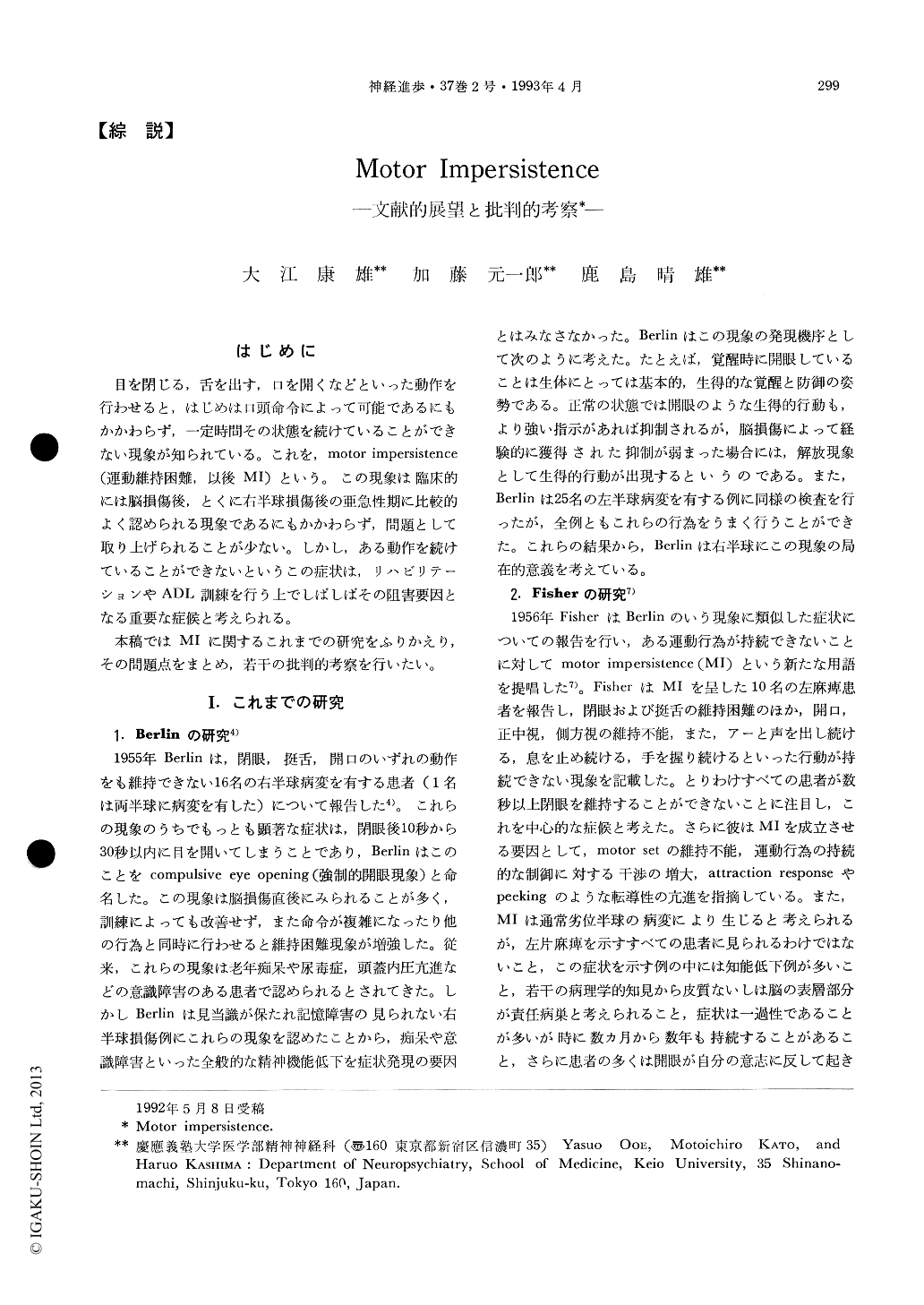
目を閉じる,舌を出す,口を開くなどといった動作を行わせると,はじめは口頭命令によって可能であるにもかかわらず,一定時間その状態を続けていることができない現象が知られている。これを,motor impersistence(運動維持困難,以後MI)という。この現象は臨床的には脳損傷後,とくに右半球損傷後の亜急性期に比較的よく認められる現象であるにもかかわらず,問題として取り上げられることが少ない。しかし,ある動作を続けていることができないというこの症状は,リハビリテーションやADL訓練を行う上でしばしばその阻害要因となる重要な症候と考えられる。
本稿ではMIに関するこれまでの研究をふりかえり,その問題点をまとめ,若干の批判的考察を行いたい。
Motor impersistence (MI) is a phenomenon which is frequently observed in brain damage, parti-cularly in the subacute phase of the right hemisphere damage. Clinically, this phenomenon often in-terferes with the rehabilitation programs or ADL training. However, a definite view concerning the mechanism of MI and the lesions responsible for MI has not yet been reached. In the present paper, we would summerize the various investigations on MI and discuss the different problems regarding MI.
There are four hypotheses with regard to the mechanism of MI appearance. First, Berlin (1955) speculated that the brain-damaged subject could not maintain an act such as keeping the eyes closed, which was opposed to a more primitive vigilant pattern, for instance, keeping the eyes open. This hypothesis stated that the experientially acquired controls were weakened as a result of brain damage, and that the behavior released from the controls demonstrated a ready expression of unconditioned behavior patterns. However, we consider that this hypothesis dose not clearly explain the machanism of MI development in detail.
Copyright © 1993, Igaku-Shoin Ltd. All rights reserved.