Japanese
English
- 有料閲覧
PPV購入案内
1,320円 (1,200円+税10%) こちらは、564ページから571ページの文献です。購入には医書.jp本会員登録が必要です。
会員登録完了後に改めて上記「購入サイトへ」を選択してください。
または「購入サイトへ」選択後に「購入ログイン」、「新規会員登録」の順に進んでください。
会員登録について詳しくはをご確認ください。
- Abstract 文献概要
- 1ページ目 Look Inside
はじめに
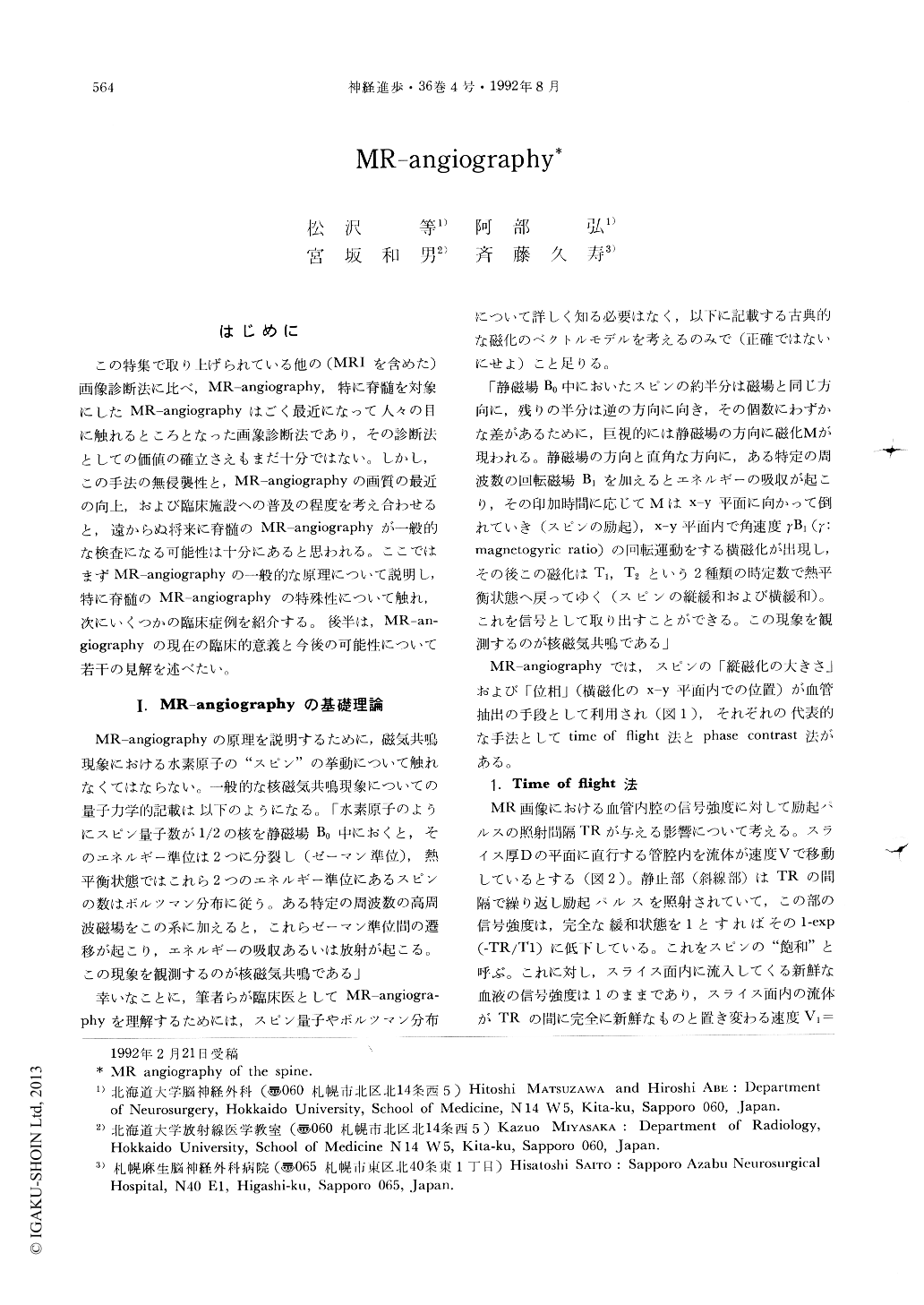
この特集で取り上げられている他の(MRIを含めた)画像診断法に比べ,MR-angiography,特に脊髄を対象にしたMR-angiographyはごく最近になって人々の目に触れるところとなった画豫診断法であり,その診断法としての価値の確立さえもまだ十分ではない。しかし,この手法の無侵襲性と,MR-angiographyの画質の最近の向上,および臨床施設への普及の程度を考え合わせると,遠からぬ将来に脊髄のMR-angiographyが一般的な検査になる可能性は十分にあると思われる。ここではまずMR-angiographyの一般的な原理について説明し,特に脊髄のMR-angiographyの特殊性について触れ,次にいくつかの臨床症例を紹介する。後半は,MR-angiographyの現在の臨床的意義と今後の可能性について若干の見解を述べたい。
NMR flow phenomena arise from two basic properties of spin magnetization. One is “Time-of-flight effects”, and the other is “phase effects”. Although the development of flow imaging techniques is still in its infantile stage, some of these techniques can successfully visualize the “in-vivo” images of vessels. A few cases with angiographically proved spinal arteriovenous malformations were examined with a 1.5 T MRI system with a surface coil using phase contrast MR-angiography. The phase contrast angiography uses flow encoding gradient pulses, which impart a velocity dependent phase shift to the transverse magnetization of moving spins. The resulting image contains signals derived only from moving spins, with stationary tissue being suppressed. Using this technique, we could visualize vessels without any contrast medium. The results showed that MR-angiography clearly demonstrated abnormal vascular structure of spinal AVMs non-invasively, and strongly suggested the potential advantages of spinal MR-angiography.
Copyright © 1992, Igaku-Shoin Ltd. All rights reserved.