Japanese
English
- 有料閲覧
PPV購入案内
1,320円 (1,200円+税10%) こちらは、273ページから281ページの文献です。購入には医書.jp本会員登録が必要です。
会員登録完了後に改めて上記「購入サイトへ」を選択してください。
または「購入サイトへ」選択後に「購入ログイン」、「新規会員登録」の順に進んでください。
会員登録について詳しくはをご確認ください。
- Abstract 文献概要
- 1ページ目 Look Inside
- 参考文献 Reference
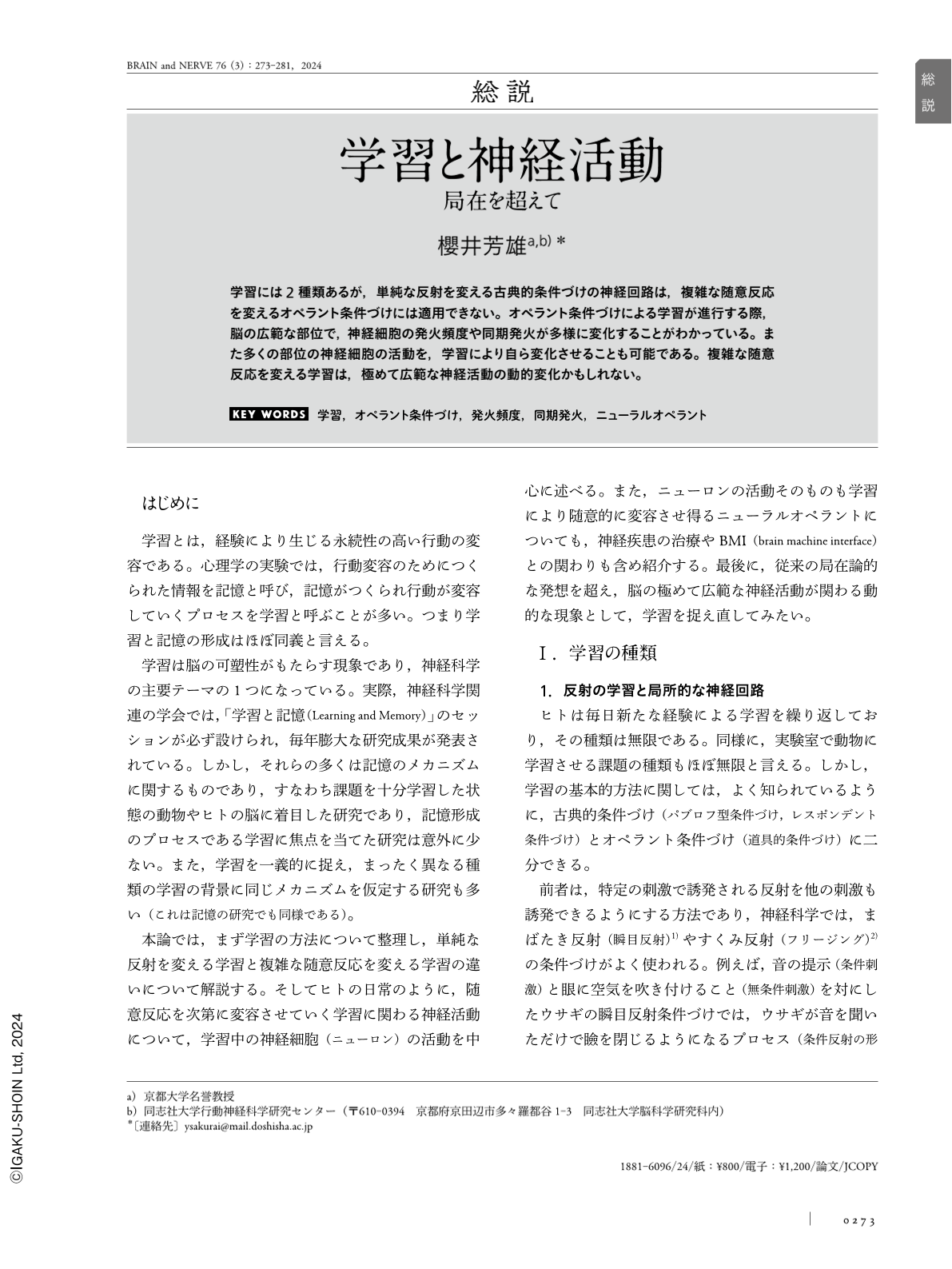
学習には2種類あるが,単純な反射を変える古典的条件づけの神経回路は,複雑な随意反応を変えるオペラント条件づけには適用できない。オペラント条件づけによる学習が進行する際,脳の広範な部位で,神経細胞の発火頻度や同期発火が多様に変化することがわかっている。また多くの部位の神経細胞の活動を,学習により自ら変化させることも可能である。複雑な随意反応を変える学習は,極めて広範な神経活動の動的変化かもしれない。
Abstract
Learning is classified into two types: “classical conditioning,” which modifies simple reflexes, and “operant conditioning,” which modifies complex voluntary behaviors. The neural circuits underlying these two types differ significantly. During the learning process of operant conditioning tasks, various changes in firing rate and firing synchrony of neurons can be observed across multiple brain regions. Additionally, neuronal firing rate and synchrony in several brain regions can be voluntarily controlled through operant conditioning. Consequently, it is evident that neurons in widespread brain regions have the potential for plastic changes to facilitate learning. It may be suggested that the learning of complex voluntary behaviors is underlined by widespread dynamic changes in neural activity and is not restricted to only a few brain regions.
Copyright © 2024, Igaku-Shoin Ltd. All rights reserved.