Japanese
English
- 有料閲覧
PPV購入案内
1,320円 (1,200円+税10%) こちらは、1361ページから1366ページの文献です。購入には医書.jp本会員登録が必要です。
会員登録完了後に改めて上記「購入サイトへ」を選択してください。
または「購入サイトへ」選択後に「購入ログイン」、「新規会員登録」の順に進んでください。
会員登録について詳しくはをご確認ください。
- Abstract 文献概要
- 1ページ目 Look Inside
- 参考文献 Reference
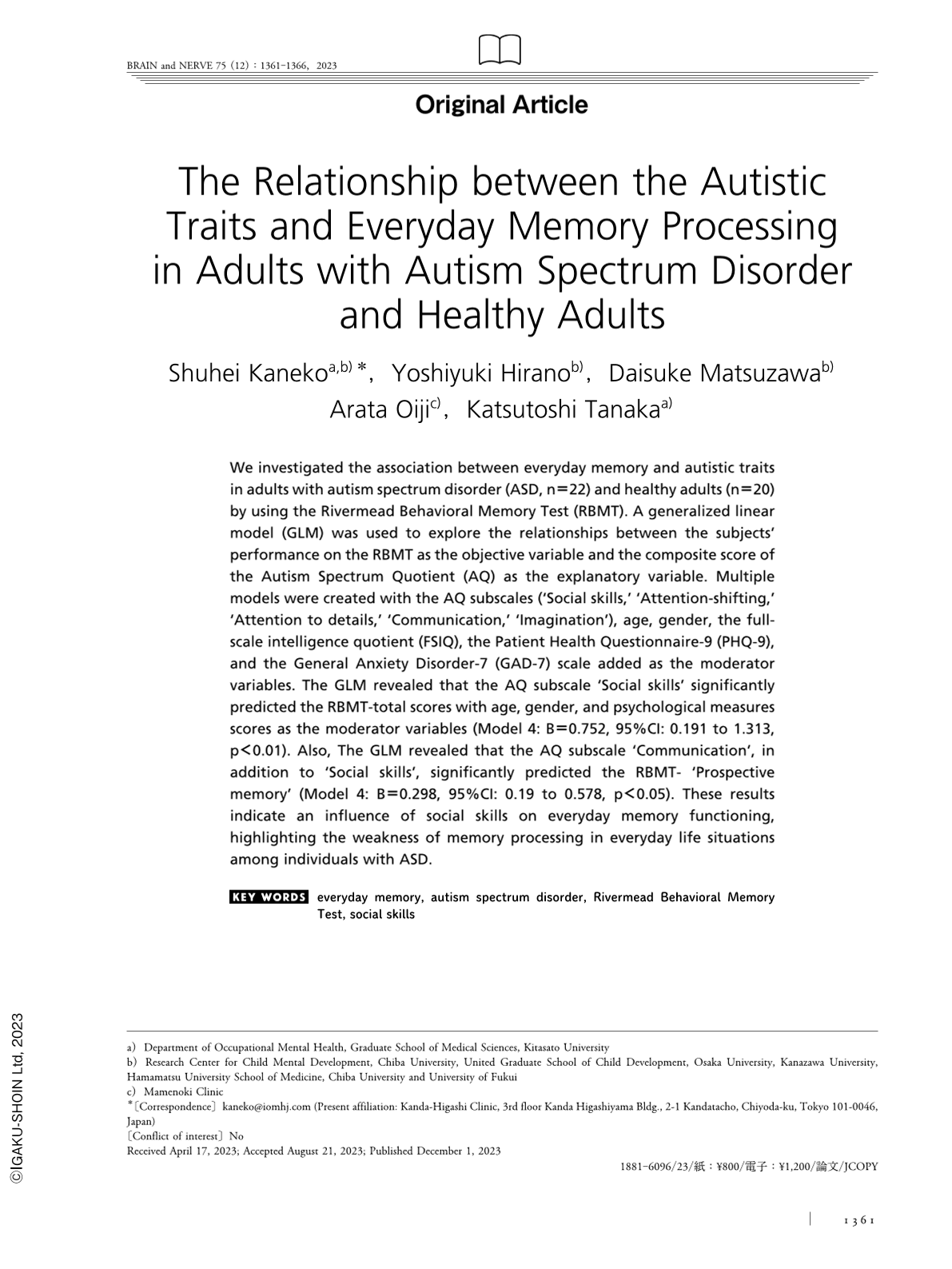
We investigated the association between everyday memory and autistic traits in adults with autism spectrum disorder (ASD, n=22) and healthy adults (n=20) by using the Rivermead Behavioral Memory Test (RBMT). A generalized linear model (GLM) was used to explore the relationships between the subjects' performance on the RBMT as the objective variable and the composite score of the Autism Spectrum Quotient (AQ) as the explanatory variable. Multiple models were created with the AQ subscales (‘Social skills,’ ‘Attention-shifting,’ ‘Attention to details,’ ‘Communication,’ ‘Imagination’), age, gender, the full-scale intelligence quotient (FSIQ), the Patient Health Questionnaire-9 (PHQ-9), and the General Anxiety Disorder-7 (GAD-7) scale added as the moderator variables. The GLM revealed that the AQ subscale ‘Social skills’ significantly predicted the RBMT-total scores with age, gender, and psychological measures scores as the moderator variables (Model 4: B=0.752, 95%CI: 0.191 to 1.313, p<0.01). Also, The GLM revealed that the AQ subscale ‘Communication’, in addition to ‘Social skills’, significantly predicted the RBMT- ‘Prospective memory’ (Model 4: B=0.298, 95%CI: 0.19 to 0.578, p<0.05). These results indicate an influence of social skills on everyday memory functioning, highlighting the weakness of memory processing in everyday life situations among individuals with ASD.
We investigated the association between everyday memory and autistic traits in adults with autism spectrum disorder (ASD, n=22) and healthy adults (n=20) by using the Rivermead Behavioral Memory Test (RBMT). A generalized linear model (GLM) was used to explore the relationships between the subjects' performance on the RBMT as the objective variable and the composite score of the Autism Spectrum Quotient (AQ) as the explanatory variable. Multiple models were created with the AQ subscales (‘Social skills,’ ‘Attention-shifting,’ ‘Attention to details,’ ‘Communication,’ ‘Imagination’), age, gender, the full-scale intelligence quotient (FSIQ), the Patient Health Questionnaire-9 (PHQ-9), and the General Anxiety Disorder-7 (GAD-7) scale added as the moderator variables. The GLM revealed that the AQ subscale ‘Social skills’ significantly predicted the RBMT-total scores with age, gender, and psychological measures scores as the moderator variables (Model 4: B=0.752, 95%CI: 0.191 to 1.313, p<0.01). Also, The GLM revealed that the AQ subscale ‘Communication’, in addition to ‘Social skills’, significantly predicted the RBMT- ‘Prospective memory’ (Model 4: B=0.298, 95%CI: 0.19 to 0.578, p<0.05). These results indicate an influence of social skills on everyday memory functioning, highlighting the weakness of memory processing in everyday life situations among individuals with ASD.
Copyright © 2023, Igaku-Shoin Ltd. All rights reserved.