Japanese
English
- 有料閲覧
PPV購入案内
1,320円 (1,200円+税10%) こちらは、1239ページから1243ページの文献です。購入には医書.jp本会員登録が必要です。
会員登録完了後に改めて上記「購入サイトへ」を選択してください。
または「購入サイトへ」選択後に「購入ログイン」、「新規会員登録」の順に進んでください。
会員登録について詳しくはをご確認ください。
- Abstract 文献概要
- 1ページ目 Look Inside
- 参考文献 Reference
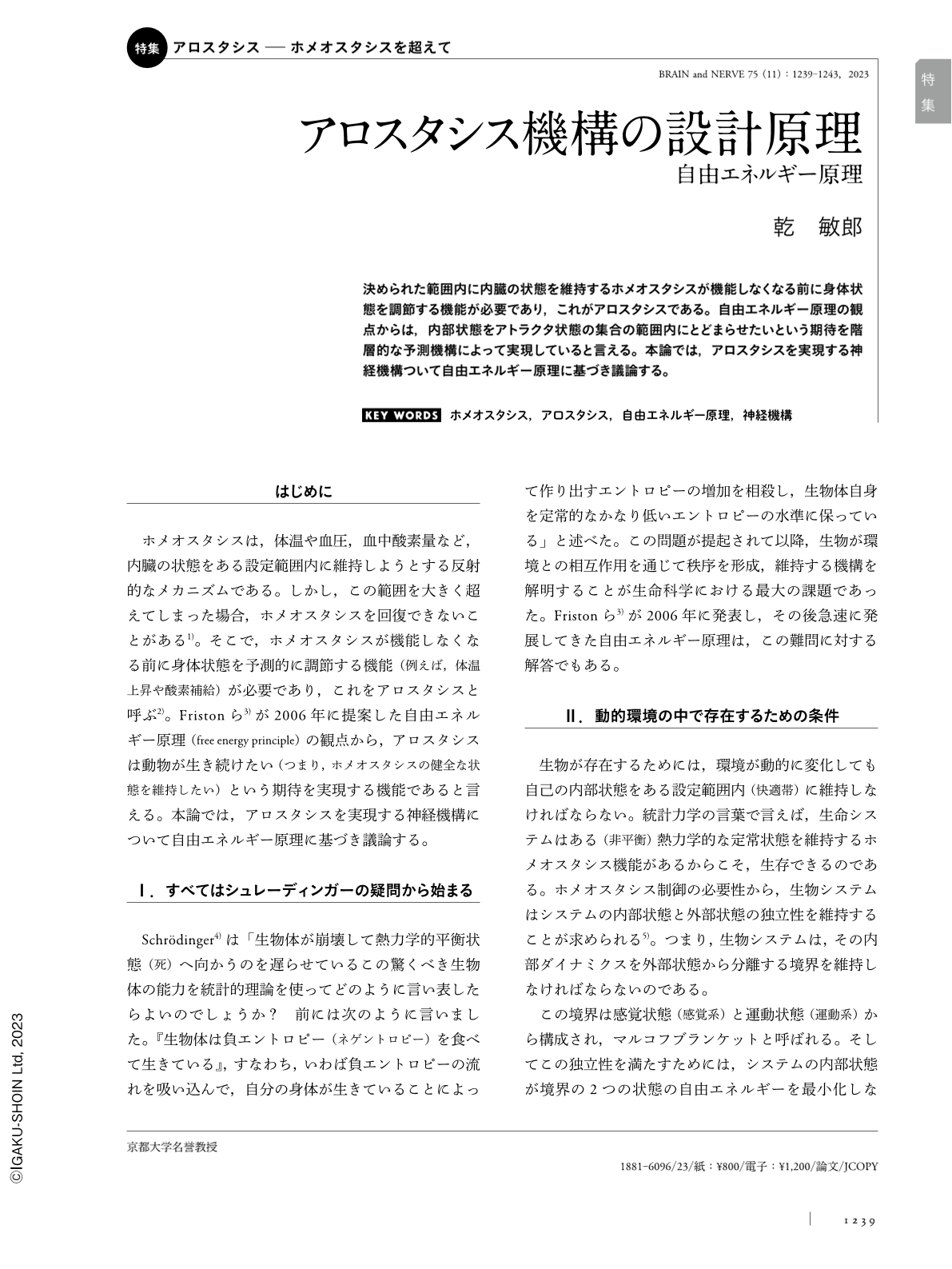
決められた範囲内に内臓の状態を維持するホメオスタシスが機能しなくなる前に身体状態を調節する機能が必要であり,これがアロスタシスである。自由エネルギー原理の観点からは,内部状態をアトラクタ状態の集合の範囲内にとどまらせたいという期待を階層的な予測機構によって実現していると言える。本論では,アロスタシスを実現する神経機構ついて自由エネルギー原理に基づき議論する。
Abstract
Homeostasis is maintained by neural reflex controls, which attempt to maintain the body's internal organs within a predetermined range. However, when deviations are significant, homeostasis may not be restored by these standard controls. Therefore, a function called allostasis is necessary to maximize the energy efficiency of bodily functions, anticipate changing needs (e.g., a future increase in body temperature or oxygen demand), and regulate the body's state before dyshomeostasis occurs. In terms of the free energy principle (FEP), the expectation to survive (i.e., to stay within established confines and to maintain homeostatic integrity over time) is realized by a hierarchical prediction mechanism. Allostasis requires the integration of exteroceptive, interoceptive, and proprioceptive signals. In this paper, the neural mechanism of allostasis is discussed in terms of the FEP.
Copyright © 2023, Igaku-Shoin Ltd. All rights reserved.