Japanese
English
- 有料閲覧
PPV購入案内
1,320円 (1,200円+税10%) こちらは、1481ページから1486ページの文献です。購入には医書.jp本会員登録が必要です。
会員登録完了後に改めて上記「購入サイトへ」を選択してください。
または「購入サイトへ」選択後に「購入ログイン」、「新規会員登録」の順に進んでください。
会員登録について詳しくはをご確認ください。
- Abstract 文献概要
- 1ページ目 Look Inside
- 参考文献 Reference
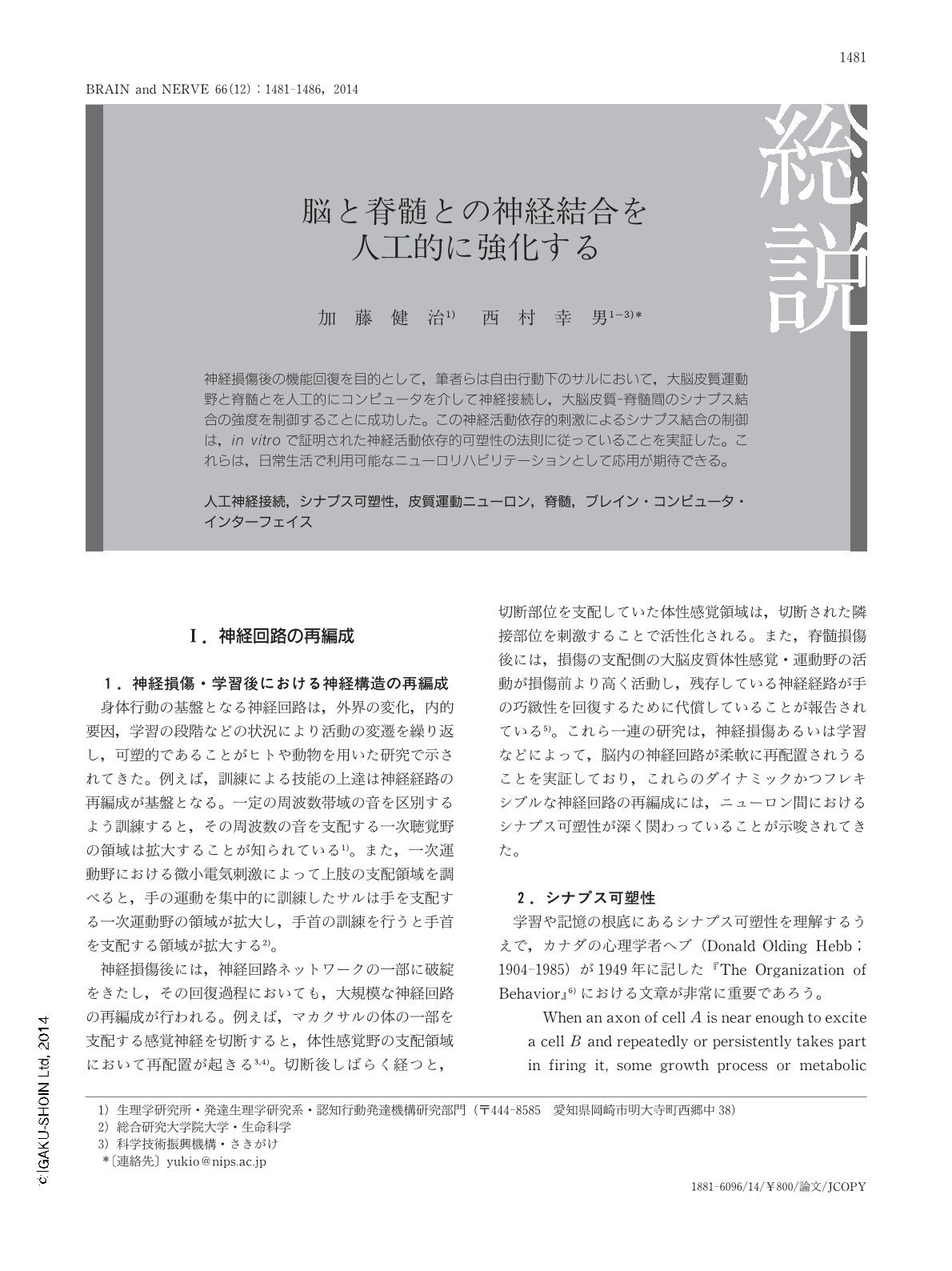
神経損傷後の機能回復を目的として,筆者らは自由行動下のサルにおいて,大脳皮質運動野と脊髄とを人工的にコンピュータを介して神経接続し,大脳皮質-脊髄間のシナプス結合の強度を制御することに成功した。この神経活動依存的刺激によるシナプス結合の制御は,in vitroで証明された神経活動依存的可塑性の法則に従っていることを実証した。これらは,日常生活で利用可能なニューロリハビリテーションとして応用が期待できる。
Abstract
Individuals with neural damage hope to regain their impaired functions. However, therapeutic rehabilitation is lacking. Nishimura et al. (2013) have documented that the strength of neural connections between the motor cortex and the spinal cord can be modified using an autonomous recurrent neural interface that delivers electrical stimuli in the spinal cord and this is triggered by action potentials of corticospinal cells during free behavior. This activity-dependent stimulation modifies the strength of the terminal connections of single corticomotoneuronal cells, which is consistent with the bidirectional spike-timing-dependent plasticity rule previously derived from in vitro experiments. The success of our protocol suggests neurorehabilitative treatments could be possible for patients with damaged pathways.
Copyright © 2014, Igaku-Shoin Ltd. All rights reserved.