Japanese
English
- 有料閲覧
PPV購入案内
1,320円 (1,200円+税10%) こちらは、377ページから384ページの文献です。購入には医書.jp本会員登録が必要です。
会員登録完了後に改めて上記「購入サイトへ」を選択してください。
または「購入サイトへ」選択後に「購入ログイン」、「新規会員登録」の順に進んでください。
会員登録について詳しくはをご確認ください。
- Abstract 文献概要
- 1ページ目 Look Inside
- 参考文献 Reference
- サイト内被引用 Cited by
はじめに
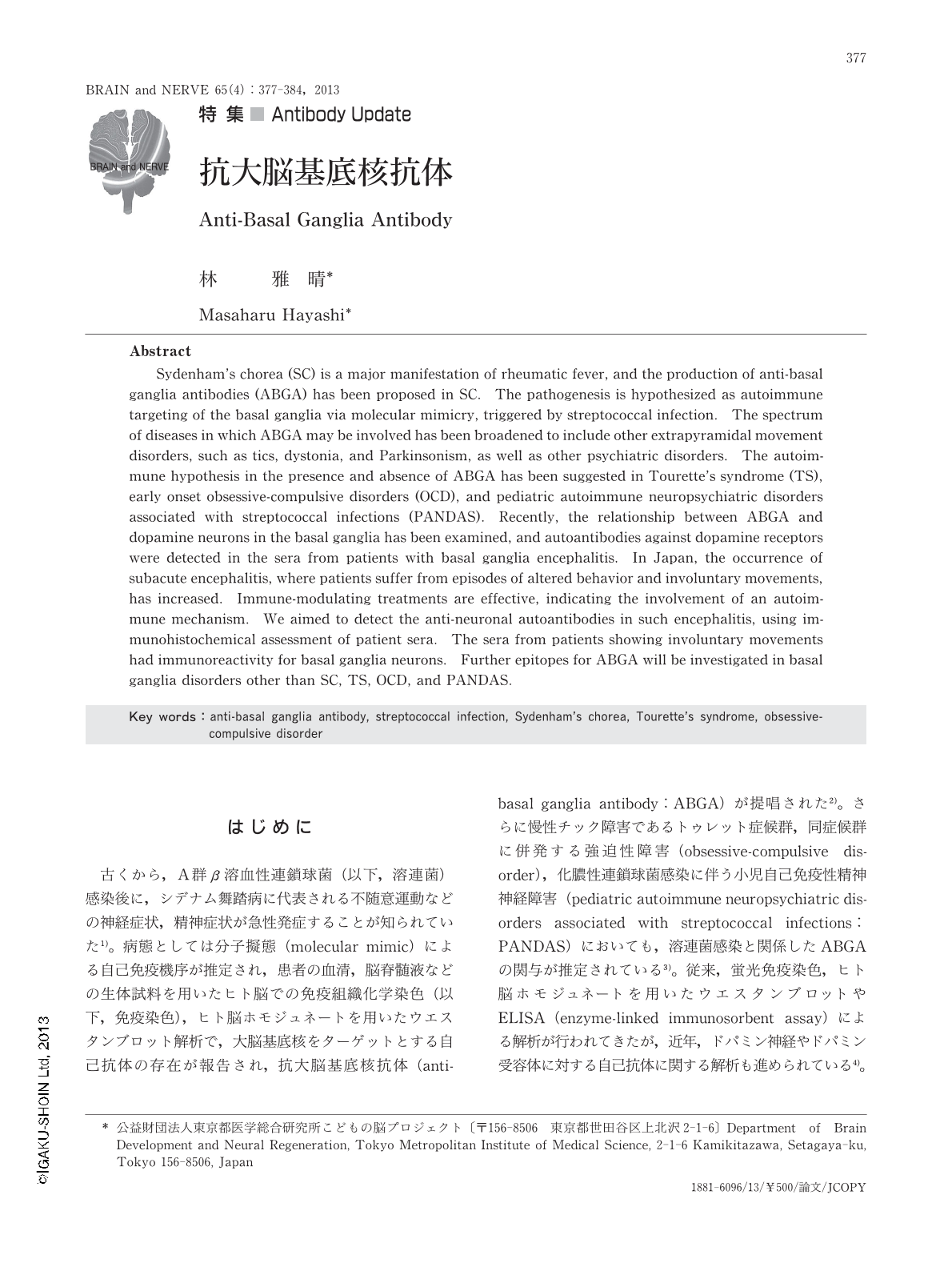
古くから,A群β溶血性連鎖球菌(以下,溶連菌)感染後に,シデナム舞踏病に代表される不随意運動などの神経症状,精神症状が急性発症することが知られていた1)。病態としては分子擬態(molecular mimic)による自己免疫機序が推定され,患者の血清,脳脊髄液などの生体試料を用いたヒト脳での免疫組織化学染色(以下,免疫染色),ヒト脳ホモジュネートを用いたウエスタンブロット解析で,大脳基底核をターゲットとする自己抗体の存在が報告され,抗大脳基底核抗体(anti-basal ganglia antibody:ABGA)が提唱された2)。さらに慢性チック障害であるトゥレット症候群,同症候群に併発する強迫性障害(obsessive-compulsive disorder),化膿性連鎖球菌感染に伴う小児自己免疫性精神神経障害(pediatric autoimmune neuropsychiatric disorders associated with streptococcal infections:PANDAS)においても,溶連菌感染と関係したABGAの関与が推定されている3)。従来,蛍光免疫染色,ヒト脳ホモジュネートを用いたウエスタンブロットやELISA(enzyme-linked immunosorbent assay)による解析が行われてきたが,近年,ドパミン神経やドパミン受容体に対する自己抗体に関する解析も進められている4)。
本稿では,ABGAと関連する大脳基底核の解剖,シデナム舞踏病,トゥレット症候群,強迫性障害,PANDASでのABGAの歴史的経緯と意義,ABGAの病態に関して解説する。加えて筆者らによる小児の亜急性自己免疫性脳炎での解析結果も紹介する。
Abstract
Sydenham's chorea (SC) is a major manifestation of rheumatic fever, and the production of anti-basal ganglia antibodies (ABGA) has been proposed in SC. The pathogenesis is hypothesized as autoimmune targeting of the basal ganglia via molecular mimicry, triggered by streptococcal infection. The spectrum of diseases in which ABGA may be involved has been broadened to include other extrapyramidal movement disorders, such as tics, dystonia, and Parkinsonism, as well as other psychiatric disorders. The autoimmune hypothesis in the presence and absence of ABGA has been suggested in Tourette's syndrome (TS), early onset obsessive-compulsive disorders (OCD), and pediatric autoimmune neuropsychiatric disorders associated with streptococcal infections (PANDAS). Recently, the relationship between ABGA and dopamine neurons in the basal ganglia has been examined, and autoantibodies against dopamine receptors were detected in the sera from patients with basal ganglia encephalitis. In Japan, the occurrence of subacute encephalitis, where patients suffer from episodes of altered behavior and involuntary movements, has increased. Immune-modulating treatments are effective, indicating the involvement of an autoimmune mechanism. We aimed to detect the anti-neuronal autoantibodies in such encephalitis, using immunohistochemical assessment of patient sera. The sera from patients showing involuntary movements had immunoreactivity for basal ganglia neurons. Further epitopes for ABGA will be investigated in basal ganglia disorders other than SC, TS, OCD, and PANDAS.
Copyright © 2013, Igaku-Shoin Ltd. All rights reserved.