Japanese
English
- 有料閲覧
PPV購入案内
1,320円 (1,200円+税10%) こちらは、753ページから760ページの文献です。購入には医書.jp本会員登録が必要です。
会員登録完了後に改めて上記「購入サイトへ」を選択してください。
または「購入サイトへ」選択後に「購入ログイン」、「新規会員登録」の順に進んでください。
会員登録について詳しくはをご確認ください。
- Abstract 文献概要
- 1ページ目 Look Inside
- 参考文献 Reference
はじめに
顔は社会への窓である。顔は他人に評価され,さまざまな場面でわれわれの人生を左右する。異性パートナーや結婚相手の選択で,顔が重要な判断要素であることは間違いない。学業成績評価や就職面接の採否,収入などが顔の魅力に影響を受けることはデータで証明されている1-3)。一方で,われわれは顔で他者を動かし,社会とつながることもできる。多くの人は,微笑みを投げれば,微笑みを返してくれる。悲しい顔をすれば,同情してくれる。われわれの乳幼児期における親子間の顔の表情によるやり取りは,コミュニケーションの初期形態である4,5)。
自分の顔を見るというのは,不思議な行為である。自分の顔は本来他者に見られるはずのものであり,自分の顔を見るためには鏡やカメラ・ビデオなどの文明の利器が必要である。われわれが鏡に映った自分を見るのはなんのためか。代表的なのは髪を整えたり化粧をしたり,という身づくろいのときであろう。鏡の前で表情を作ってみたり,鏡の中の自分に語りかけてみたりする人もいる(もちろん,自己認知ができなくなる認知症の話6,7)ではない)。他者によりよく見られようと努力したり,社会の中で迷う自分と向き合ったり,いずれもヒトをヒトたらしめている高度な社会性を反映している。実際,鏡に映った自己像を自己と認識できる動物は極めて少なく,いずれも脳が大きく高度な社会性を持った動物である8-10)。
自分の顔を見るときに脳のどのようなメカニズムが作動するのかについてわれわれが学術的な興味を持つとき,その念頭にあるのは一般的に人間の社会性,その中でもとびきり高度な部分であろう。
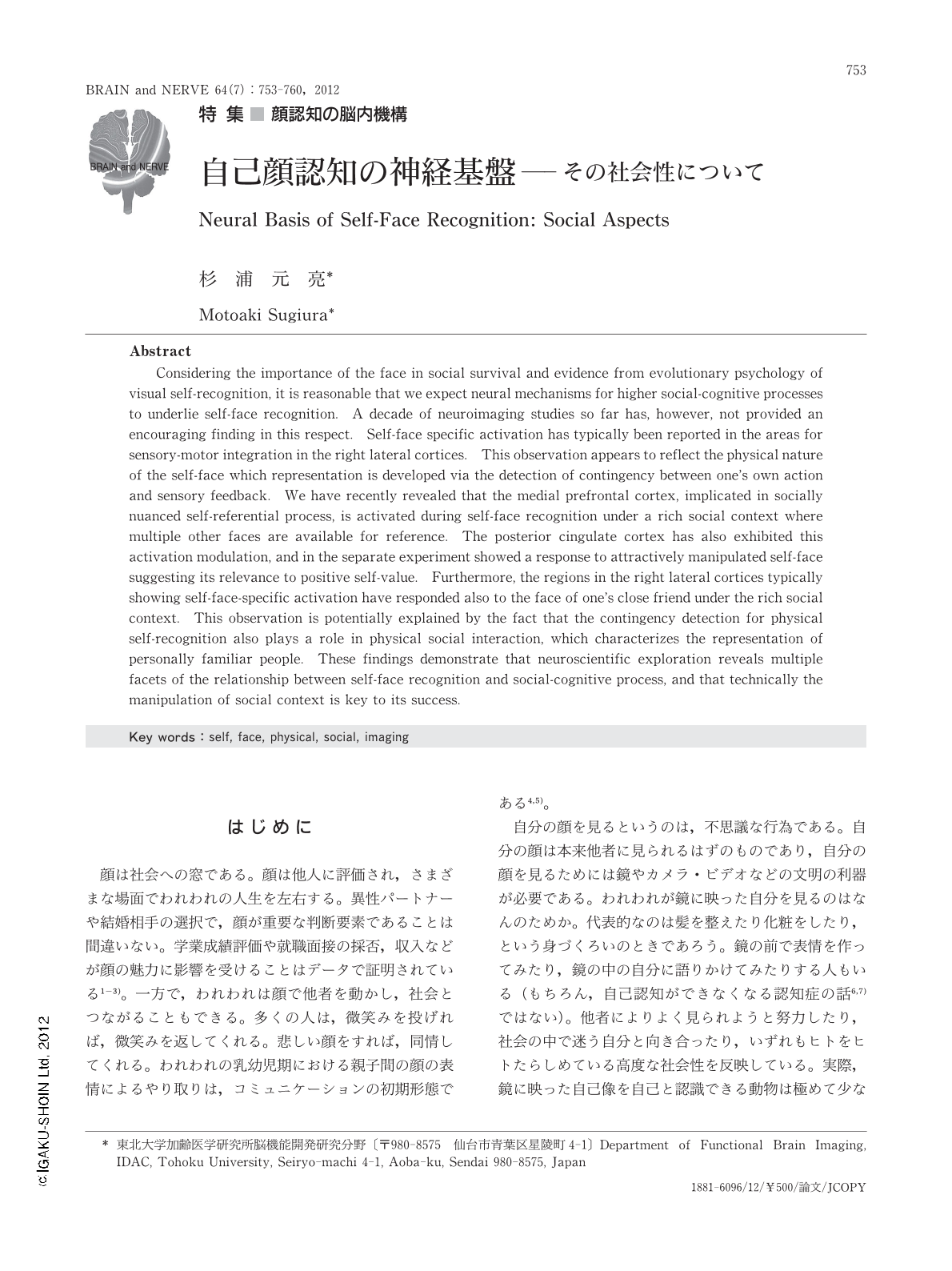
Abstract
Considering the importance of the face in social survival and evidence from evolutionary psychology of visual self-recognition,it is reasonable that we expect neural mechanisms for higher social-cognitive processes to underlie self-face recognition. A decade of neuroimaging studies so far has,however,not provided an encouraging finding in this respect. Self-face specific activation has typically been reported in the areas for sensory-motor integration in the right lateral cortices. This observation appears to reflect the physical nature of the self-face which representation is developed via the detection of contingency between one's own action and sensory feedback. We have recently revealed that the medial prefrontal cortex,implicated in socially nuanced self-referential process,is activated during self-face recognition under a rich social context where multiple other faces are available for reference. The posterior cingulate cortex has also exhibited this activation modulation,and in the separate experiment showed a response to attractively manipulated self-face suggesting its relevance to positive self-value. Furthermore,the regions in the right lateral cortices typically showing self-face-specific activation have responded also to the face of one's close friend under the rich social context. This observation is potentially explained by the fact that the contingency detection for physical self-recognition also plays a role in physical social interaction,which characterizes the representation of personally familiar people. These findings demonstrate that neuroscientific exploration reveals multiple facets of the relationship between self-face recognition and social-cognitive process,and that technically the manipulation of social context is key to its success.
Copyright © 2012, Igaku-Shoin Ltd. All rights reserved.