Japanese
English
- 有料閲覧
PPV購入案内
1,320円 (1,200円+税10%) こちらは、665ページから674ページの文献です。購入には医書.jp本会員登録が必要です。
会員登録完了後に改めて上記「購入サイトへ」を選択してください。
または「購入サイトへ」選択後に「購入ログイン」、「新規会員登録」の順に進んでください。
会員登録について詳しくはをご確認ください。
- Abstract 文献概要
- 1ページ目 Look Inside
- 参考文献 Reference
はじめに
近年,神経変性疾患の分子病態において,蛋白質のミスフォールド(折りたたみ異常)が注目されている。異常に折りたたまれた蛋白質(misfolded protein)は完全な分解・処理を免れて,細胞内外に凝集・沈着する。このようなミスフォールド蛋白質が病気の発症や進展に深く関わることが知られた疾患はprotein misfolding diseaseと称される1-3)。
いったん,ミスフォールド蛋白質が生じると,それが鋳型となって正常な蛋白質の折りたたみ異常が触媒される[“template assistance”モデル3),Fig.1]。さらにミスフォールド蛋白質同士が重合して凝集体を形成する[“seed polymerization”モデル3),Fig.1]。またミスフォールド蛋白質,あるいはその凝集体が細胞間で伝播され(cell-to-cell propagation),次第に拡がっていくことも確認されている(Fig.2)。これらの現象はちょうど異常プリオン蛋白質でみられるものと類似しているため,prion-like propagation mechanism,あるいは簡略にprion-like phenomenonとも呼ばれる1-3)。Prion-like phenomenonは,神経変性疾患が長い潜伏期間を経て発症すること,脳の特定の部位から始まった病理変化が近接した領域,あるいは特定の機能系に沿って進展することをうまく説明する。Tableにはこれまでにprion-like phenomenonが証明されたミスフォールド蛋白質とそれに関連するprotein misfolding diseaseを列記した1-3)。ただし,いずれのミスフォールド蛋白質も異常プリオン蛋白質と比べるとさまざまな意味で“不完全”である。特に個体間伝播が証明されていないがゆえに,これらの蛋白質に対して,プリオンと区別して“prionoids”(プリオノイド)という用語も提唱されている4)。
ミスフォールド蛋白質の多くはアミロイド細線維(amyloid fibril)と呼ばれる微細な線維を形成するのが特徴である。アミロイド細線維を基盤とした個体間伝播に関しては全身性アミロイドーシスで先行して解析されて来た。
本稿では全身性アミロイドーシス・モデルを参考にしながら,ミスフォールド蛋白質を介する神経変性疾患の細胞間・個体間伝播について,最近の知見を紹介する。
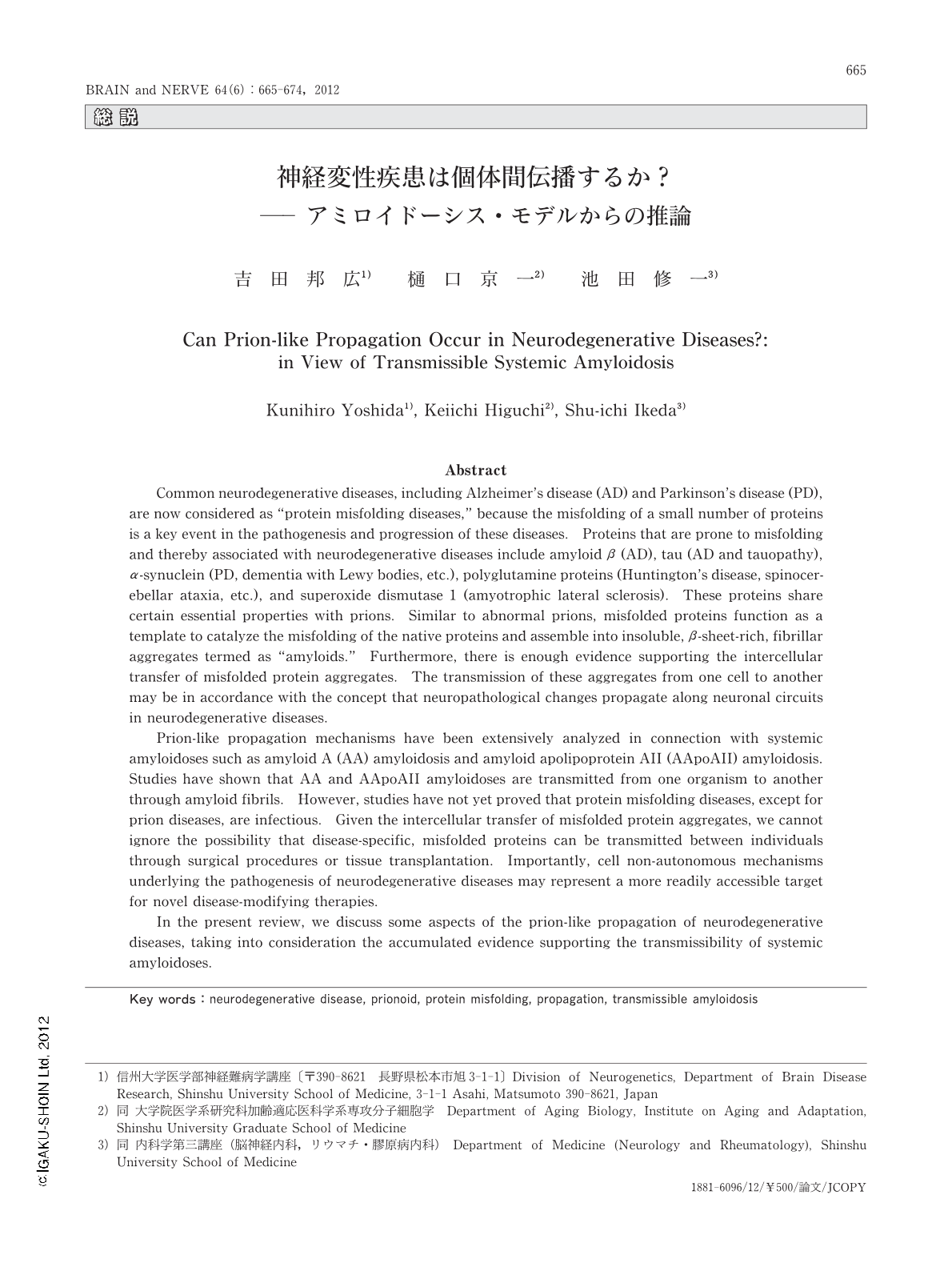
Abstract
Common neurodegenerative diseases, including Alzheimer's disease (AD) and Parkinson's disease (PD), are now considered as "protein misfolding diseases," because the misfolding of a small number of proteins is a key event in the pathogenesis and progression of these diseases. Proteins that are prone to misfolding and thereby associated with neurodegenerative diseases include amyloid β (AD), tau (AD and tauopathy), α-synuclein (PD, dementia with Lewy bodies, etc.), polyglutamine proteins (Huntington's disease, spinocerebellar ataxia, etc.), and superoxide dismutase 1 (amyotrophic lateral sclerosis). These proteins share certain essential properties with prions. Similar to abnormal prions, misfolded proteins function as a template to catalyze the misfolding of the native proteins and assemble into insoluble, β-sheet-rich, fibrillar aggregates termed as "amyloids." Furthermore, there is enough evidence supporting the intercellular transfer of misfolded protein aggregates. The transmission of these aggregates from one cell to another may be in accordance with the concept that neuropathological changes propagate along neuronal circuits in neurodegenerative diseases.
Prion-like propagation mechanisms have been extensively analyzed in connection with systemic amyloidoses such as amyloid A (AA) amyloidosis and amyloid apolipoprotein AII (AApoAII) amyloidosis. Studies have shown that AA and AApoAII amyloidoses are transmitted from one organism to another through amyloid fibrils. However, studies have not yet proved that protein misfolding diseases, except for prion diseases, are infectious. Given the intercellular transfer of misfolded protein aggregates, we cannot ignore the possibility that disease-specific, misfolded proteins can be transmitted between individuals through surgical procedures or tissue transplantation. Importantly, cell non-autonomous mechanisms underlying the pathogenesis of neurodegenerative diseases may represent a more readily accessible target for novel disease-modifying therapies.
In the present review,we discuss some aspects of the prion-like propagation of neurodegenerative diseases,taking into consideration the accumulated evidence supporting the transmissibility of systemic amyloidoses.
Copyright © 2012, Igaku-Shoin Ltd. All rights reserved.