Japanese
English
- 有料閲覧
PPV購入案内
1,320円 (1,200円+税10%) こちらは、851ページから860ページの文献です。購入には医書.jp本会員登録が必要です。
会員登録完了後に改めて上記「購入サイトへ」を選択してください。
または「購入サイトへ」選択後に「購入ログイン」、「新規会員登録」の順に進んでください。
会員登録について詳しくはをご確認ください。
- Abstract 文献概要
- 1ページ目 Look Inside
- 参考文献 Reference
目次
Ⅰ.概要
Ⅱ.母指さがし試験
Ⅲ.母趾さがし試験
Ⅳ.固有感覚性定位とは
Ⅴ.皮膚(識別感覚性)定位との相異
Ⅵ.いわゆる深部感覚(位置覚)との関係
Ⅶ.病態機序
Ⅷ.病変部位
Ⅸ.結び
Abstract
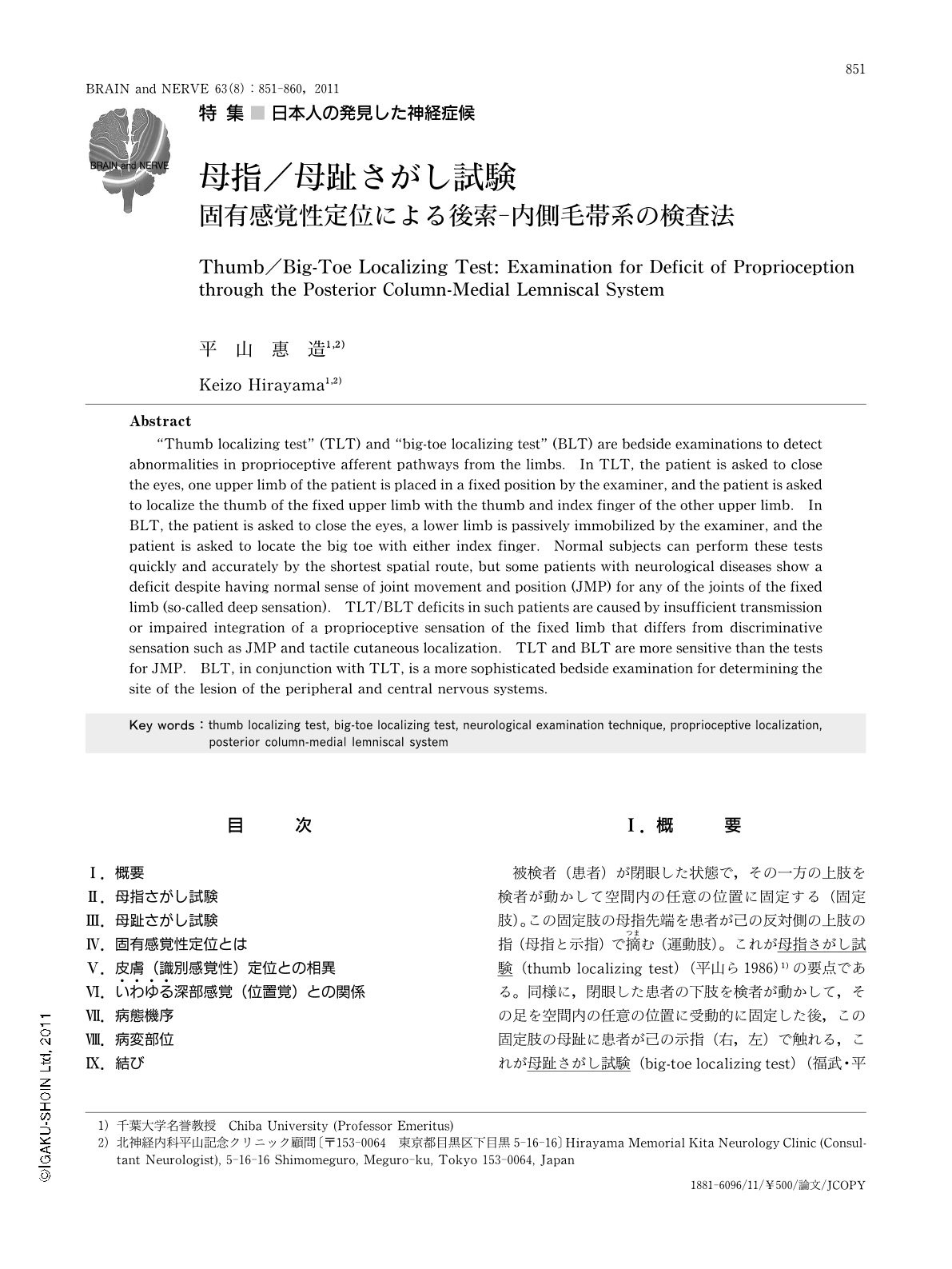
"Thumb localizing test" (TLT) and "big-toe localizing test" (BLT) are bedside examinations to detect abnormalities in proprioceptive afferent pathways from the limbs. In TLT,the patient is asked to close the eyes,one upper limb of the patient is placed in a fixed position by the examiner,and the patient is asked to localize the thumb of the fixed upper limb with the thumb and index finger of the other upper limb. In BLT,the patient is asked to close the eyes,a lower limb is passively immobilized by the examiner,and the patient is asked to locate the big toe with either index finger. Normal subjects can perform these tests quickly and accurately by the shortest spatial route,but some patients with neurological diseases show a deficit despite having normal sense of joint movement and position (JMP) for any of the joints of the fixed limb (so-called deep sensation). TLT/BLT deficits in such patients are caused by insufficient transmission or impaired integration of a proprioceptive sensation of the fixed limb that differs from discriminative sensation such as JMP and tactile cutaneous localization. TLT and BLT are more sensitive than the tests for JMP. BLT,in conjunction with TLT,is a more sophisticated bedside examination for determining the site of the lesion of the peripheral and central nervous systems.
Copyright © 2011, Igaku-Shoin Ltd. All rights reserved.