Japanese
English
- 有料閲覧
PPV購入案内
1,320円 (1,200円+税10%) こちらは、972ページから978ページの文献です。購入には医書.jp本会員登録が必要です。
会員登録完了後に改めて上記「購入サイトへ」を選択してください。
または「購入サイトへ」選択後に「購入ログイン」、「新規会員登録」の順に進んでください。
会員登録について詳しくはをご確認ください。
- Abstract 文献概要
- 1ページ目 Look Inside
- 参考文献 Reference
はじめに
高齢化する社会とともに65歳以上の老年人口は増加しており,65~74歳を前期高齢者(younger-old),75~84歳を後期高齢者(older-old)とし,85歳以上を超高齢者(oldest-old)と区分すると,超高齢者の増加割合が最も大きい1,2)。認知症の有病率は年齢とともに上昇し,超高齢者で最も高くなるとされている。欧米では90歳以上の超高齢者における認知症の有病率が40%前後であることが報告されており3,4),日本では繁信ら5)が,65歳以上の在宅高齢者を対象とした地域研究で,85歳以上の超高齢者における認知症の有病率を17.3%と報告している。超高齢者における認知症は,医学的にも社会的にも大きな検討課題であると言える。例えば,物忘れ外来をはじめとするclinic-baseの研究では,認知症の原因疾患としてAlzheimer disease(AD)が最も多く,全体の65~75%を占めると報告されている6-9)。また,前期高齢者では前頭側頭葉変性症(frontotemporal lober degeneration:FTLD)の,後期高齢者ではレビー小体を伴う認知症(dementia with Lewy bodies:DLB)の比率が比較的多い傾向が報告されている6-8,10,11)。これらの傾向は超高齢者にもあてはまるのであろうか。本研究では,地域の二次医療機関としての物忘れ外来(memory clinic)における超高齢認知症患者を対象として,これらの点を中心に検討を加えた。
Abstract
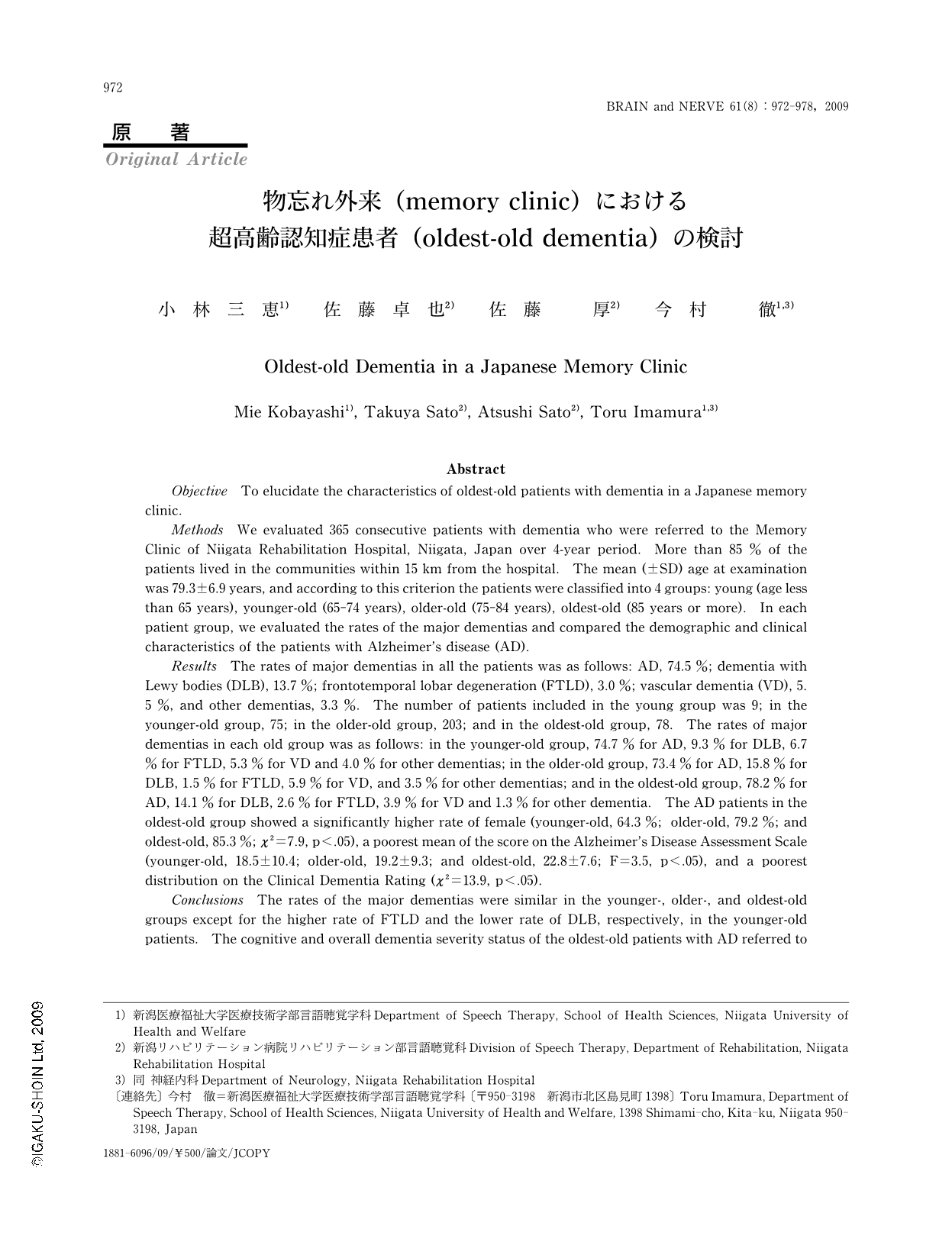
Objective To elucidate the characteristics of oldest-old patients with dementia in a Japanese memory clinic.
Methods We evaluated 365 consecutive patients with dementia who were referred to the Memory Clinic of Niigata Rehabilitation Hospital, Niigata, Japan over 4-year period. More than 85 % of the patients lived in the communities within 15 km from the hospital. The mean (±SD) age at examination was 79.3±6.9 years, and according to this criterion the patients were classified into 4 groups: young (age less than 65 years), younger-old (65-74 years), older-old (75-84 years), oldest-old (85 years or more). In each patient group, we evaluated the rates of the major dementias and compared the demographic and clinical characteristics of the patients with Alzheimer's disease (AD).
Results The rates of major dementias in all the patients was as follows: AD, 74.5 %; dementia with Lewy bodies (DLB), 13.7 %; frontotemporal lobar degeneration (FTLD), 3.0 %; vascular dementia (VD), 5.5 %, and other dementias, 3.3 %. The number of patients included in the young group was 9; in the younger-old group, 75; in the older-old group, 203; and in the oldest-old group, 78. The rates of major dementias in each old group was as follows: in the younger-old group, 74.7 % for AD, 9.3 % for DLB, 6.7 % for FTLD, 5.3 % for VD and 4.0 % for other dementias; in the older-old group, 73.4 % for AD, 15.8 % for DLB, 1.5 % for FTLD, 5.9 % for VD, and 3.5 % for other dementias; and in the oldest-old group, 78.2 % for AD, 14.1 % for DLB, 2.6 % for FTLD, 3.9 % for VD and 1.3 % for other dementia. The AD patients in the oldest-old group showed a significantly higher rate of female (younger-old, 64.3 %; older-old, 79.2 %; and oldest-old, 85.3 %; χ2=7.9, p<.05), a poorest mean of the score on the Alzheimer's Disease Assessment Scale (younger-old, 18.5±10.4; older-old, 19.2±9.3; and oldest-old, 22.8±7.6; F=3.5, p<.05), and a poorest distribution on the Clinical Dementia Rating (χ2=13.9, p<.05).
Conclusions The rates of the major dementias were similar in the younger-, older-, and oldest-old groups except for the higher rate of FTLD and the lower rate of DLB, respectively, in the younger-old patients. The cognitive and overall dementia severity status of the oldest-old patients with AD referred to the memory clinic was poor than that of the younger- and older-old patients.
(Received: September 8,2008,Accepted: March 15,2009)
Copyright © 2009, Igaku-Shoin Ltd. All rights reserved.