Japanese
English
- 有料閲覧
PPV購入案内
1,320円 (1,200円+税10%) こちらは、567ページから570ページの文献です。購入には医書.jp本会員登録が必要です。
会員登録完了後に改めて上記「購入サイトへ」を選択してください。
または「購入サイトへ」選択後に「購入ログイン」、「新規会員登録」の順に進んでください。
会員登録について詳しくはをご確認ください。
- Abstract 文献概要
- 1ページ目 Look Inside
- 参考文献 Reference
はじめに
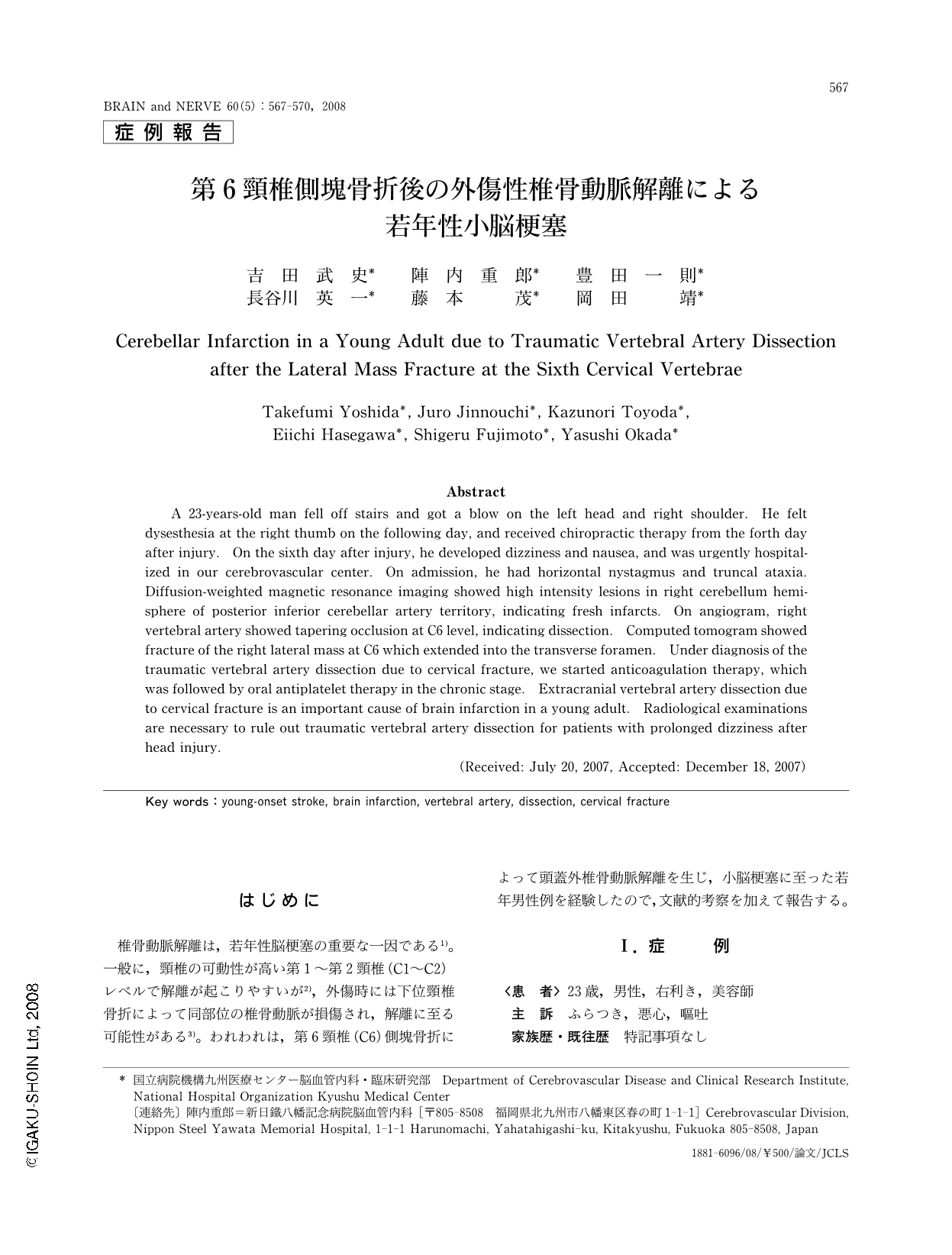
椎骨動脈解離は,若年性脳梗塞の重要な一因である1)。一般に,頸椎の可動性が高い第1~第2頸椎(C1~C2)レベルで解離が起こりやすいが2),外傷時には下位頸椎骨折によって同部位の椎骨動脈が損傷され,解離に至る可能性がある3)。われわれは,第6頸椎(C6)側塊骨折によって頭蓋外椎骨動脈解離を生じ,小脳梗塞に至った若年男性例を経験したので,文献的考察を加えて報告する。
Abstract
A 23-years-old man fell off stairs and got a blow on the left head and right shoulder. He felt dysesthesia at the right thumb on the following day, and received chiropractic therapy from the forth day after injury. On the sixth day after injury, he developed dizziness and nausea, and was urgently hospitalized in our cerebrovascular center. On admission, he had horizontal nystagmus and truncal ataxia. Diffusion-weighted magnetic resonance imaging showed high intensity lesions in right cerebellum hemisphere of posterior inferior cerebellar artery territory, indicating fresh infarcts. On angiogram, right vertebral artery showed tapering occlusion at C6 level, indicating dissection. Computed tomogram showed fracture of the right lateral mass at C6 which extended into the transverse foramen. Under diagnosis of the traumatic vertebral artery dissection due to cervical fracture, we started anticoagulation therapy, which was followed by oral antiplatelet therapy in the chronic stage. Extracranial vertebral artery dissection due to cervical fracture is an important cause of brain infarction in a young adult. Radiological examinations are necessary to rule out traumatic vertebral artery dissection for patients with prolonged dizziness after head injury.
Copyright © 2008, Igaku-Shoin Ltd. All rights reserved.