Japanese
English
- 有料閲覧
PPV購入案内
1,320円 (1,200円+税10%) こちらは、1247ページから1252ページの文献です。購入には医書.jp本会員登録が必要です。
会員登録完了後に改めて上記「購入サイトへ」を選択してください。
または「購入サイトへ」選択後に「購入ログイン」、「新規会員登録」の順に進んでください。
会員登録について詳しくはをご確認ください。
- Abstract 文献概要
- 1ページ目 Look Inside
- 参考文献 Reference
はじめに
手根管症候群は手根管内の正中神経の圧迫によって起こり,圧迫性ニューロパチーの中でも最も一般的にみられる病態である。手根管は手根骨や靱帯によって閉鎖された空間であり,その中に指屈筋とともに正中神経が走っている。そのため,その空間を狭くし,正中神経を障害するような病態が手根管症候群の原因となる。手作業を主体とする職業では,この病態の誘因となっていることが考えられる。糖尿病,甲状腺機能低下症,妊娠,関節リウマチなどの疾患を合併すると,手根管症候群の頻度が増す。ここでは,職業が原因の1つと考えられた手根管症候群の症例を呈示し,仕事内容と発症の関連性を検討した。さらに,これまで報告された文献をレビューし,仕事と手根管症候群の関係を考察した。
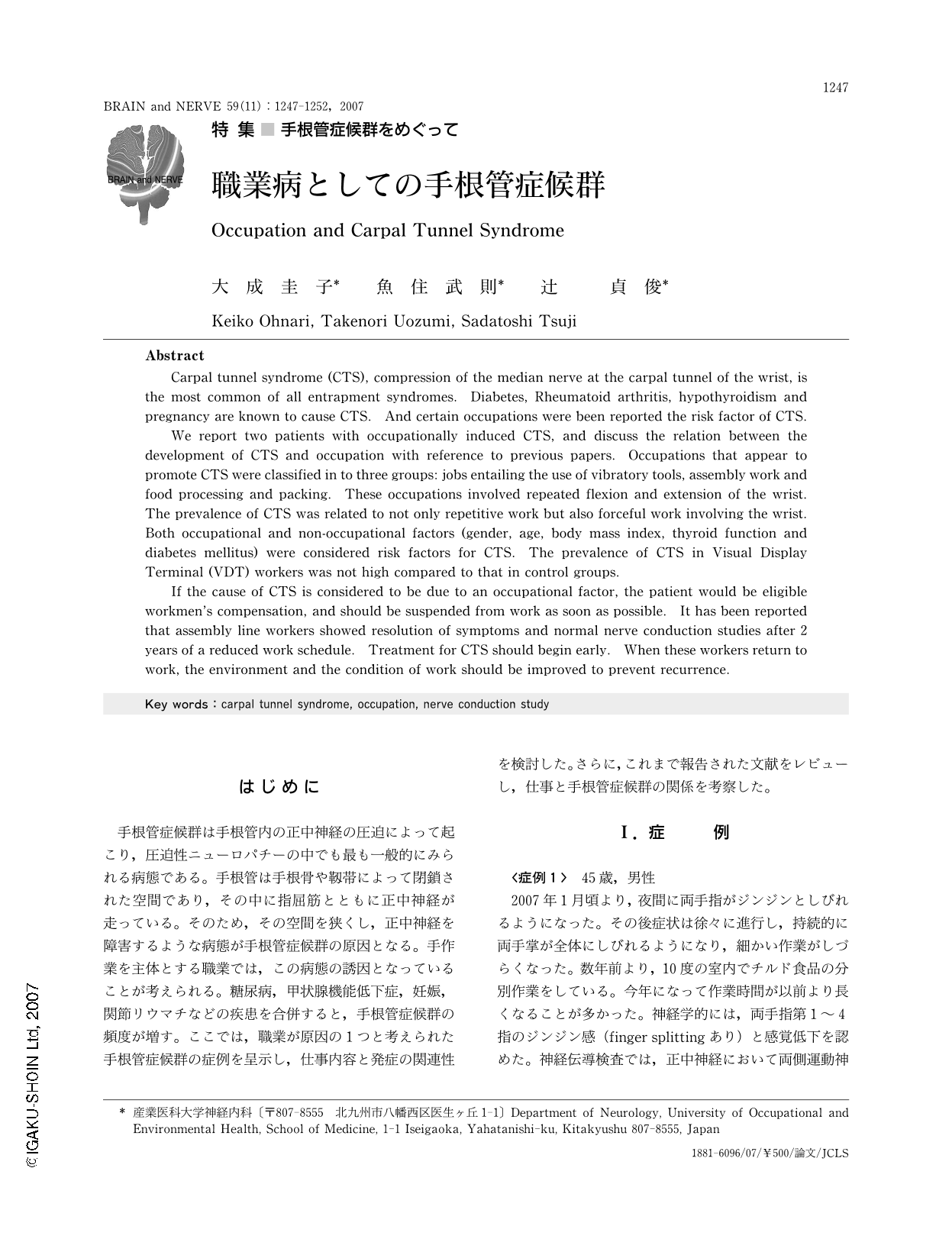
Abstract
Carpal tunnel syndrome (CTS), compression of the median nerve at the carpal tunnel of the wrist, is the most common of all entrapment syndromes. Diabetes, Rheumatoid arthritis, hypothyroidism and pregnancy are known to cause CTS. And certain occupations were been reported the risk factor of CTS.
We report two patients with occupationally induced CTS, and discuss the relation between the development of CTS and occupation with reference to previous papers. Occupations that appear to promote CTS were classified in to three groups: jobs entailing the use of vibratory tools, assembly work and food processing and packing. These occupations involved repeated flexion and extension of the wrist. The prevalence of CTS was related to not only repetitive work but also forceful work involving the wrist. Both occupational and non-occupational factors (gender, age, body mass index, thyroid function and diabetes mellitus) were considered risk factors for CTS. The prevalence of CTS in Visual Display Terminal (VDT) workers was not high compared to that in control groups.
If the cause of CTS is considered to be due to an occupational factor, the patient would be eligible workmen's compensation, and should be suspended from work as soon as possible. It has been reported that assembly line workers showed resolution of symptoms and normal nerve conduction studies after 2 years of a reduced work schedule. Treatment for CTS should begin early. When these workers return to work, the environment and the condition of work should be improved to prevent recurrence.
Copyright © 2007, Igaku-Shoin Ltd. All rights reserved.