Japanese
English
- 有料閲覧
PPV購入案内
1,320円 (1,200円+税10%) こちらは、223ページから227ページの文献です。購入には医書.jp本会員登録が必要です。
会員登録完了後に改めて上記「購入サイトへ」を選択してください。
または「購入サイトへ」選択後に「購入ログイン」、「新規会員登録」の順に進んでください。
会員登録について詳しくはをご確認ください。
- Abstract 文献概要
- 1ページ目 Look Inside
はじめに
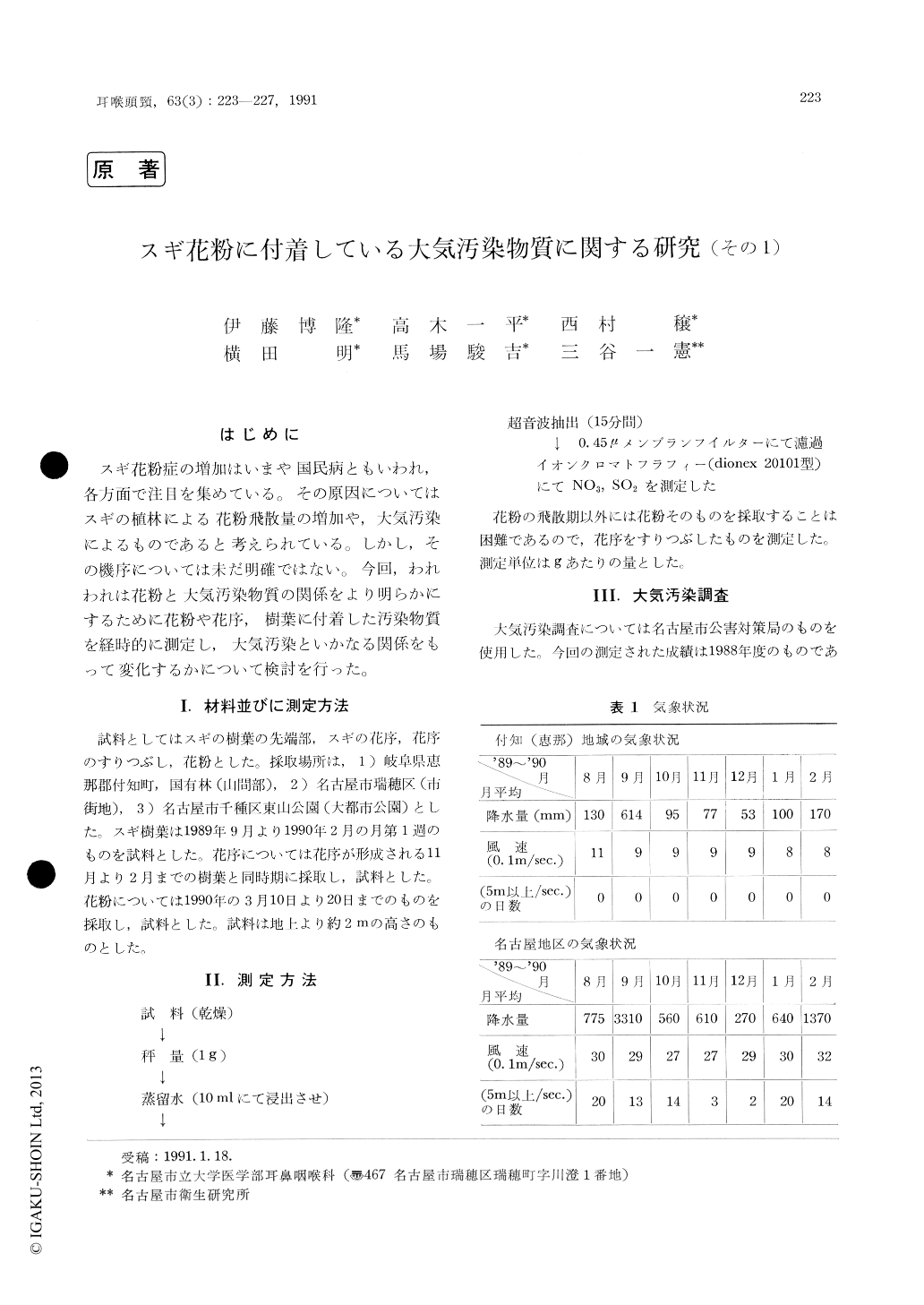
スギ花粉症の増加はいまや国民病ともいわれ,各方面で注目を集めている。その原因についてはスギの植林による花粉飛散量の増加や,大気汚染によるものであると考えられている。しかし,その機序については未だ明確ではない。今回,われわれは花粉と大気汚染物質の関係をより明らかにするために花粉や花序,樹葉に付着した汚染物質を経時的に測定し,大気汚染といかなる関係をもって変化するかについて検討を行った。
Recently, pollinosis due to Japanese cedar has gradually increased, but its cause has not been proven clearly. Residents in Japan are thought to have had the opportunity to develop the Japanese cedar pollinosis based on the large number of the pollens, but there is slight cor-relation between the numbers of the pollens and the pollinosis patients. Whereas the increase in the number of automobiles seem to have a very strong relation to the occurrence of allergy. In this study, the substances by the air pollution (NO-3, SO2-4) adhered to the surfaces of cedar leaves, stamina and pollens in the mountains and city areas are measured by ion chromatography dur-ing every month from September '89 to February '90. The results of this research are obtained were as follows:
1) There were more substances (NO-3, SO2-4) on the cedar leaves and stamina in the mountain area than the city area.
2) About the density of NO3 on the cedar pollens, there are 6.5 times more in the city and 10 times more in the city park than in the mountain area.
Therefore, it speculated that the substances in the air pollution has a major effect on the incidence of pollen allergy.
Copyright © 1991, Igaku-Shoin Ltd. All rights reserved.