Japanese
English
- 有料閲覧
PPV購入案内
1,320円 (1,200円+税10%) こちらは、318ページから326ページの文献です。購入には医書.jp本会員登録が必要です。
会員登録完了後に改めて上記「購入サイトへ」を選択してください。
または「購入サイトへ」選択後に「購入ログイン」、「新規会員登録」の順に進んでください。
会員登録について詳しくはをご確認ください。
- Abstract 文献概要
- 1ページ目 Look Inside
- 参考文献 Reference
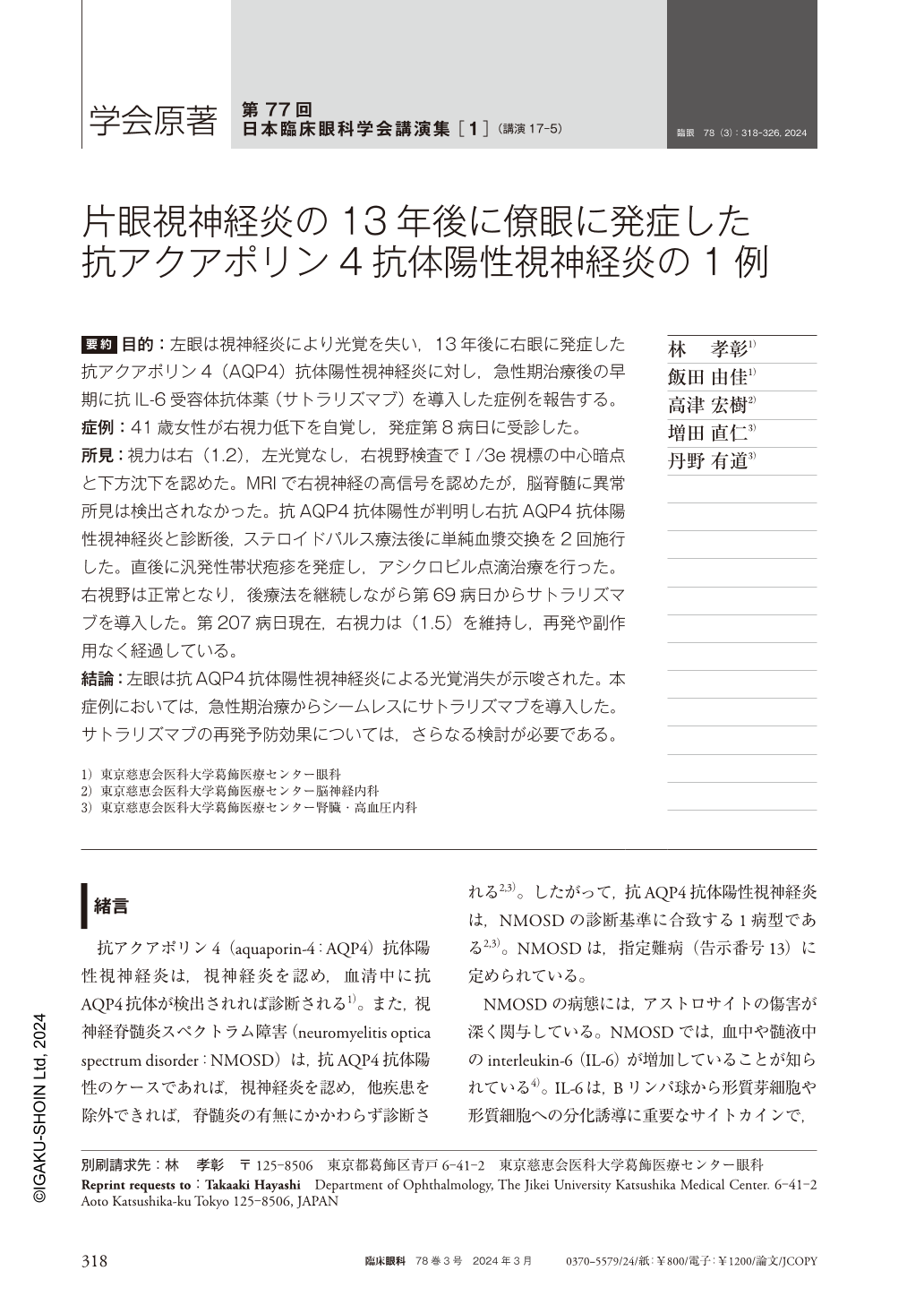
要約 目的:左眼は視神経炎により光覚を失い,13年後に右眼に発症した抗アクアポリン4(AQP4)抗体陽性視神経炎に対し,急性期治療後の早期に抗IL-6受容体抗体薬(サトラリズマブ)を導入した症例を報告する。
症例:41歳女性が右視力低下を自覚し,発症第8病日に受診した。
所見:視力は右(1.2),左光覚なし,右視野検査でⅠ/3e視標の中心暗点と下方沈下を認めた。MRIで右視神経の高信号を認めたが,脳脊髄に異常所見は検出されなかった。抗AQP4抗体陽性が判明し右抗AQP4抗体陽性視神経炎と診断後,ステロイドパルス療法後に単純血漿交換を2回施行した。直後に汎発性帯状疱疹を発症し,アシクロビル点滴治療を行った。右視野は正常となり,後療法を継続しながら第69病日からサトラリズマブを導入した。第207病日現在,右視力は(1.5)を維持し,再発や副作用なく経過している。
結論:左眼は抗AQP4抗体陽性視神経炎による光覚消失が示唆された。本症例においては,急性期治療からシームレスにサトラリズマブを導入した。サトラリズマブの再発予防効果については,さらなる検討が必要である。
Abstract Purpose:We report a case of anti-AQP4 antibody-positive optic neuritis(AQP4-ON)that occurred in the right eye(RE)13 years after loss of light perception vision due to optic neuritis in the left eye(LE), where early treatment of the anti-IL-6 receptor antibody(satralizumab)was administered following the acute phase treatment.
Case:A 41-year-old woman was aware of decreased visual acuity in the RE and presented to our hospital on the 8th day of symptom onset.
Findings:Corrected visual acuity was 1.2 in the RE and no light perception in the LE, and Goldmann visual field testing revealed a central scotoma(Ⅰ/3e target)and inferior depression in the RE. MRI showed high signal intensity in the right optic nerve, but no abnormal finding was detected in the brain and spinal cord. After confirming a positive anti-AQP4 antibody, a diagnosis of AQP4-ON in the RE was made, and two courses of plasma exchange were performed following the steroid pulse therapy. Immediately afterward, the patient developed disseminated herpes zoster and received intravenous acyclovir treatment. The visual field in the RE recovered to normal, and satralizumab treatment from the 69th day of the onset was introduced. As of the 207th day, the corrected visual acuity remained 1.5 in the RE with no recurrence or side effects.
Conclusion:No light perception in the LE may be due to AQP4-ON. In our case, satralizumab was seamlessly introduced from the acute phase treatment. Further evaluation is required regarding the effectiveness of satralizumab in preventing recurrence.
Copyright © 2024, Igaku-Shoin Ltd. All rights reserved.