Japanese
English
- 有料閲覧
PPV購入案内
1,320円 (1,200円+税10%) こちらは、843ページから848ページの文献です。購入には医書.jp本会員登録が必要です。
会員登録完了後に改めて上記「購入サイトへ」を選択してください。
または「購入サイトへ」選択後に「購入ログイン」、「新規会員登録」の順に進んでください。
会員登録について詳しくはをご確認ください。
- Abstract 文献概要
- 1ページ目 Look Inside
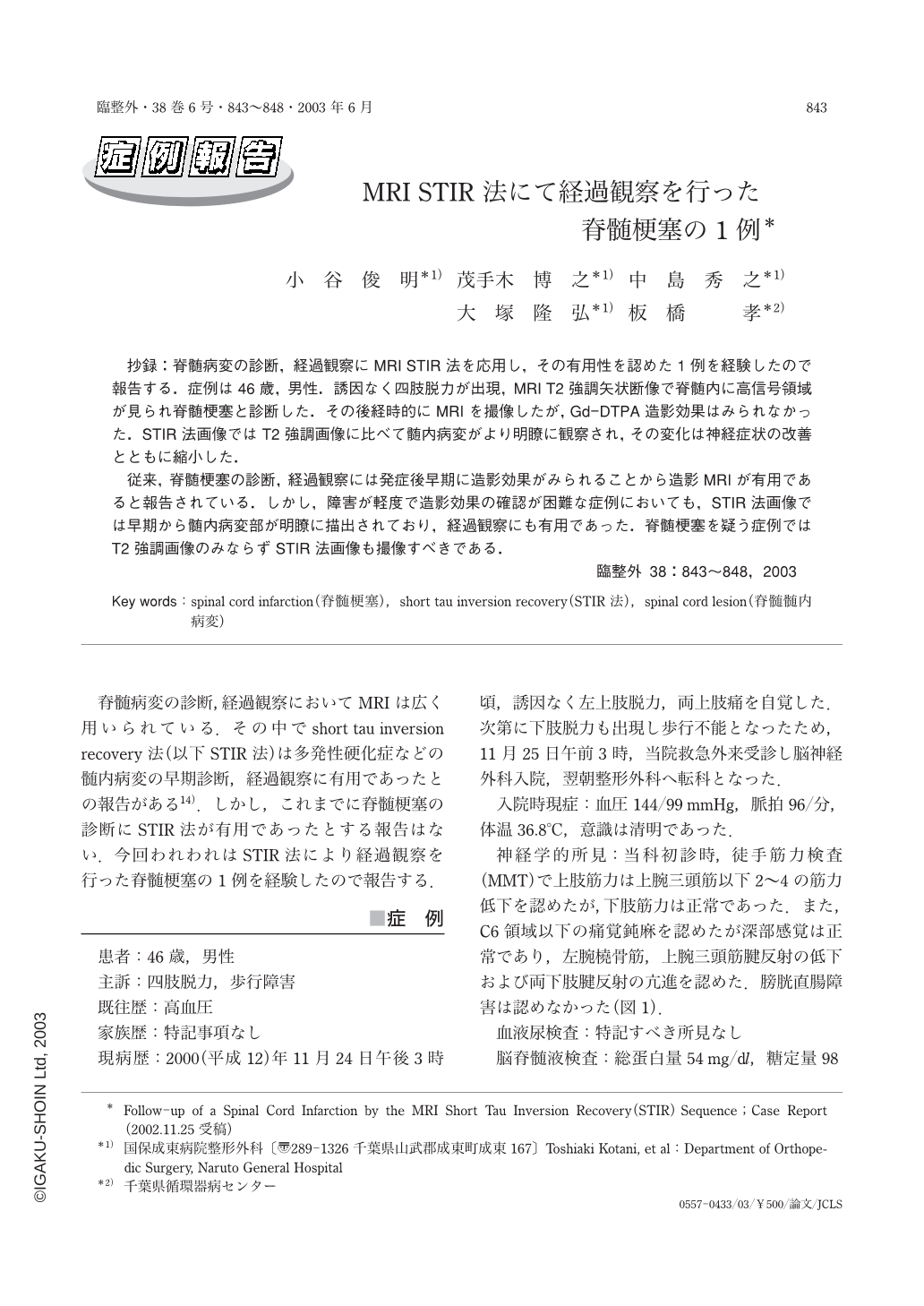
抄録:脊髄病変の診断,経過観察にMRI STIR法を応用し,その有用性を認めた1例を経験したので報告する.症例は46歳,男性.誘因なく四肢脱力が出現,MRI T2強調矢状断像で脊髄内に高信号領域が見られ脊髄梗塞と診断した.その後経時的にMRIを撮像したが,Gd-DTPA造影効果はみられなかった.STIR法画像ではT2強調画像に比べて髄内病変がより明瞭に観察され,その変化は神経症状の改善とともに縮小した.
従来,脊髄梗塞の診断,経過観察には発症後早期に造影効果がみられることから造影MRIが有用であると報告されている.しかし,障害が軽度で造影効果の確認が困難な症例においても,STIR法画像では早期から髄内病変部が明瞭に描出されており,経過観察にも有用であった.脊髄梗塞を疑う症例ではT2強調画像のみならずSTIR法画像も撮像すべきである.
A 46-year-old man experienced the sudden onset of muscle weakness and sensory disturbance in the upper and lower extremities. Neurological examination revealed paralysis and superficial sensory impairment below the C6 level of the spinal cord. Magnetic resonance imaging (MRI) revealed a linear high-intensity intramedullary lesion on T2-weighted images at the C4/5 level, and spinal cord infarction was diagnosed based on the MRI findings and clinical manifestations.
Follow-up MRI scans revealed a better defined intramedullary hyperintense signal on the short tau inversion recovery (STIR) images at the C4/5 level than the signal on the T2-weighted images. The lesion decreased and the patients symptoms gradually improved. Post-contrast T1-weighted images failed to show enhancement of the infarct lesion.
MRI is the optimal imaging modality for detecting and following up spinal cord infarcts. T2-weighted images visualize infarcts as a high-signal lesions, whereas contrast-enhanced T1-weighted images do not show an enhanced region until 1-3 weeks after its occurrence. In contrast to conventional T1-weighted and T2-weighted images, STIR images are useful for detecting and following up less severe infarctions in the acute and chronic stages that can not be diagnosed by contrast enhancement on MRI. Thus, the STIR sequence should be acquired to assess spinal cord infarcts.
Copyright © 2003, Igaku-Shoin Ltd. All rights reserved.